

The 91-day and 184-day T-bill rates dropped by more than 20 basis points at the latest auction, even as excess liquidity in the banking system contracted
Treasury bill yields fell sharply at the latest primary auction, with short-tenor rates recording their steepest declines in recent weeks even as liquidity conditions in the banking system tightened.
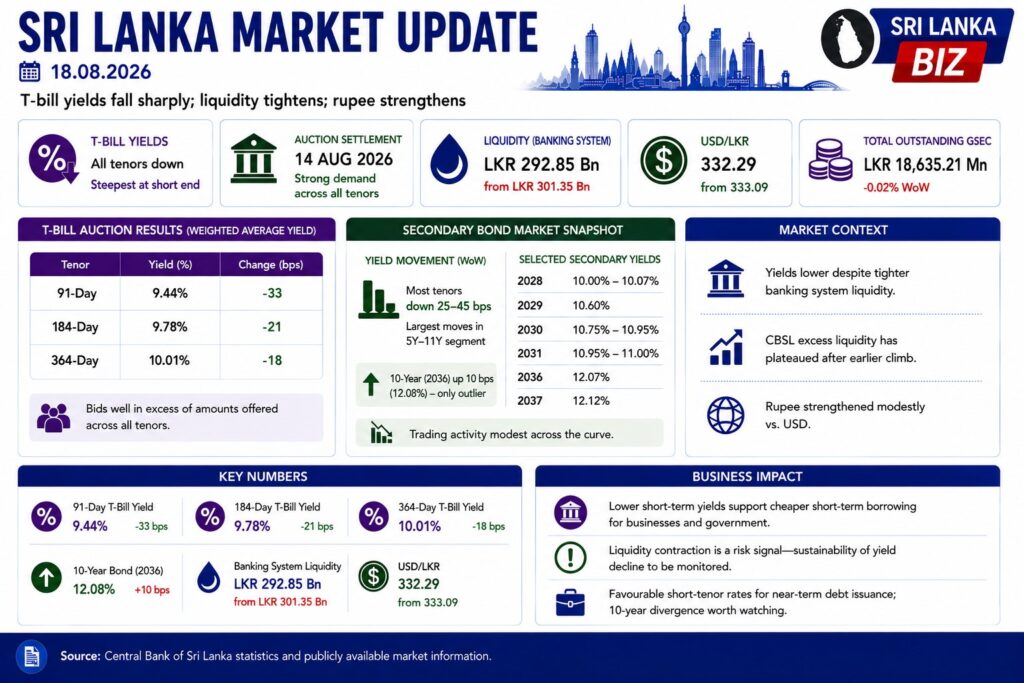
At the auction settled on August 14, the 91-day T-bill yield fell 33 basis points to 9.44%, while the 184-day yield declined 21 basis points to 9.78%. The 364-day yield eased a further 18 basis points to 10.01%. All three tenors recorded bid volumes well in excess of amounts offered, pointing to strong demand across the curve.
The move in short-term rates was echoed in the secondary bond market, where yields across most tenures were lower on a week-on-week basis. Bonds maturing between 2028 and 2037 showed declines ranging from roughly 25 to 45 basis points compared to the prior week, with the largest movements concentrated in the 5-to-11-year segment. One outlier bucked the trend: the 10-year tenor (2036 maturity) rose 10 basis points week-on-week, a divergence worth watching in coming sessions.
The broader decline in yields comes despite a contraction in banking system liquidity, which fell to LKR 292.85 billion from LKR 301.35 billion in the prior session. Excess liquidity held by the Central Bank of Sri Lanka has also plateaued in recent sessions after a steady climb earlier in the month, suggesting the rally in yields is being driven more by auction-specific demand than by a broad-based easing in system liquidity.
In the secondary market, trading activity was described as modest across the curve. Short-dated bonds maturing in 2028 traded between 10.00% and 10.07%, while the 2029 maturity changed hands at 10.60%. Bonds in the 2030 segment traded in a range of 10.75% to 10.95%, and the 2031 maturity traded between 10.95% and 11.00%. Longer-dated bonds maturing in 2036 and 2037 traded at 12.07% and 12.12% respectively.
On the currency side, the LKR appreciated against the US dollar, trading at LKR 332.29/USD compared to LKR 333.09/USD previously — a modest move that supports, but is not the primary driver of, the day’s fixed income developments.
Key Numbers
| Metric | Value |
|---|---|
| 91-Day T-Bill Yield | 9.44% (-33 bps) |
| 184-Day T-Bill Yield | 9.78% (-21 bps) |
| 364-Day T-Bill Yield | 10.01% (-18 bps) |
| 10-Year Bond (2036) | 12.08% (+10 bps WoW — outlier) |
| Banking System Liquidity | LKR 292.85 Bn (from LKR 301.35 Bn) |
| USD/LKR | 332.29 (from 333.09) |
| Total Outstanding GSec | LKR 18,635.21 Mn (-0.02% WoW) |
Business Impact
Falling short-term yields typically translate into lower short-term borrowing costs for businesses and government, and can influence money market fund returns in the near term. However, the simultaneous tightening in banking system liquidity is a signal worth flagging rather than glossing over: if liquidity conditions continue to contract, the current downward momentum in yields may not be sustained without stronger structural drivers. Corporate treasurers and businesses planning near-term debt issuance may find current short-tenor rates favourable, though the divergence at the 10-year point is a reminder that the move is not uniform across the curve.
Source Attribution
Source: Central Bank of Sri Lanka statistics and publicly available market information.