

Sri Lanka rupee trading remained broadly stable against the US dollar on Monday, with the spot rate quoted at 330.55/65, while government bond yields showed only modest movements across maturities. The market also awaits an Rs.80 billion Treasury bill auction on October 7.
Sri Lanka rupee remains stable as bond yields show limited movement and Treasury bills come to auction.
The rupee was quoted at 330.55/65 to the US dollar in the spot market, according to dealers, indicating little change from the previous trading session. The currency has, however, remained under pressure over the year, with the Central Bank reporting that it had depreciated 6.3 percent against the US dollar on a year-to-date basis at the end of September.
Trading in government securities was relatively calm, with bond yields remaining largely steady across the curve. The bond maturing on October 15, 2028 was quoted at 10.50/58 percent, compared with 10.52/55 percent previously. The movement reflected a slight change in market pricing rather than a significant shift in underlying yields.
The bond maturing on October 15, 2029 remained unchanged at 10.80/90 percent. Similarly, the August 1, 2030 maturity was quoted flat at 11.15/20 percent, while the October 15, 2030 bond was quoted at 11.18/23 percent, compared with 11.20/25 percent previously.
Slight downward adjustments were also seen in some longer-dated securities. The February 1, 2031 bond was quoted at 11.22/28 percent, down from 11.25/30 percent, while the October 15, 2034 maturity was quoted at 11.95/12.05 percent, compared with 11.99/12.05 percent earlier.
The December 15, 2032 bond was unchanged at 11.67/75 percent. Meanwhile, the January 15, 2033 maturity was quoted at 11.75/80 percent, compared with 11.70/80 percent previously. Overall, the limited movements indicate that the government securities market remained relatively balanced during the session.
The latest currency and bond market movements come as investors continue to monitor liquidity conditions, government borrowing requirements and developments in the domestic financial market. The upcoming Treasury bill auction is expected to provide another indication of short-term funding conditions and investor demand for government securities.
The government is scheduled to issue Rs.80 billion in Treasury bills through the October 7 auction. The auction will be closely watched by market participants as they assess prevailing short-term interest rates and the level of demand for government paper.
Official telegraphic transfer rates also showed the wider range in currency pricing. The US dollar was listed at Rs.326.10 for buying and Rs.335.10 for selling. The euro was quoted at Rs.363.6239 buying and Rs.377.4047 selling, while the British pound was quoted at Rs.430.5083 buying and Rs.444.6167 selling.
The currency market remains an important indicator for businesses and investors as movements in the rupee affect import costs, external debt servicing, corporate financing and broader price pressures. The 6.3 percent year-to-date depreciation reported by the Central Bank highlights the extent of the currency adjustment during the year, even as the latest spot-market quotation remained stable.
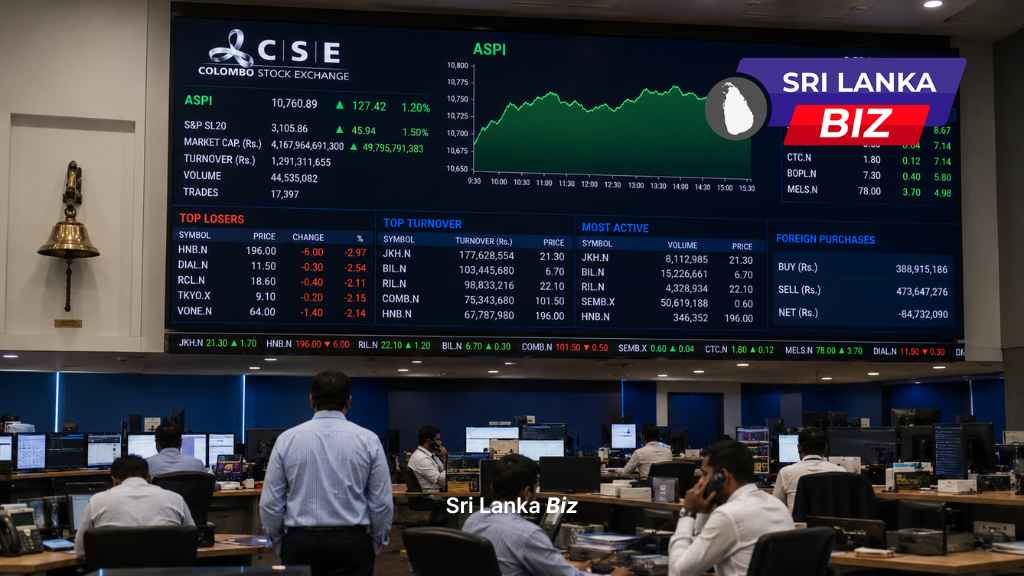
Activity in the equity market was also positive, although gains remained modest. The Colombo Stock Exchange All Share Price Index increased 0.04 percent, or 8.34 points, to 20,820. The S&P SL20 index gained 0.14 percent, or 8.01 points, to 5,891.
The combination of a stable spot exchange rate, broadly unchanged bond yields and modest equity gains points to relatively restrained market movements at the start of the week. Investors are likely to continue watching the Treasury bill auction, currency trading and government securities yields for signals on liquidity and interest-rate conditions.
For the Sri Lanka rupee, the near-term direction will remain closely linked to foreign exchange demand, external flows and broader monetary and fiscal developments. At the same time, movements in bond yields will continue to provide an important signal of investor expectations surrounding government borrowing and domestic interest rates.
With the October 7 Treasury bill auction approaching, market participants will be watching both the amount of bids received and the yields accepted. The results could provide a clearer indication of how investors are positioning themselves in the short-term government securities market and whether recent stability in bond yields is likely to continue.