


A modest single-day net selling figure masks a persistent trend, with cumulative foreign outflows from the Colombo bourse approaching LKR 55 billion since the start of the year.
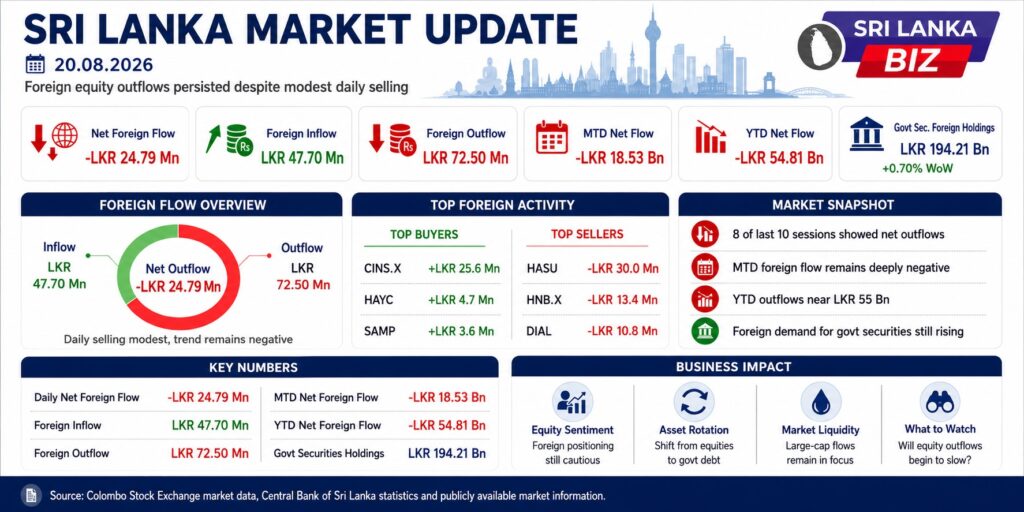
Foreign investors extended a months-long pattern of net selling on the Colombo Stock Exchange, with year-to-date outflows now approaching LKR 55 billion, even as the day’s own net selling figure was comparatively modest.
On Thursday, foreign investors recorded a net outflow of LKR 24.79 million, with inflows of LKR 47.70 million against outflows of LKR 72.50 million. Taken in isolation, the day’s figure is small and would not typically warrant standalone coverage. However, viewed against the broader trend, it forms part of a sustained pattern: net foreign selling has reached LKR 18.53 billion on a month-to-date basis and LKR 54.81 billion year-to-date, indicating outflows have persisted across most of the year rather than reflecting a one-off shift in sentiment.
A look at the daily net foreign flow trend over the past two weeks shows outflows in eight of the ten most recent sessions, interrupted only briefly by inflows earlier in the period. The scale of daily outflows has generally been modest in isolation, which is precisely why the cumulative figure is the more informative measure of foreign sentiment toward local equities.
At the stock level, foreign buying was concentrated in a small number of counters. CINS.X attracted the largest net foreign inflow at LKR 25.6 million, followed by HAYC at LKR 4.7 million and SAMP at LKR 3.6 million. On the selling side, HASU recorded the largest net foreign outflow at LKR 30.0 million, followed by HNB.X at LKR 13.4 million and DIAL at LKR 10.8 million.
Foreign holdings figures for government securities present a contrasting picture: those holdings have been rising steadily since early July, up 0.70% in the past week alone to LKR 194.21 billion. This suggests foreign investors have not broadly retreated from Sri Lankan assets, but have instead been rotating away from equities while adding to government debt holdings — a distinction worth noting rather than treating both markets as reflecting a single unified trend.
Business Impact
Sustained foreign selling in equities, even at a modest daily pace, has implications for listed companies that count foreign institutions among their major shareholders, as well as for overall market liquidity and valuation support at the index level. The contrast with rising foreign appetite for government securities suggests the outflow is more a reflection of relative asset allocation decisions than a broad loss of confidence in the Sri Lankan market. Companies and market participants should weigh the cumulative trend rather than react to any single day’s flow figure.
What to Watch Next
Market participants will watch whether the pace of cumulative foreign selling in equities begins to slow, and whether the divergence between equity outflows and rising government securities holdings persists or narrows in the weeks ahead.
Key Numbers
| Metric | Value |
|---|---|
| Net Foreign Flow (Day) | -LKR 24.79 Mn |
| Foreign Inflow (Day) | LKR 47.70 Mn |
| Foreign Outflow (Day) | LKR 72.50 Mn |
| Net Foreign Flow (MTD) | -LKR 18,532.6 Mn |
| Net Foreign Flow (YTD) | -LKR 54,812.9 Mn |
| Largest Foreign Buy | CINS.X (+LKR 25.6 Mn) |
| Largest Foreign Sell | HASU (-LKR 30.0 Mn) |
| Foreign Holdings of Govt. Securities | LKR 194.21 Bn (+0.70% WoW) |
Source Attribution
Source: Colombo Stock Exchange market data, Central Bank of Sri Lanka statistics and publicly available market information.