

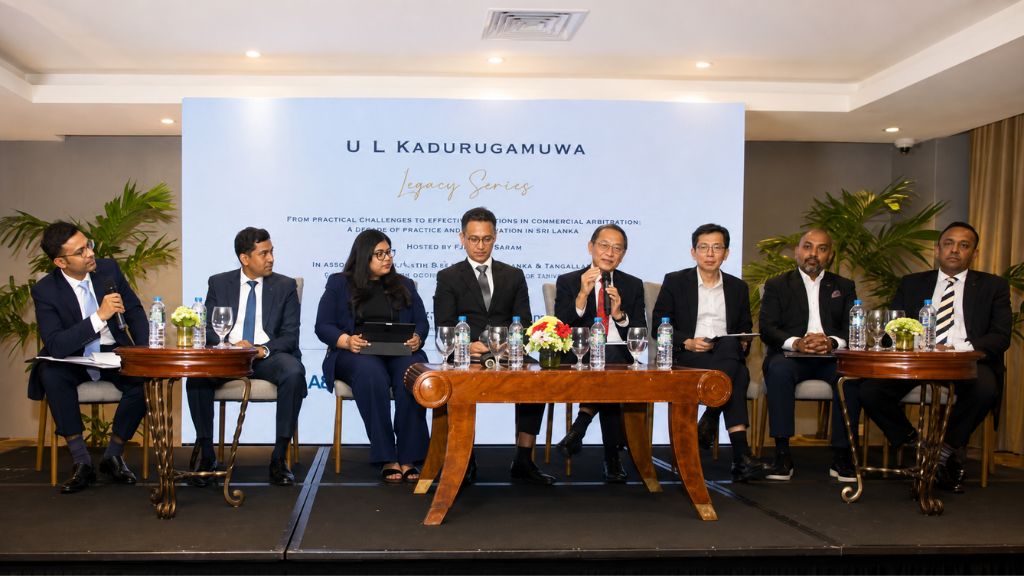
U.L. Kadurugamuwa Legacy Series has been launched by FJ&G de Saram during its 185th anniversary year, honouring the late U. L. Kadurugamuwa and his lasting contribution to Sri Lanka’s legal profession.
U.L. Kadurugamuwa Legacy Series opens new platform for commercial arbitration dialogue
The inaugural session was held at the Hilton Colombo, bringing together members of the judiciary, leading legal practitioners, arbitrators, clients and other distinguished guests for a discussion focused on “From Practical Challenges to Effective Solutions in Commercial Arbitration.”
The new thought leadership platform has been established to honour Kadurugamuwa, a former Precedent Partner of FJ & G de Saram, while continuing the tradition of professional excellence and legal dialogue associated with his career.
The event began with opening remarks from the firm’s Precedent Partner, Ayomi Aluwihare, before President’s Counsel Dr. K. Kanag-Isvaran, the Guest of Honour, paid tribute to Kadurugamuwa’s contribution to both the legal profession and the firm.
Dr. Kanag-Isvaran described Kadurugamuwa as “a mentor and a guiding force”, highlighting the broader significance of his influence on generations of legal professionals. He noted that a teacher’s lasting contribution extends beyond technical knowledge to the way of thinking, standards of conduct and commitment to excellence passed on to others.
The tribute also highlighted Kadurugamuwa’s pioneering contribution to alternative dispute resolution in Sri Lanka. His involvement included the establishment of the Institute for the Development of Commercial Law and Practice (ICLP), the enactment of the Arbitration Act No. 11 of 1995, and the establishment of both the ICLP Arbitration Centre and the International Alternate Dispute Resolution Centre.
The inaugural programme brought together experts from Allen & Gledhill, Rajah & Tann and the Singapore International Arbitration Centre (SIAC). Discussions examined several emerging issues in commercial arbitration, with a particular focus on jurisdictional challenges, cross-border disputes and mechanisms available to parties seeking urgent relief.
One of the key sessions addressed jurisdictional challenges in multi-contract transactions. Modern commercial arrangements often involve several interconnected agreements, including financing arrangements, shareholder agreements, supply contracts and service agreements. When those agreements contain different dispute resolution provisions, disputes can create complex questions about which forum has jurisdiction.
The discussion considered the risks created when only one agreement contains an arbitration clause or when interconnected contracts direct disputes towards different mechanisms. Drawing on practical cases, the panel highlighted how fragmented dispute resolution arrangements can lead to parallel proceedings, increased costs and potentially inconsistent outcomes.
The session underscored the importance of drafting dispute resolution provisions carefully across all documents forming part of a transaction. For businesses involved in complex commercial arrangements, aligning arbitration clauses and other dispute resolution mechanisms at the contractual drafting stage can reduce uncertainty when disputes eventually arise.
Another major discussion focused on transnational issue estoppel and the role of supervisory courts. The session examined the continuing importance of national courts in international arbitration, despite arbitration being designed as a private mechanism for resolving commercial disputes.
Courts can play a central role in supervising arbitrations seated within their jurisdictions, including in proceedings challenging arbitral awards. They may also become involved in the recognition and enforcement of foreign awards, making the relationship between arbitration tribunals and national courts an important consideration for companies engaged in cross-border transactions.
The discussion provided a practical reminder that the outcome of an international arbitration does not necessarily represent the end of the dispute. The approach taken by courts in relevant jurisdictions can have a significant bearing on whether an award is recognised, enforced or challenged.
Representatives from SIAC also presented developments under the recently introduced SIAC Rules 2025. The presentation covered measures intended to improve efficiency and responsiveness in commercial disputes, including emergency arbitration, interim relief, preliminary determinations and mechanisms for the early dismissal of unmeritorious claims or defences.
These developments reflect the continuing evolution of commercial arbitration as businesses seek dispute resolution processes that are efficient, flexible and suited to increasingly complex international transactions. Emergency arbitration, in particular, can provide parties with a mechanism to seek urgent interim relief when waiting for the constitution of a full tribunal could create commercial risks.
The discussions also reinforced one of the central advantages of arbitration: procedural flexibility. Businesses can structure dispute resolution arrangements around the nature of their transactions while relying on established institutional frameworks and specialist tribunals.
For U.L. Kadurugamuwa Legacy Series, the inaugural event therefore served both as a tribute and as the beginning of a continuing professional platform. Its focus on practical legal issues gives the Series an opportunity to bring together practitioners, arbitrators, judges and business stakeholders to examine developments affecting commercial activity.
The launch also carries significance for FJ&G de Saram as the firm marks its 185th anniversary. By connecting its institutional history with contemporary legal and commercial issues, the firm is positioning the U.L. Kadurugamuwa Legacy Series as a platform for continued thought leadership and professional exchange.
The successful inaugural session is expected to be followed by further discussions addressing emerging issues relevant to the legal and business communities. Through the Series, FJ&G de Saram aims to contribute to informed professional dialogue while preserving and extending the legacy of one of its prominent former partners.