


Secondary market yields on Treasury bonds rose by as much as 20 basis points week-on-week, with the increases concentrated in the five-to-nine-year segment of the curve.
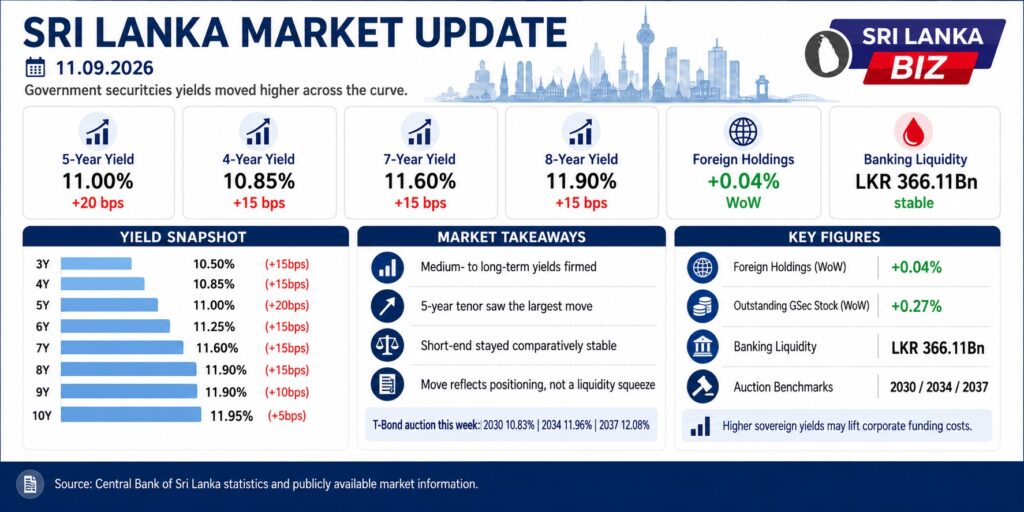
Yields on Sri Lanka’s government securities rose across the medium- to long-term segment of the curve this week, with several tenors recording increases at or above the 20-basis-point threshold that typically signals a material shift in market pricing.
The steepest movement was recorded on the five-year tenor (maturing 15 May 2031), where the offer yield rose 20 basis points week-on-week to 11.00 percent. The six-, seven-, eight- and four-year tenors each rose 15 basis points over the same period, while most other tenors in the three-to-nine-year range posted increases of 5 to 15 basis points. Shorter tenors, including bills maturing within three, six and twelve months, were comparatively stable, with the 91-day and 182-day tenors unchanged and the 364-day tenor up 5 basis points.
The broad-based nature of the move — affecting nearly every tenor from two years out to thirteen years — points to a general firming of rates across the belly and long end of the curve, rather than a shift isolated to any single maturity. Compared to the previous day’s trading, movements were more muted, with most tenors flat and only the four-year segment showing a further 15-basis-point increase, suggesting the bulk of the week’s adjustment had already been absorbed by the market.
The move coincided with a Treasury bond auction concluded this week, in which the Public Debt Management Office raised LKR 150 billion across 2030, 2034 and 2037 maturities. Weighted average yields accepted at that auction — 10.83 percent for the 2030 bond, 11.96 percent for the 2034 bond and 12.08 percent for the 2037 bond — were broadly consistent with the higher secondary market levels recorded through the week, rather than diverging sharply from them.
Foreign holdings of local government securities rose marginally, up 0.04 percent week-on-week, while the total outstanding stock of government securities increased 0.27 percent, with Treasury bonds continuing to account for the large majority of outstanding stock over Treasury bills. Banking system liquidity remained stable at LKR 366.11 billion, little changed from LKR 366.20 billion in the prior session, indicating the yield increases were not obviously driven by a liquidity squeeze.
Key Numbers
| Tenor | Current Yield | Change vs. Last Week |
|---|---|---|
| 3-Year (15-Sep-29) | 10.50% | +15 bps |
| 4-Year (01-Aug-30) | 10.85% | +15 bps |
| 5-Year (15-May-31) | 11.00% | +20 bps |
| 6-Year (01-Oct-32) | 11.25% | +15 bps |
| 7-Year (01-Jun-33) | 11.60% | +15 bps |
| 8-Year (15-Oct-34) | 11.90% | +15 bps |
| 9-Year (15-Jun-35) | 11.90% | +10 bps |
| 10-Year (15-Aug-36) | 11.95% | +5 bps |
| Foreign Holdings (WoW) | +0.04% | — |
| Outstanding GSec Stock (WoW) | +0.27% | — |
| Banking System Liquidity | LKR 366.11 billion | ~flat |
Business Impact
A broad-based rise in medium- to long-term government securities yields raises the reference rate businesses face when pricing their own debt, particularly for corporates that benchmark bond issuance or long-term borrowing against the sovereign curve. Banks and institutional investors holding government securities portfolios will see valuation effects from the move, while businesses planning medium-term financing may face a moderately higher cost of capital if the trend continues. The relative stability in banking system liquidity suggests the move reflects investor positioning and auction supply rather than a tightening of funding conditions.
Source Attribution
Source: Central Bank of Sri Lanka statistics and publicly available market information.