

Sri Lanka rupee weakened against the US dollar in spot trading on Tuesday, while government bond yields moved higher across several maturities amid market volatility. The Colombo Stock Exchange, meanwhile, recorded modest gains.
Sri Lanka rupee slips as bond yields rise and stocks post modest gains
The Sri Lanka rupee was quoted at 330.15/25 against the US dollar in the spot market on Tuesday, weakening from 329.15/35 on the previous trading day, according to market dealers.
The movement reflected a weaker trading position for the local currency, while activity in the government securities market saw yields edge higher across selected maturities. The changes came against a backdrop of continued market attention to foreign exchange movements, domestic liquidity and investor demand for government debt.
In the bond market, the government security maturing on 15 October 2028 was quoted at a yield of 10.45/65 percent. The bond maturing on 15 December 2029 was quoted at 10.75/90 percent, compared with 10.70/85 percent previously, indicating a rise in the quoted yield range.
The security maturing on 1 August 2030 was quoted at 11.10/20 percent, with the upper end of the range moving higher from the previous 11.10/15 percent. Meanwhile, the bond maturing on 1 June 2033 was quoted at 11.80/90 percent.
Further along the yield curve, the bond maturing on 1 November 2033 was quoted at 11.90/12.00 percent, up from 11.75/85 percent. The security maturing on 15 October 2034 was quoted at 11.95/12.05 percent, compared with 11.93/12.00 percent previously.
The upward movement in several bond yields points to changing pricing conditions in the secondary government securities market. Bond yields and prices generally move in opposite directions, meaning higher yields can reflect lower bond prices or shifts in investor expectations and market demand. However, individual daily movements should be interpreted within the wider context of trading volumes, liquidity and prevailing monetary conditions.
Official telegraphic transfer rates also showed a spread between buying and selling prices for major foreign currencies. The US dollar was quoted at a buying rate of 324.75 and a selling rate of 333.75. The euro was quoted at 372.2818 buying and 386.0626 selling, while the British pound was quoted at 436.9856 buying and 451.0940 selling.
The difference between the spot market quotation and telegraphic transfer rates reflects the distinct pricing conventions used across foreign exchange transactions. Spot market rates are closely watched by businesses, importers, exporters and investors, while bank buying and selling rates are relevant to customers conducting currency transactions through the banking system.
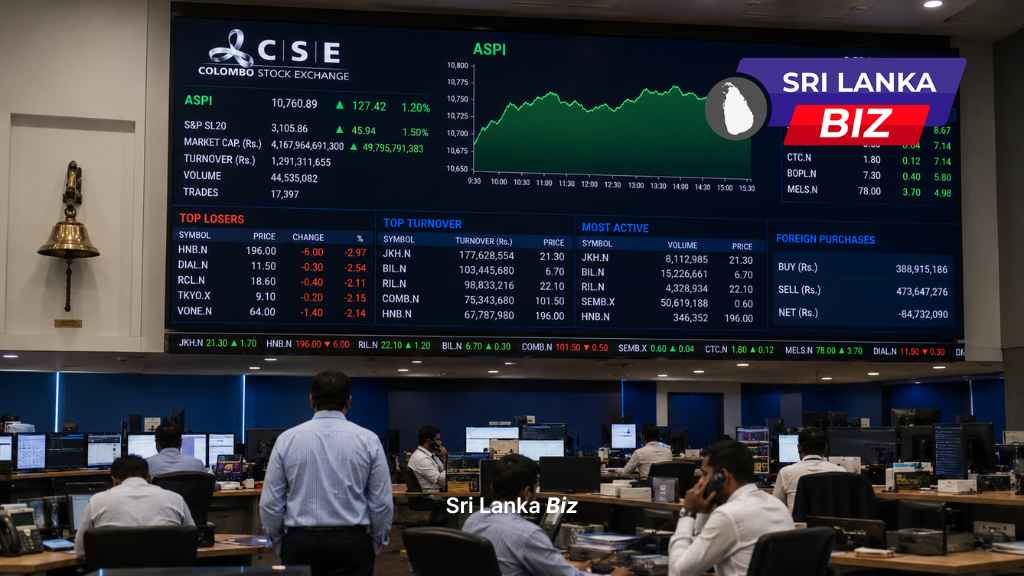
Despite the weakness in the currency and higher bond yields, equities on the Colombo Stock Exchange ended Tuesday’s session with modest gains. The All Share Price Index (ASPI) rose by 0.05 percent, or 11.61 points, to close at 21,325.53.
The S&P SL20, which tracks 20 leading companies listed on the exchange, gained 0.11 percent, or 6.63 points, to finish at 6,000.96.
The contrasting movements across asset classes highlight the different factors influencing Sri Lanka’s financial markets. Currency trading is affected by foreign exchange supply and demand, external payments and market expectations, while government bond yields respond to liquidity conditions, borrowing requirements and investor appetite for fixed-income securities. Equity prices, meanwhile, reflect company-specific developments as well as broader economic and market sentiment.
For businesses and investors, the Sri Lanka rupee’s movement remains an important indicator to monitor, particularly because exchange rate changes can influence import costs, export earnings, foreign currency liabilities and the pricing of financial assets. Similarly, shifts in bond yields can affect borrowing costs, investment returns and the valuation of existing government securities.
The latest market data therefore presents a mixed picture: the local currency weakened against the dollar, selected government bond yields moved higher, and the Colombo Stock Exchange posted marginal gains. Market participants are likely to continue watching currency trading, fixed-income pricing and equity performance for indications of the direction of financial conditions in the days ahead.