

Market liquidity contracts to LKR 347.55 billion, down from LKR 381.40 billion, as bond market activity picks up
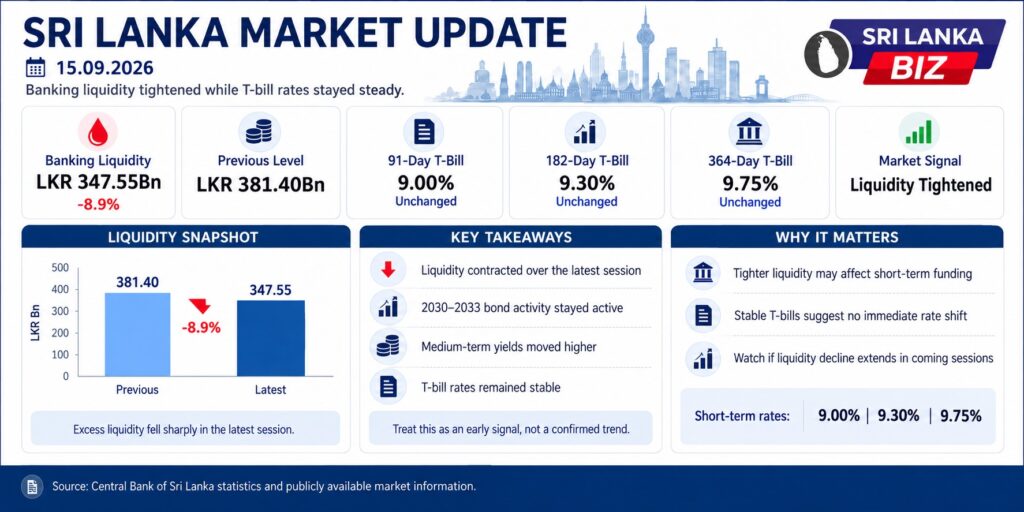
Liquidity in Sri Lanka’s banking system contracted over the latest session, with excess funds falling to LKR 347.55 billion from LKR 381.40 billion previously, a decline of roughly 9%.
The tightening coincided with a week in which secondary market activity in government bonds intensified, with yields moving higher across medium-term maturities amid what market participants described as selling pressure concentrated in the 2030 to 2033 maturity bracket. Central Bank data tracking excess liquidity and holdings of government securities shows liquidity levels had held in a relatively narrow band through most of the preceding two weeks before this latest pullback.
Money market fund yields, which tend to track short-term liquidity conditions, remained in the high single digits, broadly consistent with prevailing Treasury bill rates, which were unchanged over the week across the 91-day, 182-day and 364-day tenors.
As a single-session movement, the contraction in liquidity should be treated as an early data point rather than a confirmed shift in conditions. Subsequent sessions will show whether the decline extends or reverses.
Key Numbers
| Metric | Latest | Previous | Change |
|---|---|---|---|
| Banking system excess liquidity | LKR 347.55 Bn | LKR 381.40 Bn | -8.9% |
| 91-Day T-Bill rate | 9.00% | 9.00% | Unchanged |
| 182-Day T-Bill rate | 9.30% | 9.30% | Unchanged |
| 364-Day T-Bill rate | 9.75% | 9.75% | Unchanged |
Business Impact
Tighter banking system liquidity can influence short-term funding costs and the availability of credit for businesses that rely on bank facilities for working capital. While Treasury bill rates have so far remained stable, a sustained decline in excess liquidity could eventually put upward pressure on short-term lending rates if it persists over subsequent sessions. Businesses with near-term borrowing plans may want to monitor liquidity conditions over the coming week before drawing firm conclusions about the direction of short-term rates.
Source Attribution
Source: Central Bank of Sri Lanka statistics and publicly available market information.