

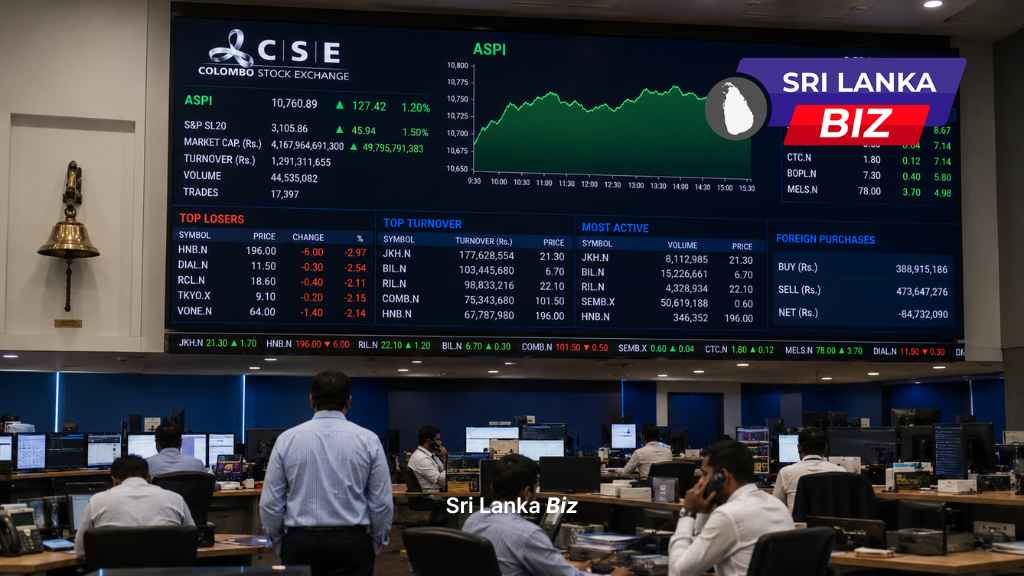
Sri Lanka rupee was quoted at 330.80/90 against the US dollar in the spot market on Tuesday, compared with 330.75/90 on the previous trading day. Meanwhile, government bond yields moved slightly higher across several maturities.
Sri Lanka rupee remained broadly stable as government bond yields edged higher
The Sri Lanka rupee showed only a marginal movement against the US dollar in the spot market on Tuesday, with dealers quoting the currency at 330.80/90, compared with 330.75/90 a day earlier. The relatively narrow movement indicates that the currency remained broadly stable against the dollar during the session.
The latest market quotations come as investors and dealers continue to monitor developments in Sri Lanka’s foreign exchange market and domestic fixed-income securities. While the Sri Lankan rupee recorded only a small change, government bond yields moved higher across maturities ranging from 2029 to 2034.
The movement in the currency market was limited to a few cents, with the buying and selling quotations shifting from 330.75/90 to 330.80/90 against the US dollar. Such day-to-day movements are closely watched by businesses, importers, exporters and investors because changes in the exchange rate can influence import costs, foreign currency payments and broader financial market conditions.
At the same time, Sri Lanka bond yields edged higher across the quoted maturities. The bond maturing on December 15, 2029 was quoted at 11.00/10 percent, compared with 10.85/95 percent previously. The increase places the yield at a slightly higher level than the previous market quotation.
The bond maturing on August 1, 2030 was quoted at 11.25/35 percent, up from 11.15/20 percent. The movement indicates a modest increase in yields for the 2030 maturity, continuing the broader upward adjustment seen across the quoted government securities.
For the February 1, 2031 maturity, the bond was quoted at 11.30/40 percent, compared with 11.30/33 percent previously. While the lower end of the quotation remained unchanged, the upper end moved higher, resulting in a somewhat wider quoted range.
The bond maturing on December 15, 2032 was quoted at 11.55/65 percent, compared with 11.50/55 percent in the previous session. The increase was visible at both ends of the quoted range, pointing to a modest upward movement in market yields.
Further along the maturity curve, the November 1, 2033 bond was quoted at 11.80/90 percent, compared with 11.70/80 percent previously. This represented another increase in the quoted yield range and added to the upward movement observed in medium- to longer-dated government securities.
The October 15, 2034 bond recorded a similar move. It was quoted at 12.00/00 percent, compared with 11.90/12.00 percent previously. The quotation places the yield around the 12 percent level, with the lower end of the previous range moving upward.
The combination of a broadly stable Sri Lanka rupee and slightly higher government bond yields provides a snapshot of conditions in the domestic financial markets. The currency market showed limited movement, while the bond market reflected a modest adjustment in yields across several maturities.
For investors, movements in government securities remain important because bond yields influence borrowing costs, investment returns and pricing across the domestic fixed-income market. Changes in yields can also reflect shifts in market demand and supply, expectations surrounding monetary and fiscal conditions, and prevailing liquidity conditions.
The latest quotations therefore point to a relatively steady foreign exchange market alongside a modest upward adjustment in government bond yields. Market participants are likely to continue monitoring the Sri Lankan rupee and fixed-income securities for further changes as trading progresses.
The quoted rates represent market dealer indications for the respective securities and should be viewed in the context of prevailing trading conditions. Further movements in the exchange rate and bond yields will depend on market activity and developments in Sri Lanka’s broader financial environment.