

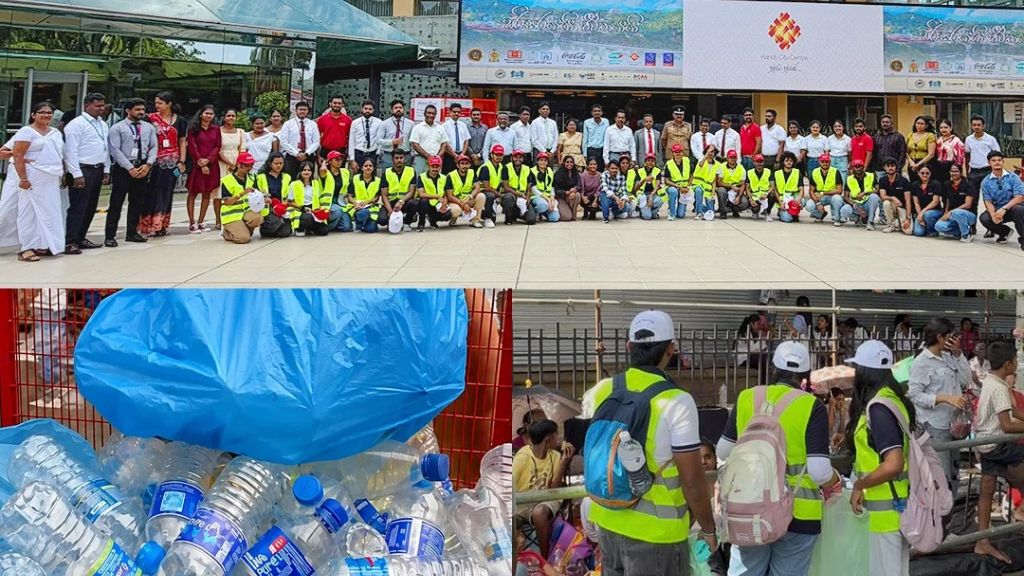
Neptune Recyclers supported a major environmental initiative during the Esala Perahera in Kandy, helping collect more than 45,000 PET bottles while bringing together government agencies, businesses, volunteers and community partners.
Neptune Recyclers helps recover more than 45,000 PET bottles during Kandy’s Esala Perahera
More than 250 university students joined the Esala Perahera PET Collection Drive, a multi-stakeholder initiative aimed at managing recyclable waste generated during one of Sri Lanka’s largest cultural gatherings. The initiative focused on recovering discarded PET bottles from along the Perahera route and directing the material towards appropriate recycling and recovery channels.
Led by the Central Provincial Ministry of Environment, the programme brought together a broad network of public and private sector organisations. Participants included Sri Dalada Maligawa, Coca-Cola Beverages Sri Lanka, Neptune Recyclers, CFC Health Care, Siyatha TV, Siyatha FM, Kandy City Centre, public coordination bodies and university volunteer groups.
The scale of the collection reflects the environmental challenge associated with major public events. Large gatherings can generate significant volumes of single-use packaging and other waste within a concentrated area and over a relatively short period. Recovering recyclable material at the source can reduce the amount of waste entering general disposal streams while supporting the continued use of valuable materials.
Collection teams worked along the Perahera route to identify and recover discarded PET bottles. The collected material was subsequently directed towards recycling and recovery channels, helping keep recyclable plastic within the resource cycle rather than allowing it to become unmanaged environmental waste.
The initiative also placed an emphasis on public awareness. Beyond the physical recovery of more than 45,000 bottles, the collection drive demonstrated how responsible disposal and organised material recovery can become part of the management of large public events.
For Neptune Recyclers, participation in the initiative builds on its role within Sri Lanka’s recycling and resource recovery sector. The company supports efforts aimed at improving responsible waste management and encouraging the recovery and reuse of materials that would otherwise potentially enter conventional waste streams.
The collaboration also forms part of Aberdeen Holdings’ broader approach to environmental stewardship and responsible business. Group companies have been involved in sustainability initiatives that combine community engagement with practical action, placing emphasis on measurable outcomes rather than awareness alone.
The involvement of more than 250 university volunteers was another significant component of the programme. Students from the University of Peradeniya, SLIIT, AIBT, BCAS, ESOFT Uni, APIIT, SLIATE and ANC contributed to collection activities, providing additional manpower along the Perahera route and strengthening the initiative’s community dimension.
Student participation also created an opportunity to connect environmental responsibility with younger members of society. By involving university students directly in waste collection and recovery activities, the programme moved beyond messaging and allowed participants to engage with the practical requirements of recycling and responsible waste management.
The participation of companies from different sectors, government institutions, media organisations and educational institutions further demonstrated the collaborative nature of the initiative. Managing waste at a major cultural event requires coordination across multiple parties, particularly when activities take place across public spaces with large numbers of visitors.
The PET Collection Drive therefore served both an operational and educational purpose. It helped recover a substantial quantity of recyclable plastic while demonstrating how partnerships can support environmental management during high-footfall events.
PET, or polyethylene terephthalate, is widely used for beverage bottles and other packaging because of its durability and versatility. When collected separately and processed through appropriate recycling systems, PET can be recovered and converted into material for further use. Effective collection is therefore an important part of maintaining the value of recyclable material within a circular economy.
The Kandy initiative illustrates the role that organised collection can play in this process. Without separation and recovery, recyclable bottles discarded during a large event can become mixed with other waste, making recovery more difficult and increasing the likelihood that useful material will ultimately be disposed of.
For businesses operating in the recycling sector, initiatives of this nature can also strengthen connections between collection networks, consumers, institutions and recycling facilities. Greater participation across the value chain is important for building a more effective circular materials economy in Sri Lanka.
The success of the Kandy initiative was ultimately dependent on the combined contribution of the participating organisations and volunteers. No single stakeholder could have achieved the same scale of collection independently, highlighting the importance of coordinated environmental action.
Neptune Recyclers continues to strengthen its involvement in Sri Lanka’s recycling and resource recovery landscape through initiatives that connect environmental objectives with practical on-ground action. The Esala Perahera drive adds another example of how collaborative collection efforts can produce measurable results while supporting cleaner public spaces.
For Aberdeen Holdings, the recovery of more than 45,000 PET bottles also reinforces a wider commitment to sustainability and community engagement. The initiative demonstrates how corporate participation in environmental programmes can extend beyond financial support, with companies, institutions and volunteers working directly to address waste management challenges.
As Sri Lanka continues to focus on resource efficiency and circularity, initiatives that improve the recovery of recyclable materials will remain relevant. The experience at the Esala Perahera shows that coordinated action involving government, business, educational institutions and communities can make a measurable contribution to keeping recyclable materials in circulation and public spaces cleaner.