

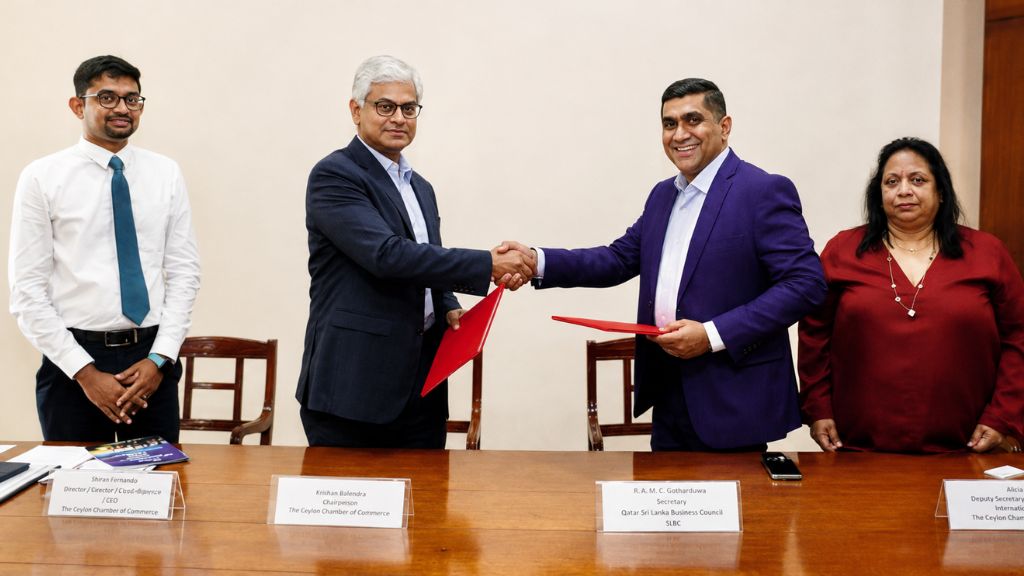
Ceylon Chamber has strengthened Sri Lanka’s international business network by signing Memoranda of Understanding with business organisations in Qatar and Lebanon, creating new opportunities for trade, investment and commercial cooperation.
Ceylon Chamber expands international partnerships to boost trade and investment opportunities
The agreements were signed with the Qatar Sri Lanka Business Council (QSLBC) and the Chamber of Commerce, Industry and Agriculture of Beirut and Mount Lebanon (CCIA-BML), further expanding the Chamber’s network of international business partnerships.
The MoU with QSLBC was signed at the Ceylon Chamber, while the agreement with CCIA-BML was concluded virtually. The two agreements establish a framework for closer cooperation between the respective business communities and provide avenues for greater engagement between companies in Sri Lanka, Qatar and Lebanon.
The partnership with QSLBC comes at a significant time for bilateral relations, as Sri Lanka and Qatar mark 50 years of diplomatic ties. The milestone provides an opportunity to strengthen not only government-to-government relations but also business-to-business connections and private-sector engagement.
Ceylon Chamber Chairperson Krishan Balendra welcomed both agreements, saying the Chamber was pleased to support and cooperate with the two organisations. He highlighted the potential for the partnerships to strengthen connections between the respective business communities and create opportunities for increased trade, investment and wider commercial activity.
The agreement with QSLBC is expected to facilitate greater interaction between companies in the two markets. QSLBC Secretary B.A.W.C. Gunasekara also welcomed the partnership, noting its potential to deepen Sri Lanka-Qatar business relations and provide a stronger platform for companies seeking commercial opportunities in both countries.
Qatar remains an important market for Sri Lankan businesses, while Sri Lankan companies can potentially benefit from stronger connections with Qatari investors, importers and business service providers. A structured relationship between business chambers can help identify areas of mutual interest and create channels through which private-sector representatives can establish direct contacts.
The second agreement, signed with CCIA-BML, extends the Chamber’s engagement into Lebanon. The virtual signing took place in the presence of Sri Lanka’s Ambassador to the Lebanese Republic, Anura Withanage.
CCIA-BML Chairman Mohamed Choucair welcomed the agreement and highlighted the potential for closer cooperation between the two chambers. The partnership is intended to encourage greater interaction between businesses in Sri Lanka and Lebanon and provide a framework for identifying commercial opportunities.
For companies seeking to enter unfamiliar markets, relationships between chambers can provide an important starting point for gaining market intelligence and establishing business contacts. Such partnerships can also help organisations identify potential trade partners, investment opportunities and areas where their respective markets complement each other.
The two MoUs provide for the exchange of business and economic information, assistance in facilitating contacts between members of the respective business communities, and the identification of opportunities for trade, investment and commercial cooperation.
These areas of cooperation are particularly relevant as Sri Lankan businesses continue to seek opportunities in international markets. Expanding commercial networks can help local companies explore new customers and partners while supporting efforts to diversify export destinations.
The agreements also strengthen the role of the Ceylon Chamber as a bridge between Sri Lankan businesses and international markets. By working with counterpart chambers and business organisations, the Chamber can provide its members with broader access to overseas business networks and potential investment relationships.
For Qatar, the partnership coincides with the 50th anniversary of bilateral relations, adding a broader diplomatic and economic context to the new business relationship. Stronger private-sector links could complement existing bilateral ties by encouraging companies to explore opportunities beyond established areas of cooperation.
The Lebanon agreement similarly creates a formal channel for increased private-sector engagement. While the two markets have different economic structures and business environments, closer interaction between chambers can help identify sectors and companies where commercial interests overlap.
The effectiveness of both agreements will ultimately depend on how actively businesses use the networks and opportunities created through them. Business delegations, information exchanges, trade events and direct company-to-company introductions could translate the framework established by the MoUs into practical commercial activity.
For Sri Lankan exporters and investors, stronger chamber-level relationships can therefore provide another route into overseas markets. Access to reliable business information and local contacts can reduce some of the barriers companies face when exploring new jurisdictions.
The latest agreements form part of the Chamber’s wider efforts to expand its international network of partnerships. They reinforce its role in connecting Sri Lankan businesses with overseas markets, potential partners and investment opportunities while supporting the broader objective of strengthening the country’s international commercial relationships.
The new partnerships with QSLBC and CCIA-BML consequently represent more than formal agreements between business organisations. They establish channels through which private-sector stakeholders can build relationships, exchange information and explore new areas of economic cooperation.
For the Ceylon Chamber, the agreements add Qatar and Lebanon to an expanding international business network and provide Sri Lankan companies with additional platforms for regional and international engagement. The next step will be turning these institutional links into tangible trade, investment and business opportunities for companies on both sides.