

Secondary market yields climb 50–70 basis points in the belly of the curve as short-tenor Treasury bill rates also move higher, signalling a broader upward shift in borrowing costs
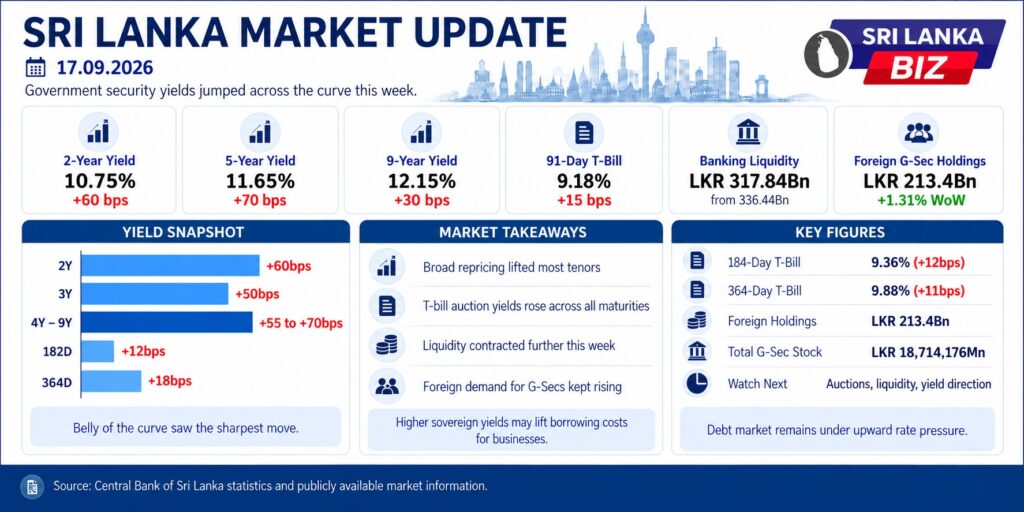
Sri Lanka’s government securities market recorded a significant upward shift in yields this week, with the belly of the curve — maturities between two and nine years — rising by 50 to 70 basis points compared to the previous week. The move was part of a broader repricing that touched nearly every tenor on the curve, from short-term instruments to bonds maturing in 2039.
Comparing yield curves from September 10 to September 17, short-tenor rates below 91 days rose 20 basis points week-on-week, while the 182-day and 364-day points gained 10 and 18 basis points respectively. Further along the curve, the 2-year maturity climbed 60 basis points, the 3-year gained 50 basis points, and maturities from 4 to 9 years rose between 55 and 70 basis points. Longer-dated paper out to 13 years also moved higher, with increases ranging from 20 to 30 basis points.
In day-to-day secondary trading, activity was described as mixed, with both buying and selling interest present across maturities. Short-tenor bonds maturing in October and December 2028 traded in a range of 10.75%-10.90%, while the September 2029 maturity traded at 11.05%. In the 2030 segment, bonds traded between 11.35% and 11.45%. Further out, the February 2031 maturity traded within a 11.40%-11.65% range, the December 2032 maturity between 11.70% and 11.80%, the November 2033 maturity between 11.95% and 12.00%, and the September 2034 maturity between 12.17% and 12.20%.
The move in secondary yields was reinforced by this week’s Treasury bill auction, where accepted yields rose across all three tenors compared to the prior auction: the 91-day rate increased by 15 basis points, the 184-day by 12 basis points, and the 364-day by 11 basis points. Total bids across the 91-day tenor reached LKR 171.6 billion against an offered amount of LKR 70 billion in the first phase.
Underpinning the move, banking system liquidity contracted to LKR 317.84 billion from LKR 336.44 billion previously, continuing a multi-day decline visible over the past week and a half after holding relatively steady through early September. Foreign holdings of local government securities, meanwhile, continued to build, rising to LKR 213.4 billion, up 1.31% week-on-week and extending a steady climb from LKR 188.8 billion in late July.
Business Impact
A broad-based rise in government securities yields typically feeds through to lending rates across the economy, raising the cost of both new borrowing and refinancing for corporates and SMEs. Businesses with upcoming debt issuance or refinancing plans should factor in a higher-rate environment than seen in previous weeks. The tightening in banking system liquidity is a related dynamic worth monitoring, as it can further influence short-term funding costs for businesses reliant on bank credit.
What to Watch Next
Market participants will watch whether the upward move in yields continues at upcoming Treasury bond and bill auctions, and whether banking system liquidity stabilises or continues to contract. Continued foreign inflows into government securities, despite the broader equity market’s foreign outflows, will also be worth tracking as a signal of relative investor positioning between asset classes.
Key Numbers
| Metric | Value |
|---|---|
| 2-Year Yield (WoW change) | 10.75% (+60 bps) |
| 5-Year Yield (WoW change) | 11.65% (+70 bps) |
| 9-Year Yield (WoW change) | 12.15% (+30 bps) |
| 91-Day T-Bill (auction) | 9.18% (+15 bps) |
| 184-Day T-Bill (auction) | 9.36% (+12 bps) |
| 364-Day T-Bill (auction) | 9.88% (+11 bps) |
| Banking System Liquidity | LKR 317.84 Bn (from LKR 336.44 Bn) |
| Foreign Holding of GSecs | LKR 213.4 Bn (+1.31% WoW) |
| Total Outstanding GSec Stock | LKR 18,714,176 Mn |
Source Attribution
Source: Central Bank of Sri Lanka statistics and publicly available market information.