

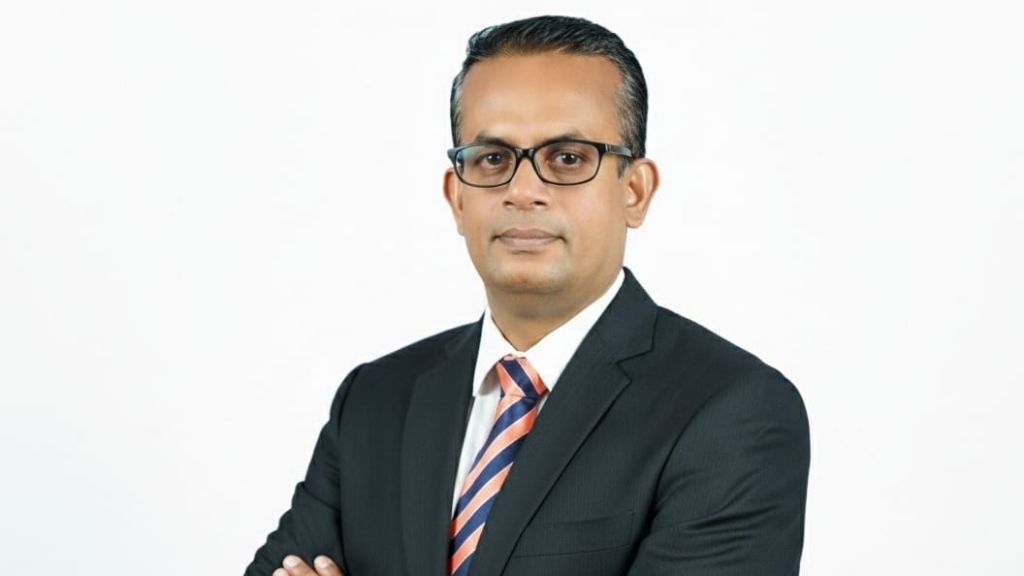
Chandana Guniyangoda has assumed duties as Chairman of People’s Bank, becoming the first chairman of a state-owned licensed commercial bank appointed as an Independent Non-Executive Director under Sri Lanka’s strengthened banking governance framework.
Chandana Guniyangoda takes charge as People’s Bank Chairman amid stronger banking governance rules
Guniyangoda took office at the bank’s head office on 25 August, succeeding Prof. Narada Fernando at a time when governance standards for state-owned financial institutions are undergoing significant changes.
His appointment comes against the backdrop of reforms introduced to strengthen corporate governance across Sri Lanka’s banking sector. The changes form part of broader reforms associated with the country’s IMF-supported economic programme and have been developed with input from international institutions including the IMF and World Bank.
The strengthened framework has also been reinforced through the Central Bank of Sri Lanka’s Banking Act Directions No. 05 of 2024. The measures introduce stricter criteria for determining director independence and place greater emphasis on independent oversight at the board level.
The appointment therefore carries significance beyond a change in leadership at one of Sri Lanka’s largest state-owned banks. It reflects the growing importance being placed on board independence, professional expertise and stronger governance practices within the financial sector.
For People’s Bank, the arrival of Chandana Guniyangoda brings extensive experience across commercial banking and corporate finance. He has more than 28 years of professional experience, including 19 years in commercial banking, with responsibilities spanning finance, strategic planning, business transformation, asset and liability management, risk management and regulatory reporting.
His professional career includes senior roles at NDB Bank PLC, where he served as Assistant Vice President for Finance, Strategic Planning and Business Support. He also served as a Director of Development Holdings (Pvt.) Ltd., a joint venture involving NDB Bank and the Export Development Board.
Guniyangoda has additionally held positions at Sampath Bank PLC and Aitken Spence PLC, giving him experience across both financial services and the wider corporate sector.
More recently, his work extended into institutional restructuring in the agriculture and plantation sectors under the World Bank-backed Agriculture Modernization Project. That experience adds another dimension to his professional background as he takes responsibility for the board leadership of a major state-owned financial institution.
His academic and professional qualifications are similarly focused on finance and management. Guniyangoda is a Fellow of CA Sri Lanka and the Institute of Certified Management Accountants of Sri Lanka. He holds an MBA in Banking and Finance from the Postgraduate Institute of Management at the University of Sri Jayewardenepura and a Master of Arts in Financial Economics from the University of Colombo.
The new People’s Bank Chairman also brings current board-level experience to the role. He serves as Independent Chairman of People’s Insurance PLC and as Group Chief Financial Officer of MG Group of Companies, while holding several other directorships.
That combination of banking, financial management and board experience is particularly relevant as Sri Lanka continues to strengthen the governance architecture of its financial institutions.
The banking sector has been a central component of Sri Lanka’s economic reform programme, with stronger governance viewed as an important element in improving institutional resilience and accountability. The regulatory emphasis on independent directors is intended to ensure that boards have sufficient oversight and are better positioned to challenge management decisions where necessary.
For state-owned banks, these requirements are especially important because they operate at the intersection of commercial banking and public-sector ownership. Stronger separation between ownership interests, board oversight and management can help improve decision-making and reinforce confidence among depositors, investors and other stakeholders.
The appointment of Chandana Guniyangoda therefore represents both a leadership transition at People’s Bank and a practical example of the evolving governance standards being applied to Sri Lanka’s state-owned banking sector.
As the bank moves forward under its new chairman, his experience in risk management, strategic planning, financial economics and institutional restructuring is likely to be closely watched. The broader test will be how effectively the strengthened governance framework translates into sound board oversight, operational discipline and sustainable banking performance.
Guniyangoda succeeds Prof. Narada Fernando at a pivotal period for Sri Lanka’s financial system, with banks continuing to operate amid economic reforms, regulatory changes and efforts to strengthen institutional resilience. His appointment signals the increasing role of independent professional expertise in the governance of state-owned commercial banks.