

Control Union Sri Lanka brought food industry leaders and safety professionals together in Colombo for Food Safety Forward, highlighting the need for stronger systems and greater readiness for evolving global food safety requirements.
Control Union Sri Lanka brings industry leaders together on FSSC Version 7 and global food safety
Control Union Academy Sri Lanka, in collaboration with Foundation FSSC, hosted the FSSC Awareness Session for Stronger Food Safety Systems, Version 7, at Jasmine Hall, BMICH, Colombo, bringing together food industry professionals, food safety practitioners, business leaders and other stakeholders.
The session focused on the changing food safety landscape and the measures Sri Lankan businesses can take to strengthen operational readiness, improve market access and build confidence among international customers.
The programme began with registration and informal networking, allowing participants from different areas of the food industry to reconnect, exchange experiences and discuss common challenges before the formal proceedings.
Roshan Ranawake, Managing Director of Control Union Sri Lanka, delivered the welcome address, establishing the context for an afternoon focused on stronger food safety systems, business preparedness and the importance of maintaining confidence in Sri Lankan products.
The keynote address, titled “Safe Food, Strong Businesses, Global Trust, Shaping the Future of Sri Lanka’s Food Industry”, was delivered by Janak Badugama of the Export Development Board of Sri Lanka. The presentation emphasised the relationship between effective food safety practices and the competitiveness of local businesses seeking to enter or expand in international markets.
Smita Murty, FSSC India and Sri Lanka Representative, subsequently introduced participants to FSSC and provided insights into changing international expectations surrounding food safety. The discussion highlighted the importance of understanding emerging requirements and preparing businesses before regulatory and customer expectations become more demanding.
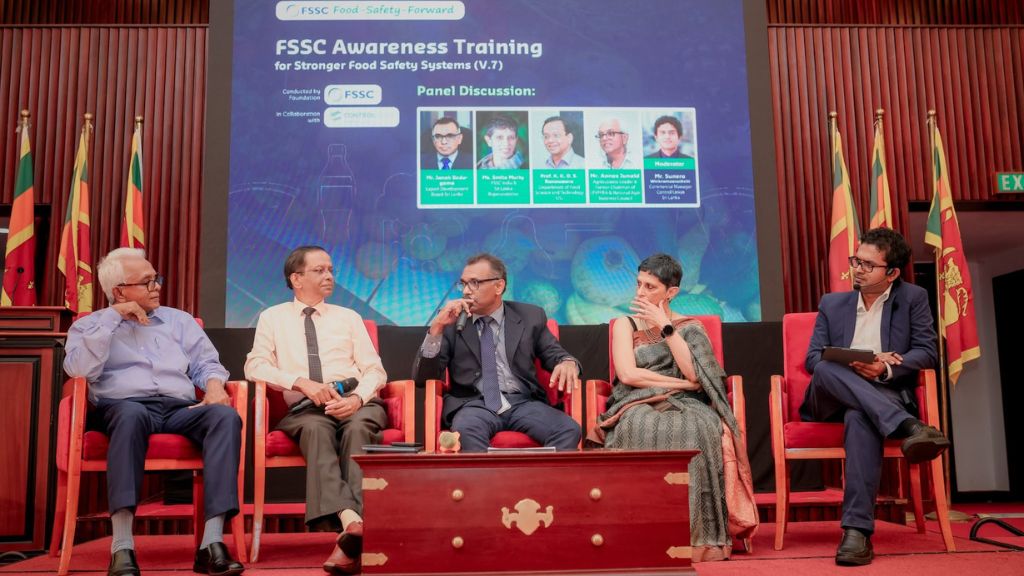
A central feature of the event was a panel discussion titled “Preparing Sri Lankan Food Businesses for Emerging Global Food Safety Requirements”. The discussion brought together specialists representing food safety systems, export development, food science and industry.
The panel included Smita Murty of FSSC India and Sri Lanka, Janak Badugama of the Export Development Board of Sri Lanka, Professor K.K.D.S. Ranaweera of the Department of Food Science and Technology at the University of Sri Jayewardenepura, and Annes Junaid, an agribusiness entrepreneur and export specialist.
The discussion was moderated by Sunera Wickramaarachchi, Commercial Manager of Control Union Sri Lanka. Panelists examined several issues affecting the future competitiveness of Sri Lankan food businesses, including changing global requirements, emerging scientific risks, market access, management commitment and the development of a strong food safety culture.
The conversation also placed emphasis on practical implementation. For businesses, meeting international food safety expectations involves more than obtaining certification. It requires management commitment, effective processes, employee awareness and systems capable of identifying and managing risks throughout the food supply chain.
This focus is particularly relevant as Sri Lankan food manufacturers and exporters seek to strengthen their position in international markets. Consistent food safety systems can help companies demonstrate reliability to buyers while reducing operational risks and supporting compliance with increasingly sophisticated customer requirements.
The introduction of FSSC Version 7 was therefore an important part of the session. Awareness of updated standards gives businesses an opportunity to assess existing systems, identify gaps and prepare their operations for evolving expectations. For exporters, such preparation can be particularly significant when entering markets where food safety certification and documented controls form part of supplier requirements.
The event also demonstrated the value of bringing industry, academia, government-linked organisations and international certification specialists into the same discussion. Such collaboration can help businesses understand not only the technical aspects of food safety but also the commercial implications of maintaining strong systems.
The formal programme concluded with a vote of thanks delivered by Kaushalya Rajapaksha, General Manager of Control Union Sri Lanka. Uthuthara Rajapaksha, Quality Manager of Control Union Sri Lanka, hosted the proceedings throughout the session.
Networking continued after the presentations and panel discussion, giving speakers, participants and industry professionals an opportunity to exchange experiences and discuss practical challenges facing the sector. These interactions extended the event beyond formal knowledge sharing and created opportunities for professional collaboration.
For Control Union Sri Lanka, the programme forms part of its broader engagement with businesses seeking to improve certification, inspection, testing and sustainability practices. The company is a member of the Control Union World Group, which operates across more than 80 countries and provides services in areas including agriculture, food safety, textiles, bioenergy and sustainability certification.
The company’s local capabilities were further strengthened in February 2026 with the opening of Sri Lanka’s first PCR-based food testing laboratory. The facility became the 28th laboratory within the global Control Union network, adding scientific testing capacity to the organisation’s inspection and certification services in the country.
The development of testing infrastructure alongside industry awareness initiatives provides businesses with a broader support ecosystem as they work to strengthen food safety performance. It also reflects the growing importance of scientific capability, certification and technical expertise in maintaining confidence throughout modern food supply chains.
As international markets continue to place greater emphasis on food safety, traceability and quality assurance, Sri Lankan businesses will increasingly need to demonstrate that their systems can meet evolving requirements. The Food Safety Forward session provided a forum for examining these challenges while connecting businesses with technical and industry expertise.
For the Sri Lankan food sector, the message from the event was clear: food safety is increasingly linked to competitiveness, market access and long-term business resilience. By strengthening systems, developing a stronger food safety culture and preparing for emerging international requirements, businesses can improve their readiness for a more demanding global marketplace.