

Foreign investor participation in Sri Lankan rupee bonds continues a steady multi-week climb, with buying interest concentrated in 2030 maturities even as local investors sell into longer-dated paper
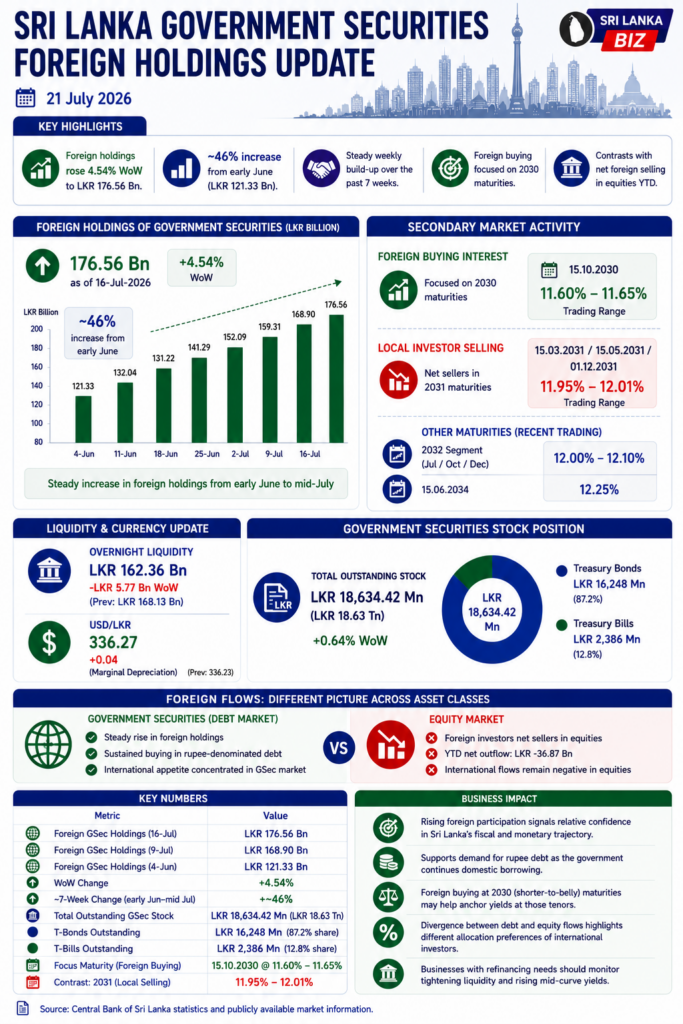
Foreign holdings of Sri Lankan government securities have risen steadily over the past seven weeks, extending a trend that points to sustained international investor interest in rupee-denominated debt even as the broader picture of foreign flows in other asset classes remains mixed.
Foreign holdings stood at LKR 176.56 billion as of mid-July, up 4.54% from the previous week and up roughly 46% from the LKR 121.33 billion level recorded in early June. The climb has been steady rather than driven by a single large purchase, building week over week from early June through mid-July.
Within the secondary market, foreign buying interest has been concentrated specifically in maturities around 2030. The 15.10.2030 bond, which saw notable foreign demand, traded in a range of 11.60% to 11.65% in the most recent session. This selective positioning contrasts with activity from local investors, who were net sellers in 2031 maturities over the same period, where yields moved higher to between 11.95% and 12.01%.
The trend comes against a backdrop of rising yields across the middle of the curve, with 5- to 7-year maturities up roughly 30 basis points week-on-week, and tightening overnight liquidity in the banking system, which fell to LKR 162.36 billion from LKR 168.13 billion. Total outstanding government securities stock stood at LKR 18.63 trillion, up 0.64% week-on-week, with Treasury bonds accounting for the large majority of the total versus Treasury bills.
The sustained rise in foreign holdings is a notably different pattern from the equity market, where foreign investors have been net sellers on a cumulative basis this year, underscoring that international appetite for Sri Lankan rupee assets is currently more concentrated in government debt than in listed equities.
Key Numbers
| Metric | Value |
|---|---|
| Foreign GSec Holdings (16-Jul) | LKR 176.56 Bn |
| Foreign GSec Holdings (9-Jul) | LKR 168.90 Bn |
| Foreign GSec Holdings (4-Jun) | LKR 121.33 Bn |
| WoW Change | +4.54% |
| ~7-Week Change (early Jun–mid Jul) | +~46% |
| Total Outstanding GSec Stock | LKR 18,634.42 Mn (LKR 18.63 Tn) |
| T-Bonds Outstanding | LKR 16,248 Mn share of stock |
| T-Bills Outstanding | LKR 2,386 Mn share of stock |
| Focus Maturity (Foreign Buying) | 15.10.2030 @ 11.60%–11.65% |
| Contrast: 2031 (Local Selling) | 11.95%–12.01% |
Business Impact
A steady rise in foreign participation in government securities is generally read as a signal of relative confidence in Sri Lanka’s fiscal and monetary trajectory, and can help support demand for rupee debt at a time when the government continues to fund itself through domestic borrowing. For businesses and banks, sustained foreign demand at the shorter-to-belly end of the curve (around 2030 maturities) may help anchor yields at those tenors, even as longer local-driven segments face upward pressure. This divergence between debt and equity market foreign flows is worth monitoring as a broader signal of how international investors are currently allocating risk within Sri Lankan assets.
Source Attribution
Source: Central Bank of Sri Lanka statistics and publicly available market information.