

Foreign ownership of local government debt has risen steadily since late July, even as the rupee softens and equity markets see sustained net foreign selling
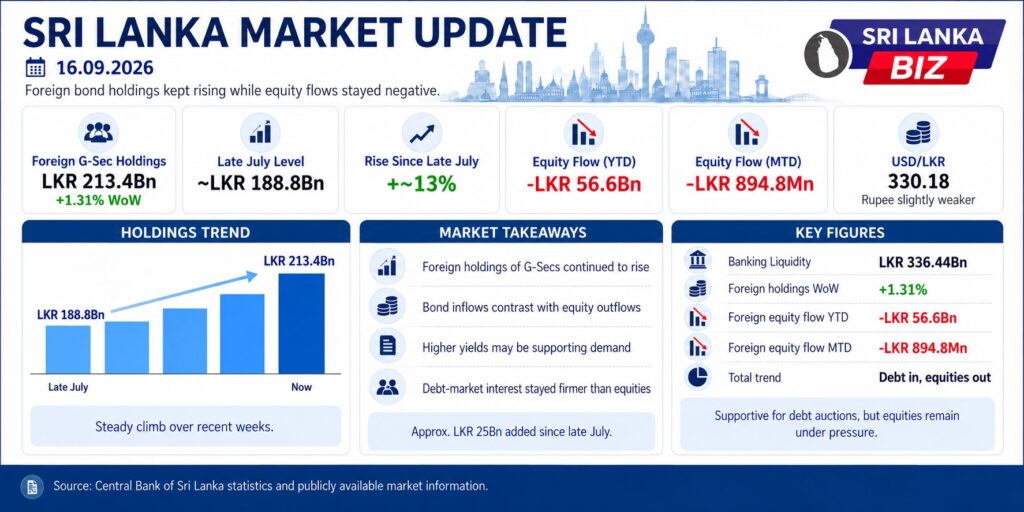
Foreign holdings of Sri Lankan government securities have climbed steadily over the past several weeks, extending a trend that stands in contrast to the sustained net-selling seen in the local equity market this year.
Foreign holdings rose a further 1.31% week-on-week to LKR 213.4 billion as of the latest reading. The increase is the continuation of a gradual build-up that began in late July, when holdings stood at roughly LKR 188.8 billion. Over the course of seven weekly readings since then, holdings have risen in six of them, taking the total up by close to LKR 25 billion, or around 13%, over that period.
The trend sits alongside a very different picture in equities, where foreign investors have been persistent net sellers. Year-to-date net foreign outflows from the stock market stand at roughly LKR 56.6 billion, with a further LKR 894.8 million in net selling recorded so far this month. The divergence suggests that while foreign investors have continued to withdraw from Sri Lankan shares, they have simultaneously been adding to their exposure in government debt.
The rise in foreign appetite for government securities has occurred against a backdrop of rising yields. At Tuesday’s weekly Treasury Bill auction, yields increased across all three tenors, while secondary market bond yields also moved higher, particularly in maturities between 2030 and 2033. Higher yields on offer may be one factor supporting continued foreign interest in the asset class, though the report does not attribute the increase to any specific cause.
Banking system liquidity, meanwhile, contracted to LKR 336.44 billion from LKR 347.55 billion previously, and the rupee depreciated marginally against the US dollar to LKR 330.18.
Business Impact
Sustained foreign inflows into government securities can help support demand at future debt auctions and may contribute to stability in the government’s borrowing costs over time. For businesses and financial institutions, the divergence between debt and equity flows is worth monitoring as a signal of where international investors currently see relative value in Sri Lankan markets. Continued foreign participation in the bond market is also a factor that can influence the exchange rate over time, alongside other current account and capital flow dynamics.
Key Numbers
| Metric | Value |
|---|---|
| Foreign holdings of G-Secs (latest) | LKR 213.4Bn |
| Foreign holdings, week-on-week | +1.31% |
| Foreign holdings, late July | ~LKR 188.8Bn |
| Approximate increase since late July | ~13% |
| Foreign equity flow (YTD) | -LKR 56.6Bn |
| Foreign equity flow (MTD) | -LKR 894.8Mn |
| Banking system liquidity | LKR 336.44Bn |
| USD/LKR | 330.18 |
Source Attribution
Source: Central Bank of Sri Lanka statistics and publicly available market information.