

All three T-Bill tenors saw higher yields at Tuesday’s auction, while secondary market rates climbed broadly, with a sharper move in bonds maturing between 2030 and 2033
Yields on Sri Lankan government securities rose broadly on Tuesday, with increases recorded at both the Public Debt Management Office’s weekly Treasury Bill auction and across secondary market trading.
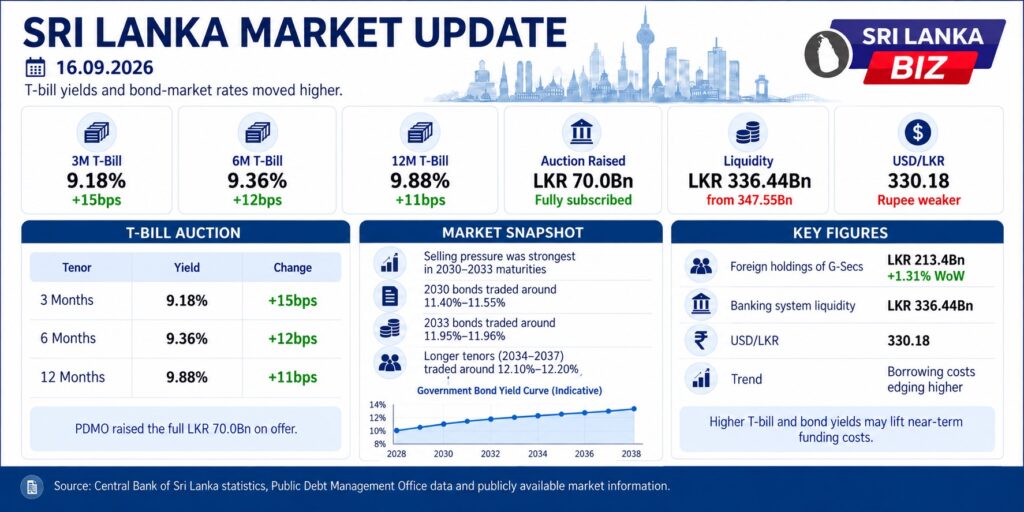
The PDMO raised the full LKR 70.0 billion on offer at its weekly T-Bill auction. The 3-month yield rose 15 basis points to 9.18%, against bids of approximately LKR 63.4 billion for the LKR 25.0 billion on offer. The 6-month yield increased 12 basis points to 9.36%, with the full LKR 25.0 billion offered accepted. The 12-month yield rose 11 basis points to 9.88%, with the full LKR 20.0 billion offered also accepted in that tenor.
In secondary market trading, activity was described as high in volume, with selling pressure concentrated in bonds maturing between 2030 and 2033 — the “belly” of the yield curve — where yields rose more sharply than at other points along the curve. Shorter-dated maturities including the September 2029 and March 2030 bonds traded at 11.00%, while bonds maturing in 2030 traded between 11.40% and 11.55%. Further along the curve, bonds maturing in 2033 traded between 11.95% and 11.96%, and longer-dated bonds maturing between 2034 and 2037 traded between 12.10% and 12.20%.
Banking system liquidity contracted to LKR 336.44 billion, down from LKR 347.55 billion in the prior session. Foreign holdings of Sri Lankan government securities, meanwhile, rose 1.31% week-on-week to LKR 213.4 billion, continuing a steady increase from roughly LKR 188.8 billion in late July.
On the currency front, the rupee depreciated marginally against the US dollar, trading at LKR 330.18 compared with LKR 329.04 previously.
While no single yield movement on the day crossed the 20-basis-point threshold typically associated with a major shift, the consistency of the increase — across all three T-Bill tenors and most of the secondary market curve — points to a broad, if measured, upward adjustment in government borrowing costs.
Business Impact
Higher T-Bill and bond yields translate into a somewhat higher cost of government borrowing and can influence pricing for corporate debt and bank lending rates that benchmark off government securities. Businesses with treasury operations holding short-term government paper may see modestly improved returns, while those planning new borrowing should note the incremental upward pressure on rates. The continued rise in foreign holdings of government securities suggests sustained external investor interest in local debt markets, a contrast with the net-selling trend seen in the equity market this year.
Key Numbers
| Metric | Value | Change |
|---|---|---|
| 3M T-Bill yield | 9.18% | +15bps |
| 6M T-Bill yield | 9.36% | +12bps |
| 12M T-Bill yield | 9.88% | +11bps |
| Total T-Bill auction raised | LKR 70.0Bn | Fully subscribed |
| Banking system liquidity | LKR 336.44Bn | Down from LKR 347.55Bn |
| Foreign holdings of G-Secs | LKR 213.4Bn | +1.31% WoW |
| USD/LKR | 330.18 | +1.14 |
Source Attribution
Source: Central Bank of Sri Lanka statistics, Public Debt Management Office data and publicly available market information.