

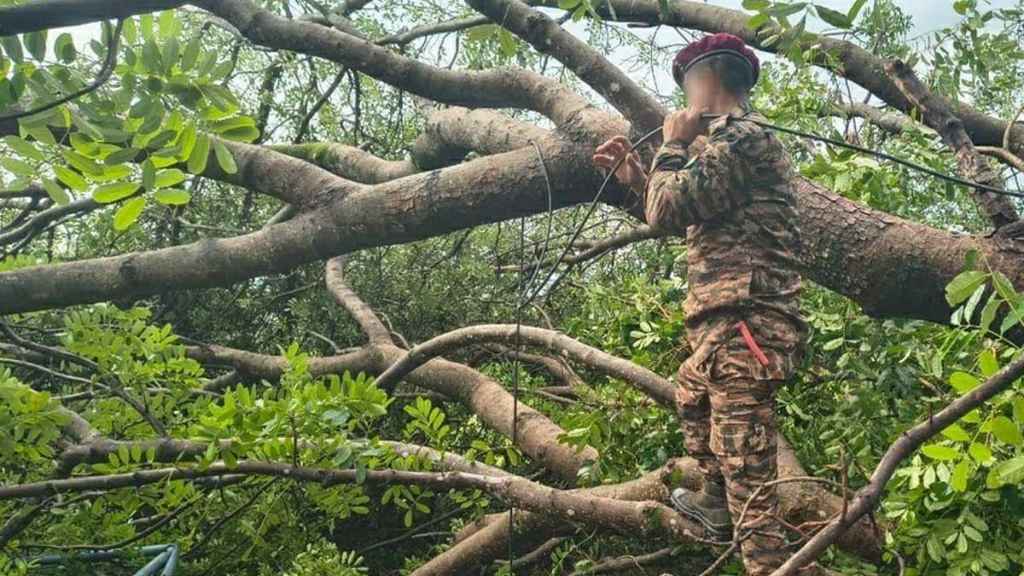
Indian army relief team Sri Lanka operations gained renewed attention after military signallers successfully restored a severed optical fibre link in Mahiyangana, helping re-establish critical communications disrupted by Cyclone Ditwah during one of the island’s worst recent natural disasters.
Indian army relief team Sri Lanka reconnects vital communications after cyclone
Indian army relief team Sri Lanka efforts played a decisive role in restoring essential communication infrastructure after Cyclone Ditwah severed a major optical fibre connection in the Mahiyangana area, triggering widespread service disruptions across parts of the country’s central and eastern regions. The intervention formed part of India’s broader humanitarian assistance mission following the cyclone, which caused extensive damage to power lines, telecom networks, and public infrastructure.
According to the Indian High Commission in Colombo, Indian Army signallers successfully reconnected the damaged optical fibre cable after it was cut by a fallen tree during the storm. The break had resulted in a significant communication blackout in Mahiyangana, a strategically located area between Kandy and Badulla, two districts that were among the worst affected by the cyclone.
The fibre restoration was carried out under challenging field conditions. Indian Army technical teams conducted precise optical fibre cable splicing close to a base transceiver station tower situated near the temporary field hospital established by the relief mission. Officials said the rapid repair enabled the restoration of mobile and data connectivity, which was critical for coordinating emergency services, medical care, and relief distribution in the affected region.
Cyclone Ditwah had damaged fibre backbone infrastructure in more than a dozen locations across Sri Lanka, placing thousands of base transceiver stations out of operation. In many cases, the failures were compounded by prolonged power outages, which further disrupted communication networks at a time when access to information and emergency coordination was most needed.
Telecommunications officials and emergency responders highlighted that the reconnection work by the Indian army relief team Sri Lanka significantly eased the strain on local authorities. Restored connectivity allowed hospitals, disaster response units, and administrative officials to resume coordination efforts that had been severely hampered in the immediate aftermath of the storm.
Alongside restoring communications, the Indian relief mission also delivered critical medical support. The Indian Army operated a fully functional field hospital in Mahiyangana, providing round-the-clock care to residents affected by flooding, injuries, and cyclone-related health complications. The facility served as a vital lifeline for communities whose access to healthcare had been disrupted by damaged roads and overwhelmed local hospitals.
Medical personnel at the field hospital treated an estimated 1,000 to 1,200 patients per day during the peak of operations. The team carried out 513 minor medical procedures and successfully performed 14 major surgeries, addressing trauma injuries, infections, and other urgent conditions that arose in the cyclone’s aftermath. Health officials noted that the presence of the field hospital significantly reduced pressure on nearby medical facilities in Kandy and Badulla.
Diplomatic sources said the relief operation reflected the depth of bilateral cooperation between India and Sri Lanka, particularly in times of crisis. India’s rapid deployment of technical specialists, medical teams, and logistical resources underscored its capacity to provide integrated disaster response support that extends beyond immediate aid to include infrastructure recovery.
The mission also included substantial humanitarian supplies. When the Indian Air Force C-17 Globemaster aircraft returned the relief teams to India on December 14, it had earlier delivered critical assistance cargo to Sri Lanka at the request of the Sri Lankan government. This included 10 tonnes of essential medicines and 15 tonnes of dry rations, aimed at supporting displaced families and overstretched healthcare facilities.
Sri Lankan officials acknowledged that the combination of medical services, communications restoration, and humanitarian supplies helped stabilise affected areas during a critical phase of recovery. Analysts noted that restoring connectivity early in disaster response efforts often accelerates overall recovery by enabling accurate assessments, efficient aid distribution, and clear communication with affected populations.
The Indian army relief team Sri Lanka mission comes as climate-related disasters increasingly test regional preparedness and cross-border cooperation. Cyclone Ditwah exposed vulnerabilities in telecommunications infrastructure, particularly in rural and mountainous areas where fibre lines are more susceptible to environmental damage.
Experts argue that such incidents highlight the importance of resilient infrastructure planning and regional partnerships capable of delivering rapid technical intervention. The successful fibre reconnection in Mahiyangana demonstrated how specialised military engineering capabilities can complement civilian disaster response mechanisms.
As Sri Lanka continues its recovery from Cyclone Ditwah, the relief operation is expected to serve as a reference point for future emergency collaboration between the two countries. Officials from both sides have emphasised the importance of institutionalising such cooperation to ensure faster response times and more effective coordination in the face of increasingly frequent extreme weather events.
The swift actions of the Indian army relief team Sri Lanka not only restored vital communications and healthcare access but also reinforced the broader strategic partnership between the neighbouring nations, highlighting how regional solidarity can translate into tangible relief for communities in distress.