

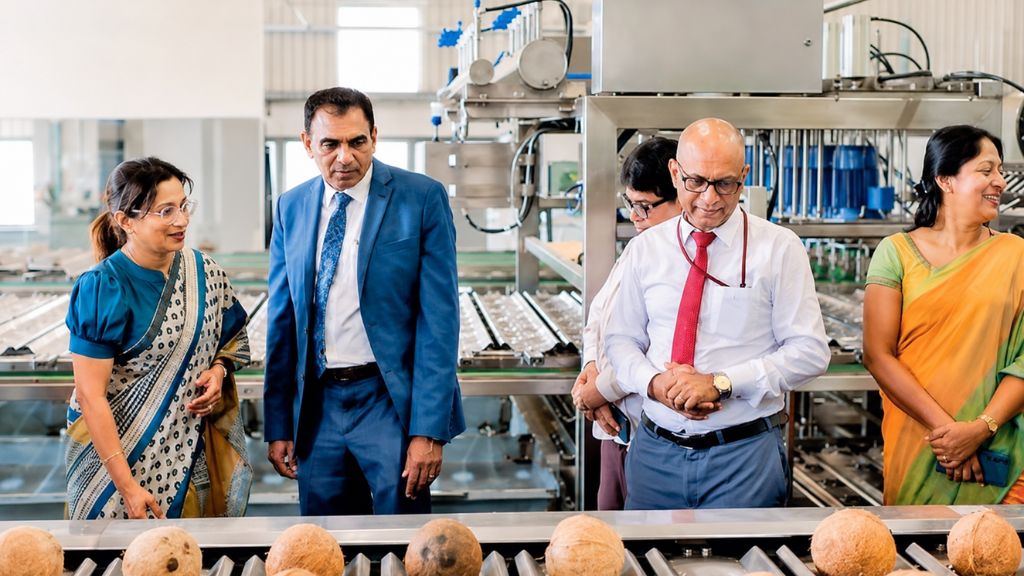
The automated coconut dewatering system launched by Sri Lankan engineering company ISF is designed to transform coconut processing by improving productivity, reducing labour dependency and helping processors achieve stronger returns on investment.
Sri Lankan engineering innovation targets higher productivity and lower labour dependency
Sri Lankan engineering and technology company ISF has officially launched what it describes as the world’s first fully automated coconut dewatering system, marking a significant step in the development of locally engineered automation solutions for the coconut processing industry.
Designed, developed and manufactured by Sri Lankan engineers, the system automates a process that has traditionally depended heavily on manual handling. By introducing automation into this stage of coconut processing, ISF aims to address operational inefficiencies while improving productivity and reducing dependence on labour.
The new technology was unveiled during a live demonstration attended by Science and Technology Minister Prof. Chrishantha Abeysena, diplomats representing ISF’s key international markets, industry leaders and members of the media. Attendees were able to observe the equipment in operation and assess its potential benefits for coconut processors.
ISF Director Anjula Sivakumaran said the system had been designed, tested and launched with the aim of addressing practical challenges faced by processors. He said customers in Indonesia and the Philippines had responded positively to the technology, with one of the machines scheduled to be shipped to the Philippines in the coming weeks.
ISF engineers are also expected to travel to the Philippines to oversee the installation and provide after-sales support. The move demonstrates the company’s focus on supporting its technology beyond the initial sale, particularly as it expands into international markets.
The launch comes as automation becomes increasingly important for manufacturers seeking to improve operational efficiency and maintain competitiveness. For the coconut processing industry, where labour availability, productivity and processing consistency can directly affect commercial performance, automated machinery can offer opportunities to streamline production and improve returns.
Sivakumaran said the company’s ambitions extend beyond the newly launched system. ISF is continuing to develop technologies across the wider coconut processing value chain, including equipment for dehusking, deshelling and paring.
The company is also placing greater emphasis on artificial intelligence and advanced engineering as part of its technology development strategy. By combining engineering expertise, automation and AI, ISF aims to develop solutions that address complex operational challenges faced by businesses in Sri Lanka and international markets.
The company’s approach also highlights the growing potential of Sri Lankan engineering talent in developing industrial technologies for export. Rather than relying exclusively on imported machinery, locally designed solutions can be adapted to specific processing requirements while potentially offering businesses a more accessible route to automation.
ISF was established in 1977 and has since developed from a manufacturing company into a provider of technology, engineering, automation and process solutions. Its operations span several industries, including dairy, coconut, food, pharmaceutical, chemical and fast-moving consumer goods (FMCG) sectors.
The company says its objective is to help businesses in Sri Lanka and across the region reach global operating standards while keeping investment costs substantially below those associated with some Western technology providers.
For the coconut processing industry, the introduction of the automated coconut dewatering system represents an example of how local engineering capabilities can be applied to longstanding production challenges. The system also forms part of ISF’s broader effort to develop automation technologies that can be deployed across the region.
With its expansion into international markets and continued investment in research and development, ISF is positioning locally developed industrial automation as a potential export opportunity while helping manufacturers improve efficiency and competitiveness.