

Kaspersky: One in three victims of tech-enabled abuse reveals that digital abuse frequently extends beyond online platforms, with many victims experiencing significant impacts on their personal lives, careers and education while a large number still do not seek help.
Kaspersky: One in three victims of tech-enabled abuse face lasting real-world consequences
A new global study by Kaspersky has found that technology-facilitated abuse is causing serious offline consequences for victims, yet many affected individuals remain unsure where to seek support. The second part of the cybersecurity company’s latest report highlights the growing need for greater awareness, stronger support systems and improved digital safety practices.
The research, conducted by Kaspersky’s internal market research centre, surveyed 7,600 respondents across 19 countries, including the United Kingdom, the United States, Germany, India, Brazil and China. According to the findings, 34% of respondents reported experiencing real-world consequences resulting from tech-enabled abuse, ranging from social withdrawal to losing employment or leaving education.
While psychological harm remains the most widely recognised consequence, the report suggests public awareness of the broader impacts remains limited. Nearly 79% of respondents identified mental health effects such as depression, trauma and long-term stress, while 73% recognised social consequences including damaged reputations, isolation and strained personal relationships.
However, fewer respondents associated technology-facilitated abuse with economic and physical risks. Only 55% recognised the potential for financial harm, while just 51% acknowledged that online abuse could escalate into physical threats or violence. According to Kaspersky, this demonstrates a significant gap in public understanding of how digital abuse can evolve into serious real-world dangers.
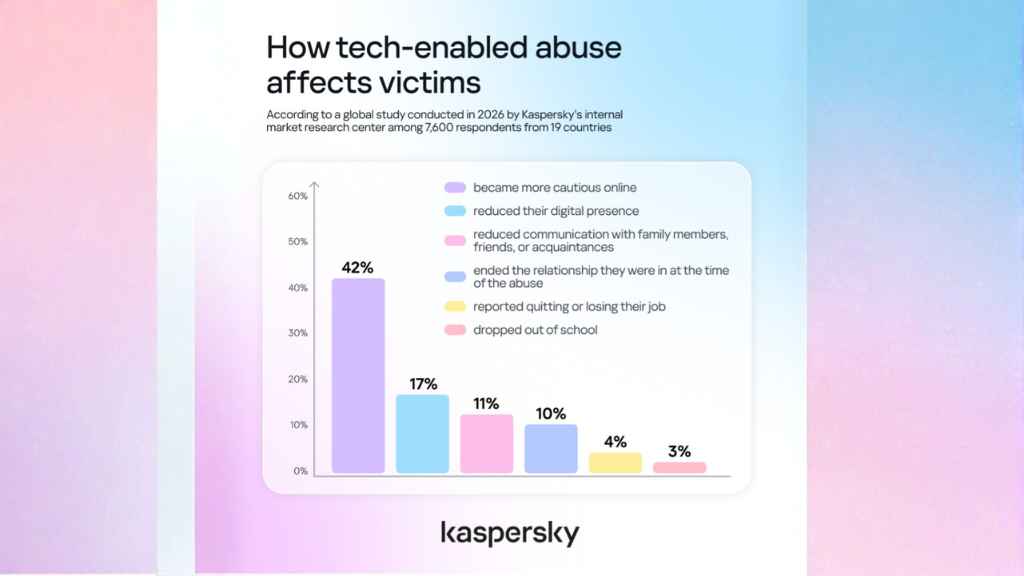
The study also examined how victims change their behaviour after experiencing abuse. Around 42% said they became more cautious about their online activities, while 17% reduced their digital presence altogether. Another 11% limited communication with friends or family, and approximately one in ten respondents ended a personal relationship due to the abuse they experienced.
More severe consequences were also reported. Four percent of respondents said they had either lost or left their jobs because of technology-facilitated abuse, while 3% reported dropping out of school, highlighting the lasting impact digital harassment can have on both professional and educational opportunities.
Despite these significant consequences, many victims continue to suffer in silence. The report found that more than one in five victims (22%) took no action after experiencing abuse. Among Baby Boomers, that figure rose sharply to 37%, suggesting older generations may face additional barriers when seeking help or recognising available support services.
The study also revealed uncertainty among witnesses. Of those who had observed someone they knew experiencing digital abuse, 12% chose not to intervene. Importantly, this hesitation was largely driven by uncertainty rather than indifference. Nearly one-third (32%) said they did not know how to help, while 23% were unsure whether it was appropriate to become involved.
Commenting on the findings, Tatyana Shishkova, Lead Security Researcher and Acting Head of Research Center Americas & Europe at Kaspersky’s Global Research and Analysis Team (GReAT), said the research highlights a troubling disconnect between recognising the emotional impact of digital abuse and understanding its broader consequences.
She noted that victims often remain silent not because they dismiss the abuse, but because they do not know where to seek assistance. Raising awareness, providing accessible resources and offering clearer guidance are therefore essential to helping victims respond before situations escalate.
Supporting these findings, Dr Leonie Maria Tanczer, Associate Professor at UCL Computer Science and Head of the Gender and Tech Research Lab, said the research reflects broader challenges surrounding cyberstalking and technology-facilitated abuse. She explained that online forms of abuse are frequently underestimated compared with offline incidents, despite having equally serious effects on victims’ safety and wellbeing.
Dr Tanczer added that many victim-survivors do not seek professional support because technology-facilitated abuse is often difficult to recognise, has become normalised within digital environments or lacks sufficient evidence for reporting. She stressed that governments, technology platforms and society all have important roles to play, but meaningful progress also depends on individuals recognising harmful behaviour early and taking appropriate action.
To reduce the risks associated with tech-enabled abuse, Kaspersky recommends recognising the warning signs early, documenting incidents where possible and protecting digital accounts with strong passwords and two-factor authentication. The company also advises users to regularly review privacy settings, avoid sharing sensitive information unnecessarily, use trusted security software capable of detecting stalkerware and unauthorised tracking, and seek assistance from trusted individuals or professional organisations when needed.
The report concludes that greater public awareness, stronger cybersecurity practices and earlier intervention are essential to preventing technology-facilitated abuse from escalating into lasting personal, professional and physical harm.