

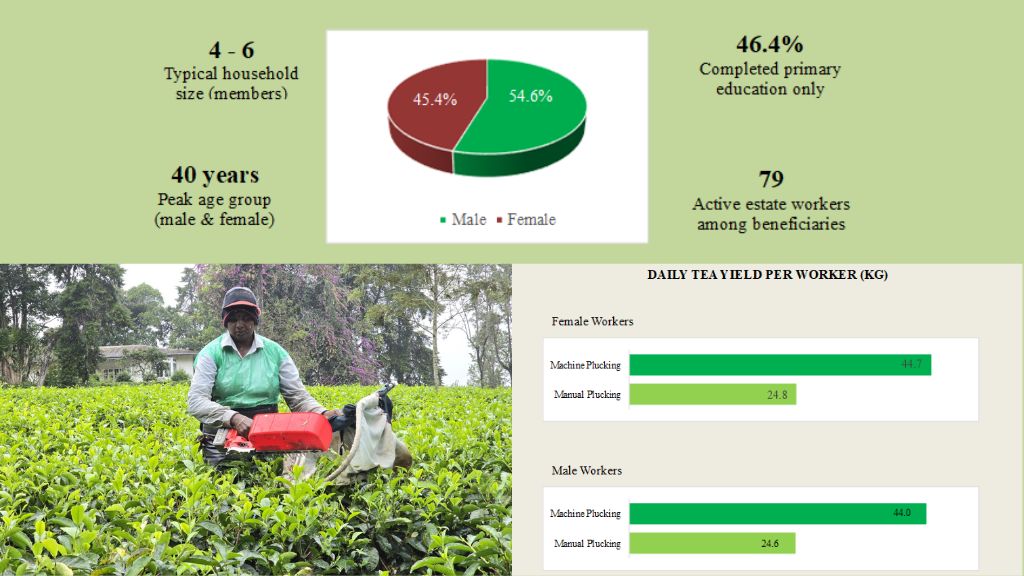
Mechanized Tea Plucking is changing the daily realities of tea estate workers in Nuwara Eliya, helping increase productivity, improve incomes and reduce the physical burden associated with traditional manual harvesting.
Mechanized Tea Plucking raises incomes while easing workloads for estate workers
Mechanized Tea Plucking is changing the daily realities of tea estate workers in Nuwara Eliya, helping increase productivity, improve incomes and reduce the physical burden associated with traditional manual harvesting.
In the misty highlands of Nuwara Eliya, where tea plucking has remained a demanding and highly labour-intensive occupation for generations, a new approach is beginning to reshape the way estate workers earn their livelihoods.
Berendina Development Services (Guarantee) Limited (BDS), a Sri Lankan non-profit community development organisation focused on poverty alleviation, financial inclusion and sustainable livelihoods, has introduced mechanized tea harvesting as part of its efforts to create stronger economic opportunities for estate communities.
The initiative is particularly significant in a sector where income is closely linked to the quantity of tea leaves harvested each day. Traditional tea plucking requires workers to spend long hours bending, reaching and moving across steep plantation terrain, often under difficult weather conditions. For many estate families, the physical demands of the work can directly affect their earning capacity.
The challenge is especially important for communities where alternative employment opportunities remain limited. When productivity is constrained by the physical demands of manual labour, households can find it difficult to increase their earnings even when workers put in longer hours.
BDS has sought to address this challenge by introducing technology directly into the hands of estate workers. Since 2022, the organisation has provided tea plucking machines to 179 workers across nine estates in the Nuwara Eliya District. The estates involved are Clarendon, Desford, Fordyce, Great Western, Ingestre, Mount Vernon, Palmaston, Drayton and Somerset.
Each machine is valued at approximately Rs. 58,000. Rather than transferring ownership of the equipment to individual workers, BDS retains ownership and provides the machines through a tripartite arrangement involving the organisation, workers and estate management.
The approach is intended to make modern equipment accessible to workers who may otherwise be unable to afford the initial investment required for mechanized harvesting. By reducing that financial barrier, BDS is seeking to demonstrate how appropriate technology can be used as a livelihood development tool rather than simply as an industrial productivity measure.
The impact of Mechanized Tea Plucking extends beyond the amount of tea harvested. For workers, improved productivity can translate into stronger earning potential, while the reduced need for repetitive bending and reaching can help ease some of the physical demands associated with traditional plucking.
The initiative also has an important gender dimension. Women have historically formed a major part of the tea estate workforce and have often carried a significant share of the physically demanding work involved in tea harvesting. Providing access to machinery can therefore help create a more level working environment while supporting women’s economic participation.
For the wider Sri Lanka Tea Industry, the adoption of technology comes as plantations face continuing challenges related to labour availability, productivity and the need to remain competitive in international markets. Mechanisation cannot replace every aspect of estate work, but targeted technologies can help address some of the productivity and labour constraints affecting the sector.
The introduction of Tea Plucking Machines also highlights a broader shift taking place within agriculture, where technology is increasingly being considered as a means of improving both productivity and working conditions. In the plantation sector, where many tasks have traditionally depended heavily on manual labour, carefully designed mechanisation programmes could provide practical benefits for both workers and estate operators.
BDS’s programme forms part of its broader mission to support economically marginalised communities and build more sustainable livelihoods. By combining access to equipment with community-level development initiatives, the organisation is positioning mechanisation as a tool for improving household resilience rather than simply increasing production.
The experience from Nuwara Eliya could also provide useful lessons for the future of Sri Lanka’s plantation sector. If technology can help workers harvest more efficiently while reducing physical strain, similar approaches could potentially be expanded to other estates and agricultural activities where labour-intensive processes remain a major constraint.
For the workers already participating in the programme, however, the change is more immediate. A machine that costs around Rs. 58,000 and is made available through BDS can alter the relationship between physical effort, productivity and daily earnings.
As Sri Lanka’s tea industry continues to navigate changing labour conditions and international market expectations, initiatives such as this demonstrate how innovation can be applied at the ground level. The future of plantation work may not be defined solely by larger-scale automation, but also by practical technologies that place greater productivity and improved working conditions within reach of individual workers.