

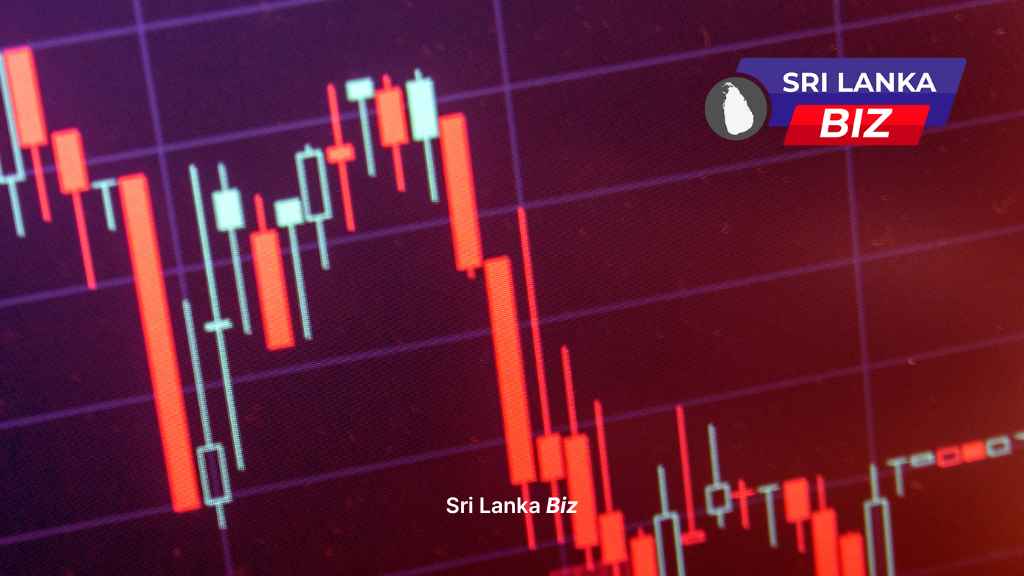
Panic selling, rising oil prices drive CSE down 3.5% to below 22,000 points as investor sentiment weakened sharply at the start of the week, with the Colombo stock market reacting to surging global oil prices and heightened geopolitical tensions.
Panic selling, rising oil prices drive CSE down 3.5% to below 22,000 points amid global uncertainty
Panic selling, rising oil prices drive CSE down 3.5% to below 22,000 points as Sri Lanka’s stock market began the week on a sharply negative note, reflecting investor anxiety triggered by global energy price spikes and escalating geopolitical uncertainty.
The benchmark All Share Price Index (ASPI) plunged 3.51 percent, losing 797.77 points to close at 21,904.14, marking its lowest level since 22 December 2025. The more liquid S&P SL20 Index also declined significantly, dropping 3.65 percent or 231.89 points to end the session at 6,128.86.
The steep decline underscores how quickly global developments can influence local market sentiment. In particular, rising global oil prices have emerged as a major concern for investors worldwide after crude prices surged more than 25 percent to around $115 per barrel, driven largely by the ongoing conflict in the Middle East.
Market analysts noted that investor behaviour reflected widespread caution rather than a fundamental deterioration in Sri Lanka’s economic outlook. Nevertheless, the sharp market reaction shows how sensitive equities remain to global macroeconomic developments.
The sell-off also extended an ongoing downward trend for the ASPI. Since peaking above 24,000 points during intra-day trading on 19 February, the index has now shed more than 2,000 points, highlighting the intensity of the recent correction in the Colombo stock market.
The sharp decline occurred despite reassurances from Central Bank of Sri Lanka (CBSL) Governor Dr. Nandalal Weerasinghe, who recently told international media that Sri Lanka’s economy is now better positioned to absorb external shocks, including higher energy prices.
However, investor sentiment appeared to be driven more by immediate global developments than by domestic economic fundamentals.
Daily market turnover remained relatively strong, exceeding Rs. 5.8 billion, with nearly 198 million shares traded during the session. Despite the high activity levels, the direction of trading remained overwhelmingly negative.
Foreign investors continued to exit the market modestly, recording a net outflow of Rs. 6.1 million, adding further pressure to the Colombo stock market during the trading session.
Market research firm First Capital Research attributed the broad-based decline primarily to the surge in rising global oil prices and the uncertainty created by escalating geopolitical tensions in the Middle East. According to the firm, global equity markets also traded in the red throughout the day as investors reassessed risk exposure.
The negative sentiment was clearly reflected in market breadth. A total of 260 stocks declined, while only six counters recorded gains, indicating widespread selling pressure across the market.
Losses were largely concentrated in banking and blue-chip stocks, which traditionally carry significant weight in the benchmark index. Major counters that contributed to the decline included Commercial Bank, Hatton National Bank, John Keells Holdings, Sampath Bank, and Ceylon Tobacco Company.
Retail investors appeared to be the primary drivers of selling pressure, while participation from high-net-worth investors remained relatively subdued.
Sector-wise, the Banking sector emerged as the largest contributor to market turnover, accounting for 32 percent of total trading activity. The Capital Goods sector and the Food, Beverage and Tobacco sector together contributed another 32 percent.
Commercial Bank and Sampath Bank were among the most actively traded stocks during the session. The share price of Commercial Bank fell Rs. 8.75 to close at Rs. 205.25, while Sampath Bank declined Rs. 5.25 to end the day at Rs. 150.25.
The Capital Goods sector also experienced significant pressure. ACL Cables saw its share price drop Rs. 3 to close at Rs. 94.60, while John Keells Holdings declined Rs. 0.90 to finish at Rs. 20.10.
Research by Asia Securities indicated that the broad-based decline was led by several major counters including John Keells Holdings (-4.3%), Access Engineering (-4.2%), Commercial Bank (-4.1%), Hatton National Bank (-3.8%), Hayleys (-3.6%), Sampath Bank (-3.4%), and ACL Cables (-3.1%).
Among the top contributors to daily turnover were Commercial Bank, which generated approximately Rs. 719 million, followed by Sampath Bank with Rs. 577 million, and ACL Cables with around Rs. 246 million.
Meanwhile, Lanka IOC was also among the day’s active counters. Unlike many other stocks, its share price moved slightly higher, gaining Rs. 1.75 to close at Rs. 148.75, potentially reflecting investor expectations that energy sector firms could benefit from rising global oil prices.
Market participants also noted mixed trading interest across several mid-cap counters. Institutional and high-net-worth investor participation was visible in Commercial Bank, ACL Cables, and Colombo Dockyard, while retail investors showed interest in Co-Operative Insurance Company, Industrial Asphalts, and LOLC Finance.
Looking ahead, analysts believe investor sentiment in the Colombo stock market will likely remain sensitive to global developments, particularly movements in energy prices and geopolitical tensions. If rising global oil prices continue to push inflation expectations higher worldwide, equity markets across emerging economies could experience further volatility.
Despite the current turbulence, some analysts maintain that Sri Lanka’s market fundamentals remain relatively stable compared with previous crisis periods. However, restoring investor confidence may depend heavily on the direction of global markets and whether geopolitical tensions ease in the coming weeks.
As panic selling, rising oil prices drive CSE down 3.5% to below 22,000 points, the latest market correction highlights how closely Sri Lanka’s financial markets are tied to global economic developments and investor sentiment.