

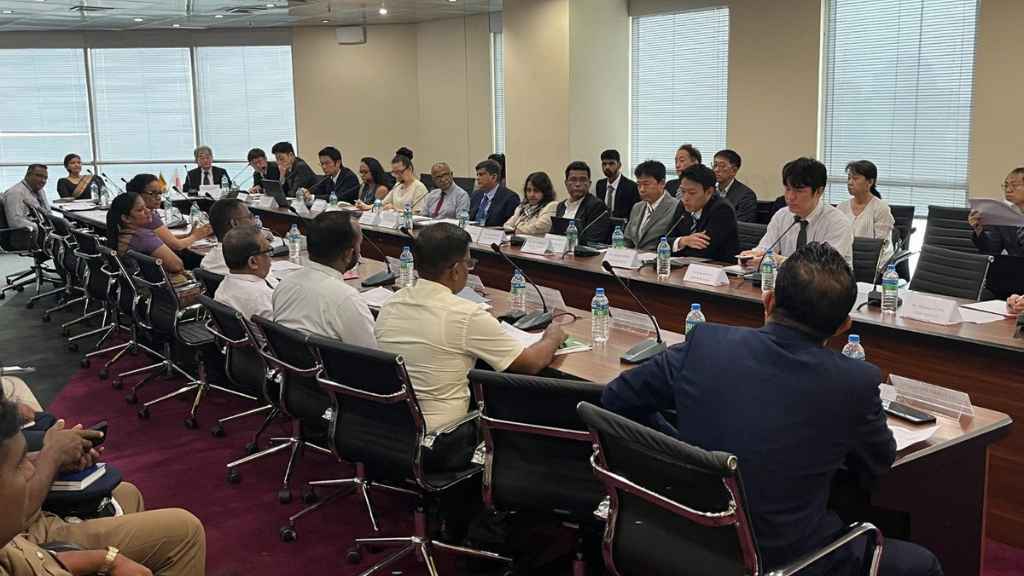
The Sri Lanka-Japan business environment took centre stage this week as officials from both countries met to discuss challenges affecting Japanese investors. The high-level dialogue marks a renewed push to strengthen investment ties and improve long-term confidence.
Sri Lanka-Japan business environment panel meets to address key investor concerns
Sri Lanka and Japan convened the second meeting of the Japan-Sri Lanka Committee on Business Environment on Thursday, bringing together a broad cross-section of government agencies, trade bodies and corporate representatives. Held at the Board of Investment in Colombo, the meeting was attended by officials from the Embassy of Japan, the Japan External Trade Organization, the Japan International Cooperation Agency, and the Japanese Chamber of Commerce and Industry, alongside representatives of Japanese companies operating in Sri Lanka. Senior officials from the BOI and other Sri Lankan institutions also joined the discussions, underscoring the meeting’s importance to bilateral economic cooperation.
According to a statement by the Japanese Embassy, the two sides engaged in detailed exchanges covering a wide spectrum of investment-related concerns currently affecting Japanese enterprises in Sri Lanka. Participants evaluated persistent regulatory issues, procedural delays, and operational bottlenecks that have constrained the ease of doing business. The Embassy noted that these discussions come at a critical moment, with Sri Lanka moving along a path of gradual economic stabilization after several years of financial strain. With investor sentiment slowly recovering, both governments view the initiative as an essential platform for problem-solving and constructive dialogue.
The Japan-Sri Lanka Committee on Business Environment, launched in August 2025, was designed as a formal mechanism to support investment growth while addressing ongoing challenges faced by Japanese firms. Its mandate revolves around three core principles—transparency, predictability and non-discriminatory treatment—each considered vital for attracting stable, long-term foreign investment into the country. Participants at this week’s meeting reaffirmed their commitment to upholding these principles as foundational elements of a more resilient and competitive business climate.
During the discussions, Japanese investors highlighted a number of practical issues, such as delays in investment approvals, shifting compliance expectations and uncertainties in regulatory interpretation. Sri Lankan authorities acknowledged the concerns and outlined steps being taken to improve procedural efficiency, standardize regulatory frameworks and reduce ambiguity across multiple administrative layers. While progress has been gradual, both sides agreed that consistent engagement and prompt follow-up would be essential to delivering meaningful improvements.
One of the meeting’s broader objectives was to help rebuild investor confidence. Japanese companies have long played an active role in Sri Lanka’s development, contributing to key sectors including manufacturing, energy, infrastructure and services. However, economic turbulence and administrative complexities in recent years have slowed new investment flows. Strengthening bilateral cooperation through formal channels such as this committee is expected to address those concerns directly, allowing both sides to resolve issues more swiftly and build a more stable economic foundation.
The committee aims to serve as a working-level forum, enabling officials and industry representatives to address issues as they arise rather than waiting for annual or high-level reviews. This approach is expected to reduce friction in investment procedures, remove unnecessary regulatory obstacles and reinforce Sri Lanka’s position as a reliable destination for Japanese capital. Discussions during the meeting also emphasised the need for regular sessions to maintain continuity and ensure accountability on previously identified tasks.
Beyond its practical function, the committee also complements long-standing collaborative frameworks such as the Sri Lanka–Japan Business Council, which remains the primary private-sector bridge between the two economies. While the SLJBC has historically facilitated trade and commercial exchanges, the newer committee adds an institutional channel for direct government-to-government and government-to-business coordination. Together, these mechanisms aim to create a more seamless environment for trade, investment and long-term partnership.
Officials from both countries expressed optimism that the strengthened dialogue will deepen trust and expand opportunities for businesses on both sides. With Japan continuing to view Sri Lanka as a strategic economic partner in South Asia, the emphasis on reform, stability and transparency is likely to play a major role in shaping future investment decisions. As Sri Lanka continues its recovery trajectory, sustained engagement through the Sri Lanka-Japan business environment committee will be key to ensuring that investor concerns are addressed and that bilateral economic ties remain robust.