
Labour Friction & Fiscal Impact
- Mobilization Event: Nationwide Black Protest scheduled for Monday, November 23
- Core Financial Demand: Interim cost-of-living allowance of LKR 25,000 per month
- Key Participating Sectors: Education, agricultural irrigation, and veterinary services
- Macroeconomic Catalyst: Headline inflation climbing to 8.3% in October 2026
- Statutory PFMA Hurdle: Primary expenditure strictly capped at 13.0% of GDP
- Fiscal Risk: Potential deviation from the 2.3% primary surplus target
COLOMBO (SriLankaBiz): Sri Lankan trade unions announced a nationwide Public Sector Wage Protest scheduled for November 23, demanding an interim monthly allowance of LKR 25,000 to offset purchasing power erosion as headline inflation reached 8.3%.
The mobilization represents the first coordinated civil service trade union action confronting the National People’s Power (NPP) administration since the tabling of the 2027 fiscal framework earlier this month.
Public Sector Wage Protest Strains Fiscal Expenditure Targets
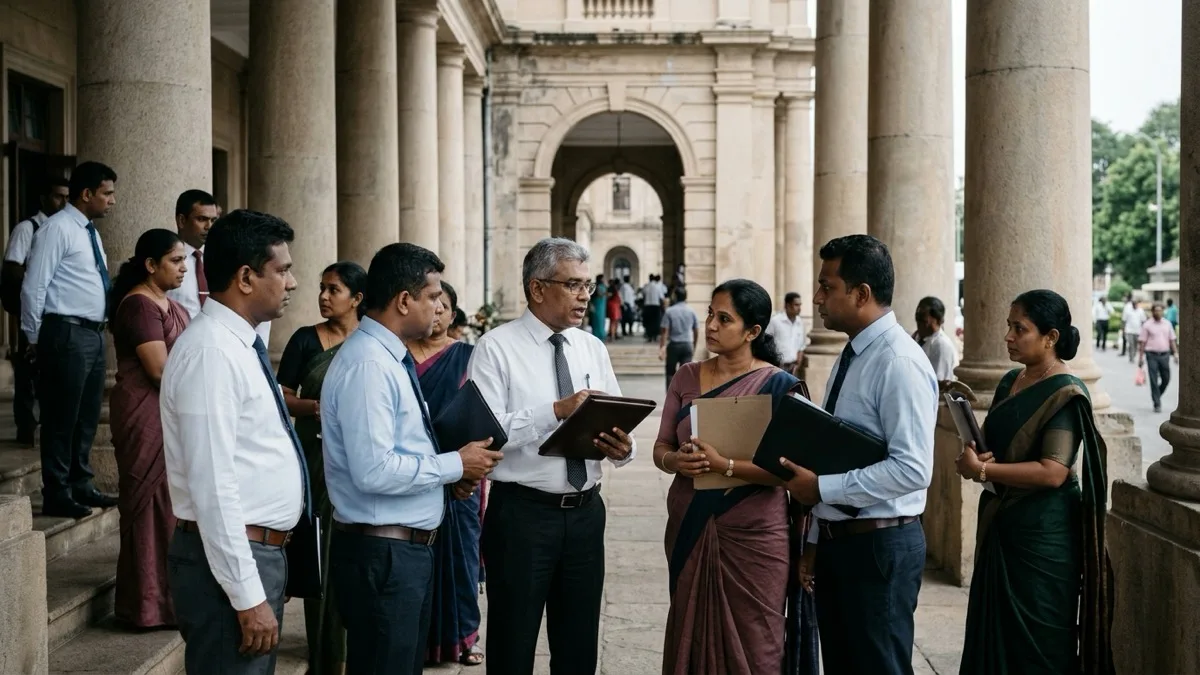
Trade union federations representing educators, state engineers, and agricultural field officers confirmed that thousands of provincial state employees will participate in a coordinated black demonstration next Monday.
Union leaders stated that unaddressed salary anomalies across junior and mid-tier state services have compounded living cost pressures following cumulative rupee depreciation and elevated utility charges over recent quarters.
The demand for an interim LKR 25,000 allowance across roughly 1.3 million state employees would require approximately LKR 32.5 billion in additional recurrent state spending each month, presenting a severe financing challenge for the Ministry of Finance.
Macroeconomic Pressures Confronting Treasury Wage Bill
| Fiscal & Labour Indicator | Current Official Level | Union Demand / Benchmark | Budgetary Variance | Primary Macro Risk |
|---|---|---|---|---|
| Public Sector Workforce | 1.32 Million personnel | Uniform compensation claim | State-wide application | Recurrent expenditure surge |
| Monthly Allowance Request | Existing baseline allowances | LKR 25,000 interim claim | +LKR 32.5 Bn per month | Deficit expansion pressure |
| October Headline Inflation | 8.3% year-on-year | Real purchasing power erosion | Cost-of-living escalation | Secondary wage-price spiral |
| 2027 Primary Surplus Goal | 2.3% of GDP target | Undefined union funding model | Fiscal margin contraction | Sovereign credit rating scrutiny |
| Statutory PFMA Spending Cap | 13.0% of GDP ceiling | 13.6% projected in 2027 | Structural legal limit | PFMA compliance compliance breach |
Statutory PFMA Boundaries and Debt Restructuring Constraints
The Treasury’s ability to accommodate wage concessions is tightly constrained by the Public Finance Management Act (PFMA) of 2024. The statute mandates that primary expenditure must not exceed 13.0% of GDP, with strict penalties for unauthorized supplemental allocations.
Fitch Ratings confirmed earlier on Thursday that Sri Lanka’s 2027 Budget maintains a credible sovereign debt consolidation trajectory precisely because the government committed to a 2.3% primary surplus target.
Granting unbudgeted recurrent wage increases would either force compensatory cuts in public development capital or require new domestic borrowing, potentially destabilizing benchmark Treasury bill yields.
Governance Dilemma and Economic Outlook
The pending Public Sector Wage Protest highlights the delicate political balance facing economic planners. While state workers face genuine living cost increases following the currency adjustments of recent years, macro-stability hinges on non-inflationary public finance management.
Treasury officials are exploring non-cash relief options, including targeted transport subsidies and phased performance-linked restructuring, rather than across-the-board cash allowances.
As the Public Sector Wage Protest approaches on November 23, domestic market participants are monitoring government responses closely, viewing fiscal wage discipline as a critical litmus test for Sri Lanka’s post-restructuring economic program.