

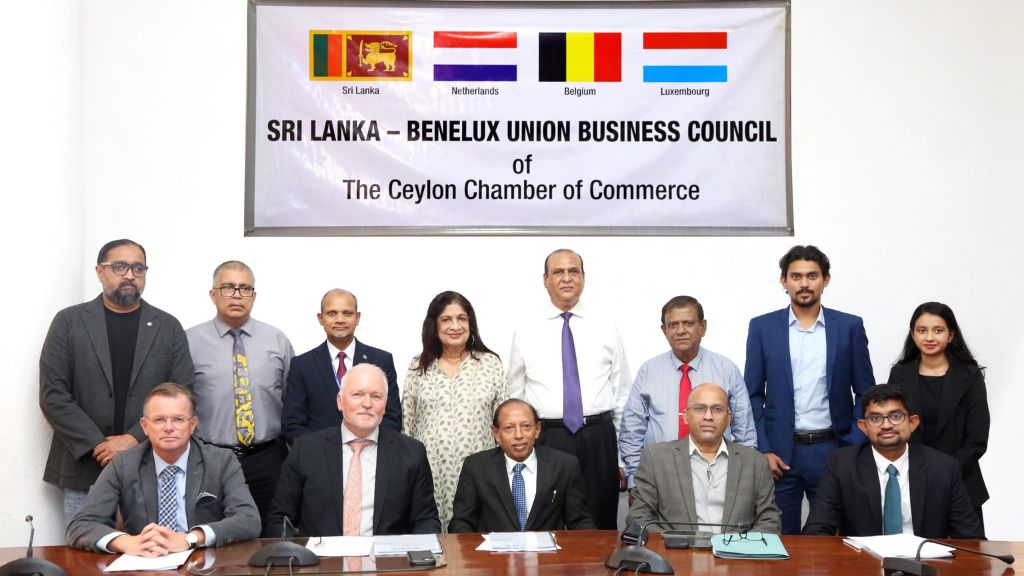
Sri Lanka – Benelux Business Council held its 31st Annual General Meeting, with business and diplomatic leaders calling for stronger trade, investment and export links between Sri Lanka and the Benelux region. Discussions focused on GSP+ access, European market opportunities and emerging areas for cooperation.
Sri Lanka – Benelux Business Council targets stronger trade, investment and export links
The AGM of the Sri Lanka – Benelux Business Council (SLBBC), affiliated with The Ceylon Chamber of Commerce, brought together representatives from the business and diplomatic communities to assess existing economic ties and identify opportunities for expanding bilateral commercial relations.
Chief Guest Wiebe de Boer, Ambassador of the Kingdom of the Netherlands to Sri Lanka and the Maldives, highlighted the continuing importance of the Benelux union as a platform for wider European integration. He also pointed to the Netherlands’ strategic role in connecting Sri Lankan exporters with the Port of Rotterdam, one of Europe’s key trade gateways.
The Ambassador noted that Sri Lanka’s GSP+ access remains in place until 2029, with a two-year period available to reapply under a new regime. He expressed hope that Sri Lanka could eventually move beyond GSP+ towards a comprehensive Free Trade Agreement with the European Union, similar to the EU-India FTA signed this year.
Such an agreement could provide a broader and more predictable framework for Sri Lankan exporters seeking access to European markets. For businesses, the prospect also underlines the importance of improving competitiveness, meeting European standards and addressing regulatory barriers that can affect market access.
De Boer also raised concerns over bureaucratic obstacles facing entrepreneurs, including delays in quality-control clearances and restrictions related to foreign investment caps. His comments highlighted the importance of improving the ease of doing business if Sri Lanka is to attract greater European investment and encourage international companies to expand their local operations.
President of the Council Farhath Amith reaffirmed the Council’s commitment to strengthening Sri Lanka–Benelux trade and investment ties. He called for continued support from the Benelux countries to extend Sri Lanka’s GSP+ status by a further five years, emphasising the importance of maintaining preferential access to European markets for Sri Lankan businesses.
Amith identified several sectors where greater cooperation could generate new opportunities. These included renewable energy, floriculture, agriculture and agro-processing, eco-tourism, the coconut industry and healthcare.
Renewable energy was highlighted against Sri Lanka’s target of generating 70% of its electricity from renewable sources by 2030. Increased cooperation with European partners could support investment, technology transfer and expertise in areas such as clean energy infrastructure and sustainable development.
Agriculture and agro-processing were also identified as areas with significant export potential. The Council President pointed to commodities such as cocoa and vanilla that could potentially benefit from Geographical Indication certification and stronger positioning in international markets.
The issue of GI certification for Sri Lankan spices and agricultural products received particular attention. Amith said the process had progressed slowly over the years, limiting opportunities for Sri Lankan products to establish stronger positions in European markets. He maintained that Sri Lanka’s regulatory and competent authorities had provided the information required by relevant stakeholders, indicating that faster progress could help unlock additional export opportunities.
Floriculture was another sector singled out for development. With the Netherlands serving as a major gateway for the European floriculture industry, Amith argued that Sri Lanka has the potential to become a South Asian hub for tropical ornamental plants and cut foliage. The country’s climate and agricultural base could provide a foundation for expanding this segment, provided production, certification, logistics and market access are strengthened.
The Council also called for a long-awaited business promotion mission to the Netherlands. Such a mission could give Sri Lankan companies an opportunity to establish direct contacts with European buyers, investors and industry partners while showcasing products and investment opportunities.
The AGM also confirmed the Council’s leadership for the 2026/2027 term. Farhath Amith, Director of Fanam International Ltd., was re-elected as President. Shaameel Mohideen of Spillburg Holdings Ltd. was reappointed Senior Vice President, while P.M. Abeysekara of Vinu International Trading Company Ltd. was reappointed Vice President.
Committee members were also elected from Andrew The Travel Company Ltd., MAC Holdings Ltd., Maliban Healthcare Ltd., Propylon One Ltd., Sri Lanka Technology Development Corporate Society and Thames International Educational Consultancy Ltd. Aitken Spence Travels Ltd. was also represented, while Assistant Vice President Sajith Wijenayake will continue as a committee member in his capacity as Immediate Past President.
The AGM comes at a time when Sri Lanka is seeking to expand exports, attract investment and strengthen its integration with international markets. For the Sri Lanka – Benelux Business Council, the priorities outlined at the meeting point towards a broader agenda that combines trade promotion with investment facilitation, regulatory reform and sector-specific cooperation.
The discussions also underline the importance of using existing European market access more effectively. Maintaining GSP+ benefits, advancing GI certification, reducing bureaucratic delays and developing stronger commercial links with the Netherlands could collectively help Sri Lankan businesses increase their presence in the European market.