

Select secondary market maturities push past a 20-basis-point move even as this week’s Treasury bill auction sees yields decline across all tenors
Sri Lanka’s fixed income market delivered a mixed signal on Wednesday, as yields on select longer-dated government bonds in the secondary market rose sharply even as short-term Treasury bill rates fell across the board at the week’s primary auction.
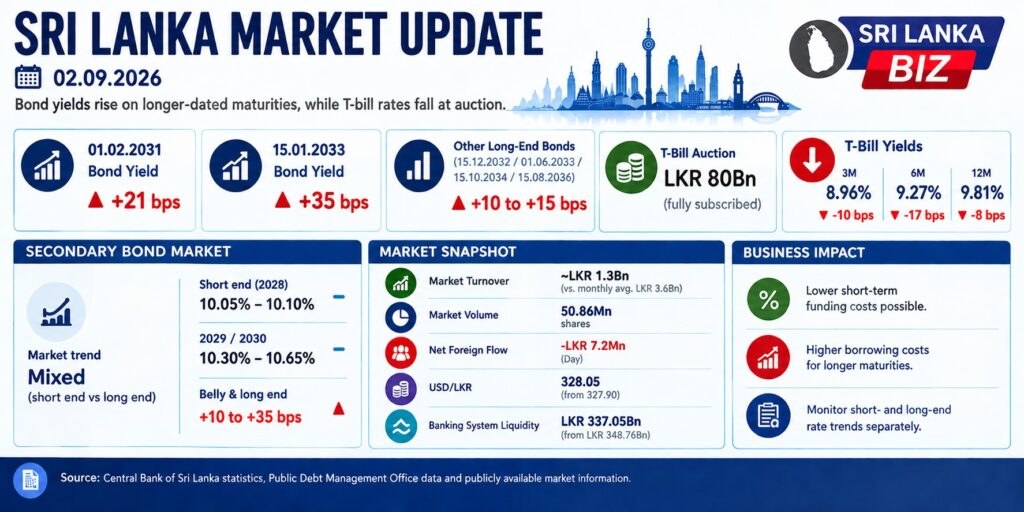
Trading in the secondary bond market was described as moderate, with activity across the curve showing divergent movements rather than a uniform trend. At the short end, maturities due in 2028 traded in a narrow band around 10.05% to 10.10%. Moving further out, bonds maturing in 2029 and 2030 traded broadly between 10.30% and 10.65%.
The more pronounced movement came at the belly and long end of the curve. Two maturities recorded yield shifts exceeding the 20-basis-point threshold that typically signals a meaningful market move: the bond maturing 01.02.2031 rose 21 basis points, while the 15.01.2033 maturity climbed 35 basis points. Other maturities also firmed, though by smaller margins, including the 15.12.2032, 01.06.2033, 15.10.2034 and 15.08.2036 bonds, each moving between 10 and 15 basis points higher.
The moves in secondary market yields stood in contrast to the outcome of the week’s Treasury bill auction, where the Public Debt Management Office raised LKR 80 billion, matching the amount initially offered. All three tenors saw yields decline: the 3-month yield fell 10 basis points to 8.96%, the 6-month yield eased 17 basis points to 9.27%, and the 12-month yield dropped 8 basis points to 9.81%. Bids received across all tenors were accepted in full at the offered amounts.
The divergence — rising yields on select longer-dated secondary bonds against falling short-term auction rates — points to differing pressures at different points on the curve, with the short end continuing to see strong demand while certain longer maturities faced selling pressure.
On the currency front, the rupee depreciated marginally against the US dollar, closing at LKR 328.05 compared to LKR 327.90 previously. Banking system liquidity contracted to LKR 337.05 billion from LKR 348.76 billion in the prior session.
Key Numbers
| Metric | Value |
|---|---|
| 01.02.2031 bond yield | +21 bps |
| 15.01.2033 bond yield | +35 bps |
| 15.12.2032 / 01.06.2033 / 15.10.2034 / 15.08.2036 | +10 to +15 bps each |
| T-Bill auction size | LKR 80Bn (fully subscribed at offer) |
| 3M T-Bill yield | 8.96% (-10 bps) |
| 6M T-Bill yield | 9.27% (-17 bps) |
| 12M T-Bill yield | 9.81% (-8 bps) |
| USD/LKR | 328.05 (from 327.90) |
| Banking system liquidity | LKR 337.05Bn (from LKR 348.76Bn) |
Business Impact
The decline in short-term Treasury bill yields may translate into marginally lower short-term funding costs for businesses and financial institutions that benchmark against government securities rates. However, the rise in yields on select longer-dated bonds suggests that borrowing costs tied to longer maturities could face upward pressure, a relevant consideration for businesses and institutions planning longer-term debt issuance or refinancing. The contrasting moves across the curve underscore the importance of monitoring both short- and long-end rate trends separately rather than assuming a uniform direction for borrowing costs.
Source Attribution
Source: Central Bank of Sri Lanka statistics, Public Debt Management Office data and publicly available market information.