

Sri Lanka rupee traded firmer at 328.20/30 against the US dollar in the spot market on Friday, while government bond yields moved slightly higher across several maturities, dealers said.
Sri Lanka rupee strengthens against the dollar as government bond yields edge higher
The Sri Lanka rupee strengthened modestly against the US dollar on Friday, with spot market quotations improving from 328.45/60 a day earlier to 328.20/30. The movement came alongside a marginal increase in government securities yields, indicating continued activity in both the foreign exchange and domestic bond markets.
The latest currency quotation suggests a relatively stable trading environment for the rupee, with the local currency gaining ground against the dollar compared with the previous session. While the daily movement was limited, exchange-rate developments remain closely watched by investors and businesses because of their implications for import costs, inflation, external payments and broader financial conditions.
In the government securities market, yields were quoted higher across several longer-dated maturities. The bond maturing on May 15, 2030 was quoted at 10.45/55 percent, while the October 15, 2030 maturity was quoted at 10.73/78 percent, compared with 10.68/75 percent previously.
The bond maturing on October 1, 2032 was quoted at 11.05/15 percent, while the January 15, 2033 maturity was quoted at 11.20/30 percent. Further along the curve, the October 15, 2034 bond was quoted at 11.75/80 percent, up from 11.65/75 percent, while the August 15, 2036 maturity was quoted at 11.83/90 percent, compared with 11.80/90 percent previously.
The increase in Sri Lanka bond yields was relatively modest but was visible across several maturities, particularly in the longer end of the government securities curve. Bond yields are closely monitored because they influence borrowing costs, investment returns and expectations surrounding future monetary and fiscal conditions.
The latest foreign exchange rates also showed movements in major international currencies against the Sri Lankan rupee. The telegraphic transfer rate for the US dollar stood at 323.90 for buying and 332.90 for selling. The euro was quoted at 374.3715 buying and 388.1523 selling, while the pound sterling was quoted at 437.4812 buying and 451.5896 selling.
The difference between spot market quotations and bank telegraphic transfer rates reflects the different pricing mechanisms and transaction conditions applicable to foreign exchange dealings. For businesses engaged in international trade, movements in these rates remain important for determining the rupee value of imports, exports and other foreign currency transactions.
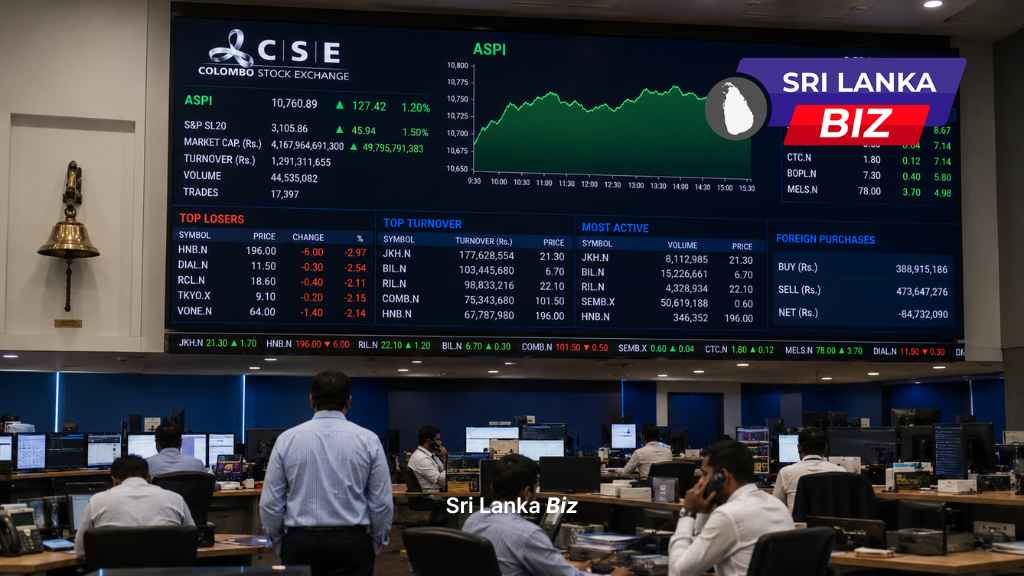
Meanwhile, equities on the Colombo Stock Exchange moved higher during Friday’s trading session. The All Share Price Index (ASPI) gained 0.32 percent, or 67.83 points, to close at 21,462. The S&P SL20 index also advanced, rising 0.46 percent, or 27.68 points, to 6,022.
The simultaneous movement across the currency, bond and equity markets provides a broader snapshot of Sri Lanka’s financial market conditions. The firmer rupee points to relative stability in the foreign exchange market, while higher bond yields indicate some upward pressure on government securities pricing. At the same time, gains in equity benchmarks suggest positive sentiment among stock market investors.
For businesses and investors, the direction of the Sri Lanka rupee remains an important indicator as the country continues to manage its external position and broader economic recovery. Currency stability can help improve predictability for importers and other businesses exposed to foreign exchange movements, while changes in bond yields can influence portfolio allocation between fixed-income and equity investments.
Friday’s market movements were relatively measured, but the combination of a firmer currency, higher government bond yields and gains in equities highlights the importance of monitoring developments across Sri Lanka’s financial markets rather than viewing each market in isolation.