


Rates fell between 8 and 17 basis points across the 91-day, 184-day and 364-day tenors, extending a downward trend in short-term government borrowing costs
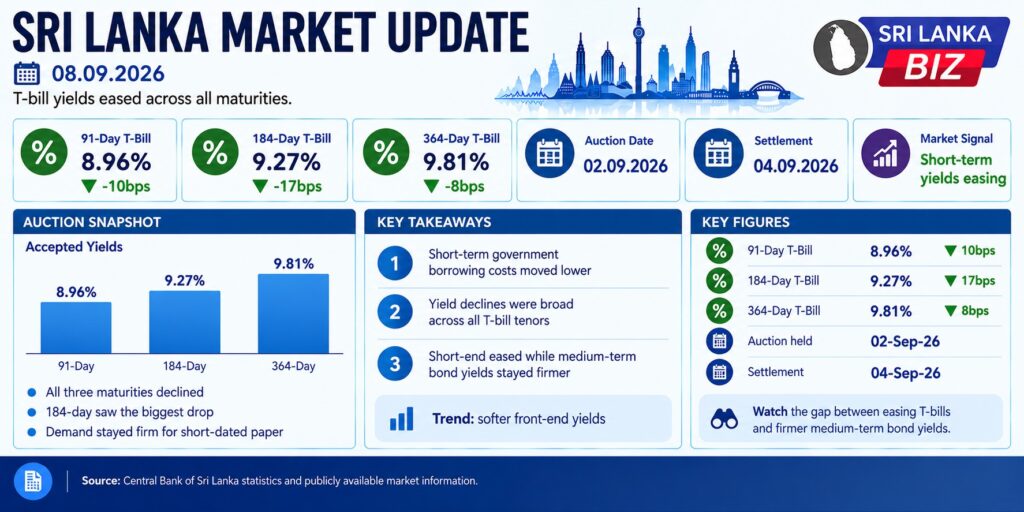
Yields on Sri Lankan Treasury bills declined across all three maturities at the latest primary auction, continuing a recent softening trend in short-term government borrowing costs.
At the auction held on 2 September and settled on 4 September, the 91-day bill was accepted at a yield of 8.96%, down 10 basis points from the previous auction. The 184-day bill saw the largest decline, accepted at 9.27%, down 17 basis points. The 364-day bill was accepted at 9.81%, down 8 basis points.
The uniform decline across all tenors suggests steady demand for short-dated government paper, even as yields on medium-term bonds in the secondary market have moved in the opposite direction, rising over the past week. The divergence points to differing dynamics between the short and medium segments of the yield curve, with short-term rates easing while three-to-nine-year bonds have seen yields climb.
A further T-bill auction was scheduled for settlement on 4 September, with results for the 91-day, 184-day and 364-day tenors again reflecting yields of 8.96%, 9.27% and 9.81% respectively, matching the prior auction’s accepted levels.
Key Numbers
| Tenor | Accepted Yield | Change |
|---|---|---|
| 91-day T-bill | 8.96% | -10 bps |
| 184-day T-bill | 9.27% | -17 bps |
| 364-day T-bill | 9.81% | -8 bps |
| Auction date | 2-Sep-26 | Settlement: 4-Sep-26 |
Business Impact
Lower T-bill yields translate into reduced short-term borrowing costs for the government and can influence pricing on short-tenor corporate instruments, money market fund returns, and bank deposit rates linked to government securities. For businesses relying on short-term working capital facilities or holding money market fund investments, the softening trend may gradually feed through to lower short-term lending and deposit rates. The contrast with rising medium-term bond yields is worth watching, as it suggests the market is pricing near-term conditions differently from the three-to-nine-year outlook.
Source Attribution
Source: Central Bank of Sri Lanka statistics and publicly available market information.