

Secondary market yields for government securities maturing from 2030 to 2037 have declined by as much as 60 basis points over the past week, even as the latest T-Bill auction priced slightly higher.
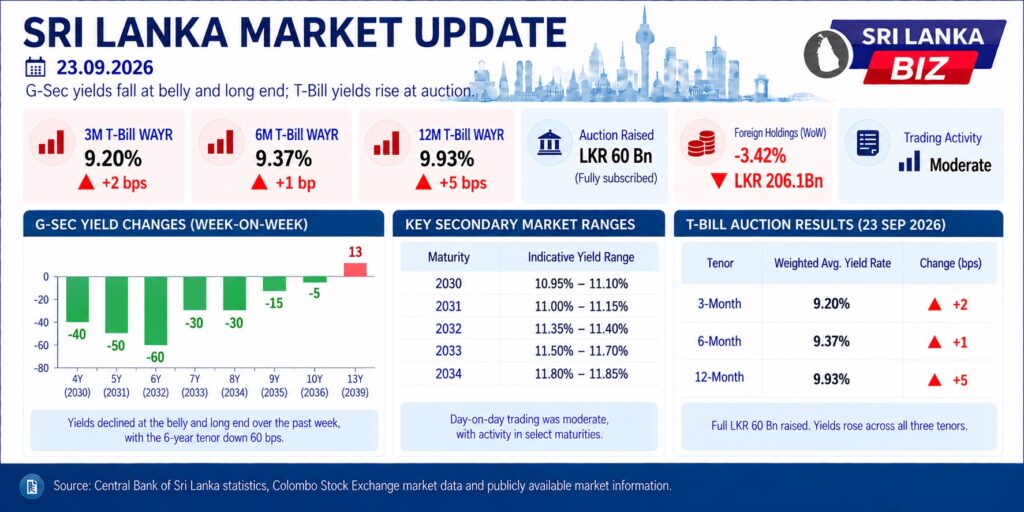
Yields on Sri Lanka’s government securities have declined meaningfully at the belly and long end of the curve over the past week, even as day-on-day trading on Wednesday showed only modest movement.
Comparing indicative bid yields between September 16 and September 23, the shift is most pronounced in the medium-to-long tenors. The 4-year maturity (August 2030) saw its bid yield fall 40 basis points over the week, while the 5-year (May 2031) declined 50 basis points and the 6-year (October 2032) dropped 60 basis points — the largest weekly move on the curve. Yields on the 7-year and 8-year maturities each eased 30 basis points over the same period, while the 9-year and 10-year tenors declined 15 and 5 basis points respectively.
Shorter-dated paper showed comparatively little change on a weekly basis, with yields on tenors under two years largely flat to marginally higher. At the very long end, the 13-year maturity (August 2039) rose 13 basis points over the week, a divergence from the broader downward trend seen through the belly of the curve.
Day-on-day, secondary market activity was described as moderate, with trading concentrated in specific maturities. The 2030 maturities traded between 10.95% and 11.10%, the 2031 maturity between 11.00% and 11.15%, and the 2032 maturity between 11.35% and 11.40%. Bonds maturing in 2033 traded in a 11.50%–11.70% band, while the 2034 maturity traded between 11.80% and 11.85%.
Separately, the Public Debt Management Office concluded its weekly Treasury Bill auction on Wednesday, raising the full LKR 60 billion offered across three tenors. The weighted average yield rate rose 2 basis points to 9.20% on the 3-month bill, 1 basis point to 9.37% on the 6-month bill, and 5 basis points to 9.93% on the 12-month bill. The 3-month and 6-month bills were accepted below the amounts offered, while the 12-month bill was accepted at less than the amount offered as well.
Foreign holdings of rupee-denominated government securities declined 3.42% week-on-week, according to the latest data.
Business Impact
The pullback in medium-to-long-term yields is a relevant signal for corporates and institutions pricing long-dated borrowing or considering fixed income allocations, suggesting some easing in longer-term rate expectations even as short-term T-Bill rates edged higher. The divergence between a softer secondary market curve and a firmer primary auction result is worth monitoring in the weeks ahead, particularly for businesses using T-Bill rates as a benchmark for short-term credit costs.
Key Numbers
| Tenor | Week-on-Week Change |
|---|---|
| 4-Year (Aug 2030) | -40 bps |
| 5-Year (May 2031) | -50 bps |
| 6-Year (Oct 2032) | -60 bps |
| 7-Year (Nov 2033) | -30 bps |
| 8-Year (Oct 2034) | -30 bps |
| 13-Year (Aug 2039) | +13 bps |
| 3M T-Bill WAYR | 9.20% (+2 bps day-on-day) |
| 6M T-Bill WAYR | 9.37% (+1 bp day-on-day) |
| 12M T-Bill WAYR | 9.93% (+5 bps day-on-day) |
| T-Bill Auction Raised | LKR 60 Bn (fully subscribed) |
Source: Central Bank of Sri Lanka statistics, Colombo Stock Exchange market data and publicly available market information.