

The Role of Equity Insurance in Enhancing Investor Confidence and Sustainable Stock Market Development is gaining attention as financial experts explore innovative ways to reduce investment risk and encourage broader participation in capital markets. A proposed equity insurance model seeks to provide investors with downside protection while preserving the long-term growth potential of stock investments.
The Role of Equity Insurance in Enhancing Investor Confidence and Sustainable Stock Market Development
Stock markets serve as organised platforms where companies raise capital and investors buy and sell ownership stakes through listed shares. Unlike fixed-income investments, equity investments do not guarantee returns. Shareholders receive dividends only when they are declared by a company’s board of directors and approved by shareholders, making equity investing inherently more volatile but also offering greater long-term return potential.
However, stock markets are highly sensitive to a wide range of economic, political and corporate developments. Factors such as interest rates, inflation, exchange rate movements, taxation, regulatory reforms, geopolitical conflicts, natural disasters and company performance can significantly influence share prices. Recent global events, including changes in international trade policies and geopolitical tensions in the Middle East, have demonstrated how quickly investor sentiment can shift, triggering market volatility.
Against this backdrop, Equity insurance has been proposed as an innovative financial product designed to reduce downside risk while strengthening investor confidence. The concept introduces an insurance-based protection mechanism that allows investors to insure selected listed shares against substantial declines in market value.
The proposal argues that although market risk can never be eliminated entirely, structured risk-management solutions can reduce perceived investment risk and encourage more individuals and institutions to participate in equity markets.
Under the proposed model, investors would purchase insurance coverage for selected shares by paying a premium to an insurance company. In return, the insurer would guarantee a predetermined insured value, effectively establishing a minimum buy-back price for those shares.
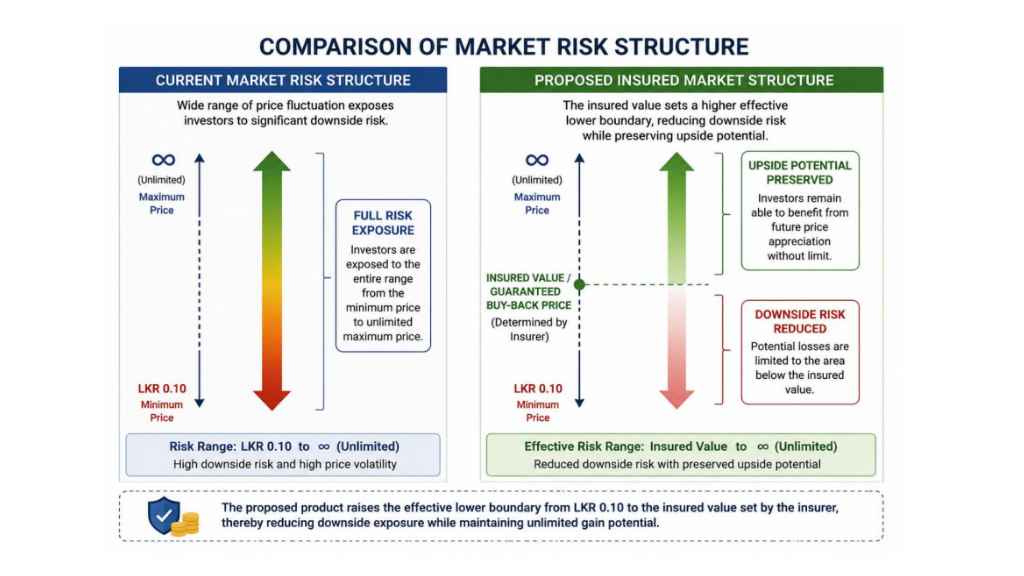
If market prices fall below the agreed insured value because of adverse economic or market conditions, investors would have the option, subject to policy terms and conditions, to sell their shares back to the insurer at the insured price. This mechanism would provide protection against extreme market declines while allowing investors to retain exposure to future price appreciation.
The proposal highlights the current structure of the Colombo Stock Exchange, where listed shares have no theoretical upper price limit but may fall to the minimum tradable price of Rs. 0.10. This creates significant downside risk for investors, particularly during periods of severe market uncertainty.
By introducing an insured value above the minimum market price, the proposed equity insurance framework would effectively establish a protective price floor. Investors would continue to benefit from unlimited upside potential while reducing the financial impact of major market downturns.
According to the proposal, the objectives of the product extend beyond investor protection. It also aims to strengthen overall capital market participation, improve confidence among retail and institutional investors, and create an entirely new business segment for Sri Lanka’s insurance industry.
To ensure transparency and market integrity, the proposal recommends establishing a Share and Equity Valuation Committee comprising representatives from the Central Bank, Securities and Exchange Commission, Colombo Stock Exchange, licensed stockbrokers, the Insurance Regulatory Authority and insurance companies.
This committee would review and approve the insured values proposed by insurance companies using recognised valuation methodologies. Such oversight would help ensure that insured prices remain consistent with market fundamentals while preventing excessive risk-taking.
The proposal also recognises that different insurance companies may offer varying insured values for the same listed company. Differences in valuation models, risk appetite and market expectations could create competition among insurers, allowing investors to select policies that best suit their investment objectives and risk tolerance.
Beyond protecting investors, supporters believe the concept could contribute to the long-term development of Sri Lanka’s capital markets. Reduced downside risk may encourage greater retail participation, improve liquidity, strengthen market resilience and support more sustainable capital formation for listed companies.
While the concept would require careful regulatory design, actuarial analysis and financial safeguards before implementation, The Role of Equity Insurance in Enhancing Investor Confidence and Sustainable Stock Market Development presents an innovative perspective on integrating insurance principles into capital markets. If successfully developed, Equity insurance could become a valuable risk-management tool that benefits investors, insurers and the broader Colombo Stock Exchange, supporting the continued evolution of Sri Lanka’s financial sector.
Author:
Sameera Jayathilaka
MBA, PG.Dip. in Marketing, MSLIM, MCPM, MAPIEM, MFMA
Certified Professional Marketer (Asia) | Practicing Marketer (Sri Lanka)