

Wider sell-off in medium-term maturities pushes yields up by as much as 60 basis points, as trading activity intensifies in the secondary bond market
Yields on Sri Lanka’s government bonds rose broadly during the week, with the sharpest increases concentrated in medium-term maturities as trading volumes picked up in the secondary market.
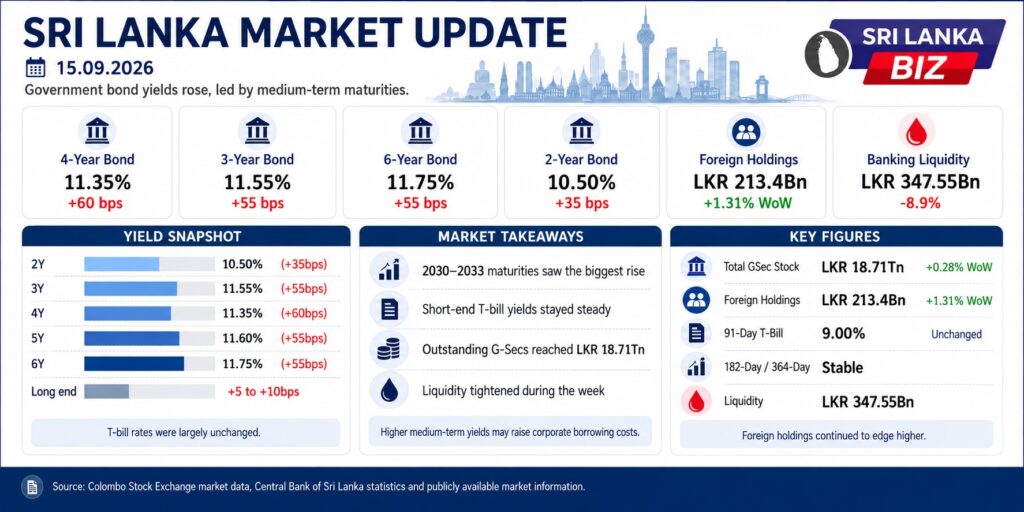
The 2030 to 2033 maturity segment saw the most pronounced movement. Bonds maturing in August 2030 climbed to a range of 11.35% from 10.75% a week earlier, a rise of 60 basis points. Similar increases were recorded across neighbouring maturities: the September 2029 series rose 55 basis points to 11.55%, the October 2032 bond gained 55 basis points to 11.75%, and the May 2031 maturity added 55 basis points to reach 11.60%.
Shorter and longer-dated bonds also moved higher, though by smaller margins. The December 2028 bond, at the shorter end of the curve, rose 35 basis points to 10.50%, while longer maturities toward 2039 posted more modest gains of 5 to 10 basis points.
At the very short end of the market, Treasury bill rates were largely unchanged. Rates on 91-day, 182-day and 364-day instruments held steady week-on-week, indicating that the yield movement was concentrated in belly and long-end government paper rather than across the full curve.
Total outstanding government securities stood at LKR 18.71 trillion, up 0.28% for the week, with Treasury bonds accounting for the large majority of that stock. Foreign holdings of government securities continued to rise, reaching LKR 213.4 billion, up 1.31% for the week and part of a steady increase over recent weeks.
Separately, banking system liquidity contracted to LKR 347.55 billion from LKR 381.40 billion previously, a tightening that coincided with the week’s bond market activity. As a single-session change, this should be read as an early signal rather than a confirmed trend, and will bear watching over the coming sessions.
Key Numbers
| Metric | This Week | Previous | Change |
|---|---|---|---|
| 4-Year bond (Aug 2030) | 11.35% | 10.75% | +60 bps |
| 3-Year bond (Sep 2029) | 11.55% | 11.00% | +55 bps |
| 6-Year bond (Oct 2032) | 11.75% | 11.20% | +55 bps |
| 2-Year bond (Jul 2028) | 10.50% | 10.15% | +35 bps |
| 91-Day T-Bill | 9.00% | 9.00% | Unchanged |
| Total outstanding G-Secs | LKR 18.71 Tn | — | +0.28% WoW |
| Foreign holdings of G-Secs | LKR 213.4 Bn | LKR 210.7 Bn | +1.31% WoW |
| Banking system liquidity | LKR 347.55 Bn | LKR 381.40 Bn | -8.9% |
Business Impact
Rising medium-term yields translate directly into higher benchmark rates for corporate borrowing, project financing and fixed-rate lending tied to government securities. Businesses planning debt issuance or renegotiating credit facilities in the coming weeks may face a higher cost of capital than they would have a week ago. The steady rise in foreign holdings of government securities suggests continued external interest in Sri Lankan rupee debt, a factor that can support currency stability, though this should be weighed alongside the tightening in banking system liquidity, which could affect short-term funding conditions for businesses reliant on bank credit.
Source Attribution
Source: Colombo Stock Exchange market data, Central Bank of Sri Lanka statistics and publicly available market information.