

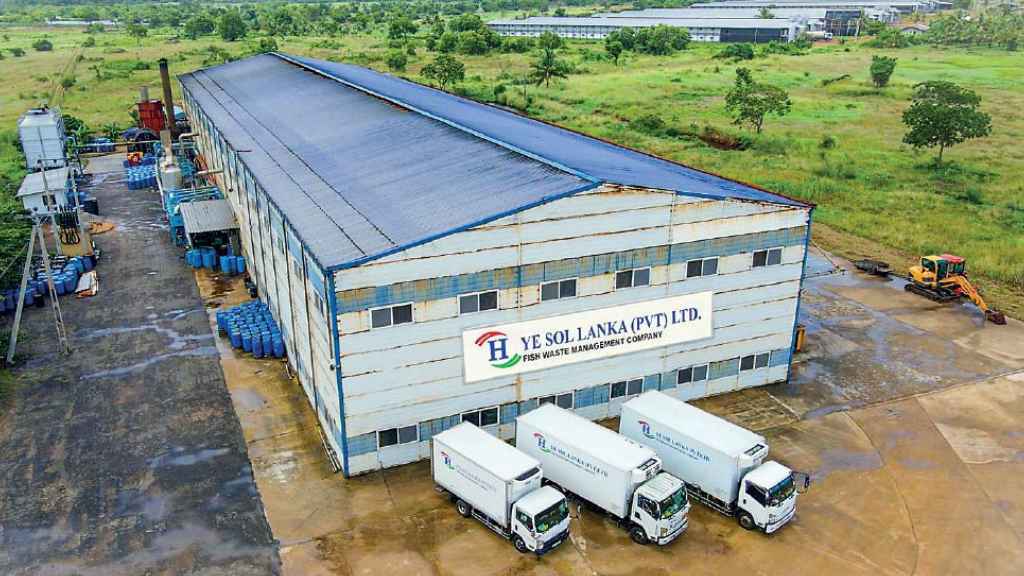
Yesol Lanka is transforming discarded fish waste into a thriving export business, demonstrating how sustainable innovation and value addition can generate foreign exchange, create jobs and reduce environmental pollution in Sri Lanka.
Yesol Lanka transforms discarded fish waste into global export opportunities from Sri Lanka
What was once considered an environmental burden along Sri Lanka’s coastline has become a profitable export industry through a Board of Investment (BOI)-approved venture in Madurankuliya, Puttalam. Yesol Lanka has built a business around converting fish-processing waste into internationally traded animal feed ingredients, creating economic value from material that previously ended up in landfills or was dumped into the sea.
The company was founded by entrepreneur Vijitha Kumara Rajapaksa, who spent a decade working in South Korea after leaving Sri Lanka as an unskilled migrant worker. During his time with the Hantech Group, a leading animal feed manufacturer operating across South Korea, Vietnam, Indonesia and India, Rajapaksa gained extensive experience in processing discarded fish waste into valuable feed ingredients. Inspired by the industry’s success overseas, he returned to Sri Lanka determined to establish a similar operation while attracting foreign investment and modern technology.
Before the project was launched, discarded fish heads, skins, viscera and other by-products from fish processing created serious environmental challenges across the country. Fish markets and dried fish producers often disposed of waste without organised collection systems, leaving local authorities to manage costly clean-up operations while coastal communities dealt with pollution.
Recognising both the environmental and commercial potential of fish waste recycling, Rajapaksa submitted a proposal to BOI Sri Lanka to collect fish-processing waste from across the island, convert it into raw materials for animal feed and export the finished products. The proposal received swift approval after officials identified multiple national benefits, including reducing environmental pollution, generating export earnings, creating employment and providing an additional source of income for fishermen and waste collectors.
Backed by a US$3 million investment, Yesol Lanka established its production facility on a 50-acre site in Madurankuliya. The factory currently employs 45 people directly while supporting significant indirect employment throughout its collection network. Fishermen and waste collectors are now paid between Rs. 20 and Rs. 30 per kilogram for material that previously had little or no commercial value.
The facility has an installed processing capacity of 100 metric tonnes of fish waste per day, although Sri Lanka currently collects between 50 and 70 metric tonnes daily. Advanced machinery processes up to 15 tonnes of raw material at temperatures of 120 degrees Celsius, while every production batch undergoes laboratory testing to ensure compliance with international quality standards.
Today, Yesol Lanka exports between 30,000 and 35,000 metric tonnes of fish meal, fish oil and fish paste annually, generating approximately US$2 million to US$2.5 million in foreign exchange each year. Among its international customers is CP Company of Vietnam, one of the world’s leading shrimp farming enterprises. The company has also achieved 100% Green Project status by replacing conventional export packaging with recyclable intermediate bulk containers and reusable plastic pallets.
The company’s success reflects growing global demand for sustainable marine ingredients. According to BOI analysis, the global fishmeal and fish oil market is valued at nearly US$9.9 billion in 2026 and is projected to expand to approximately US$19.1 billion by 2036, driven by rising aquaculture production, premium pet food demand and circular economy policies. Meanwhile, the global aquafeed market is forecast to grow from US$67.7 billion in 2026 to US$97.1 billion by 2031.
Sri Lanka’s fishing industry also presents significant untapped potential. The country lands between 480,000 and 530,000 metric tonnes of fish annually, generating substantial volumes of processing waste. However, less than three percent of the national catch is currently exported as processed marine ingredients. Industry experts believe producers can substantially increase export earnings by moving beyond conventional fishmeal into higher-value certified products such as fish protein hydrolysates and premium pet food ingredients.
Rajapaksa believes Sri Lanka’s youth should look beyond traditional career paths and pursue innovative export-oriented businesses that create sustainable value for the country. As BOI Sri Lanka continues promoting investment in circular economy industries, the success of Yesol Lanka demonstrates how environmental challenges can be transformed into globally competitive businesses that generate employment, support coastal communities and strengthen Sri Lanka’s export economy.