

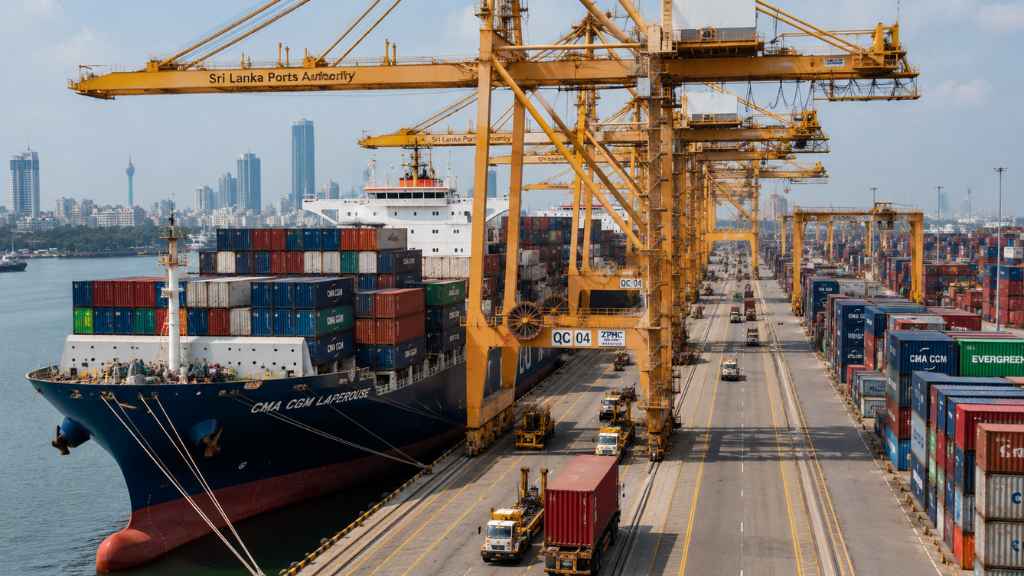
German businesses eye Sri Lanka as strategic hub as policymakers, investors, and business leaders from Germany call for deeper economic cooperation, faster reforms, and stronger investment facilitation to unlock new opportunities between the two countries.
German businesses eye Sri Lanka for trade, logistics and investment growth
The message emerged at the Sri Lankan-German Business Forum 2026 in Colombo, where participants highlighted Sri Lanka’s strategic location, skilled workforce, and growing potential as a regional trade and logistics center amid changing global economic conditions.
German business leaders and government representatives identified Sri Lanka as an increasingly important partner in the Indo-Pacific region, particularly as companies seek to diversify operations and strengthen global trade networks. The forum, themed “Building Trusted Partnerships,” brought together 40 German delegates alongside Sri Lankan business leaders, policymakers, and investors to explore avenues for collaboration.
German Ambassador to Sri Lanka Dr. Felix Neumann said Germany was actively seeking reliable international partners that support free trade, multilateral cooperation, and predictable governance. He noted that Sri Lanka’s position in the Indian Ocean provides a significant advantage for East-West trade connectivity, making it an attractive destination for future commercial engagement.
According to Dr. Neumann, Sri Lanka is well-positioned to become a stronger partner for German industry as global companies look to reduce dependence on single markets and build more diversified operational networks. He also highlighted Germany’s longstanding contribution to Sri Lanka’s vocational education sector, which has helped strengthen the country’s skilled labour force over several decades.
At the same time, the Ambassador stressed that further progress is needed in improving the ease of doing business. He identified policy consistency, anti-corruption measures, and modernization of company registration systems as key factors that could enhance investor confidence and attract greater levels of foreign investment.
“Predictability is important in doing business,” Dr. Neumann said, emphasizing the need for a stable and transparent regulatory environment.
Delegation of German Industry and Commerce in Sri Lanka (AHK Sri Lanka) Chief Delegate Martin Klose said the forum was designed to move beyond dialogue and create tangible business outcomes. He encouraged participants to actively explore new opportunities and build stronger partnerships between Sri Lankan and German enterprises.
Klose pointed to significant opportunities in maritime industries, logistics, infrastructure development, and export trade facilitation. He stressed that sustained engagement and practical collaboration would be essential in transforming discussions into long-term business relationships that benefit both economies.
German Chamber of Commerce and Industry (DIHK) Managing Director for International Economic Relations Dr. Nicole Renvert highlighted the increasing importance of resilient supply chains in today’s uncertain global environment. She noted that geopolitical tensions and disruptions to international trade routes have prompted companies worldwide to rethink sourcing strategies and diversify operational risks.
“Building resilient and diversified supply chains has become vital,” she said.
Dr. Renvert explained that Sri Lanka’s maritime location, logistics capabilities, and skilled workforce offer significant advantages for German companies seeking alternative markets and strategic partners. She identified sectors such as renewable energy, green technology, energy efficiency, logistics, and maritime services as areas with strong potential for future cooperation.
She also emphasized the importance of transparent business processes, streamlined regulations, and stronger vocational training systems to support long-term economic growth and investment.
Federal Ministry for Economic Affairs and Energy (BMWE) Head of Division for South and Southeast Asia Tobias Pierlings echoed similar views, describing Sri Lanka as a strategically positioned gateway connecting Europe, Africa, and Asia.
He noted that geopolitical developments have increased the importance of reliable trade corridors and diversified logistics networks. Against this backdrop, Germany and the European Union are seeking transparent, mutually beneficial, and long-term partnerships with countries that can support sustainable economic cooperation.
Pierlings also reaffirmed Germany’s support for Sri Lanka’s economic recovery efforts and ongoing reforms aimed at improving the investment climate. He encouraged Sri Lankan businesses to participate in future investment and business forums in Germany to further strengthen bilateral engagement.
German Asia-Pacific Business Association (OVA) Executive Member Almut Rößner said bilateral business relations had gained fresh momentum through increased political engagement and private-sector collaboration. She urged businesses on both sides to capitalize on this positive momentum and pursue new partnerships across key sectors.
Rößner identified renewable energy, maritime logistics, tourism, infrastructure, and agriculture as areas attracting growing German investor interest. She also praised the resilience demonstrated by Sri Lankan businesses despite recent economic challenges and global uncertainties.
The forum concluded with a strong message that Sri Lanka’s strategic location, improving economic outlook, and commitment to reforms continue to attract international attention. As German businesses eye Sri Lanka as strategic hub for trade and investment, stakeholders believe that stronger partnerships, improved policy consistency, and enhanced investor confidence can help unlock significant opportunities for both nations in the years ahead.