

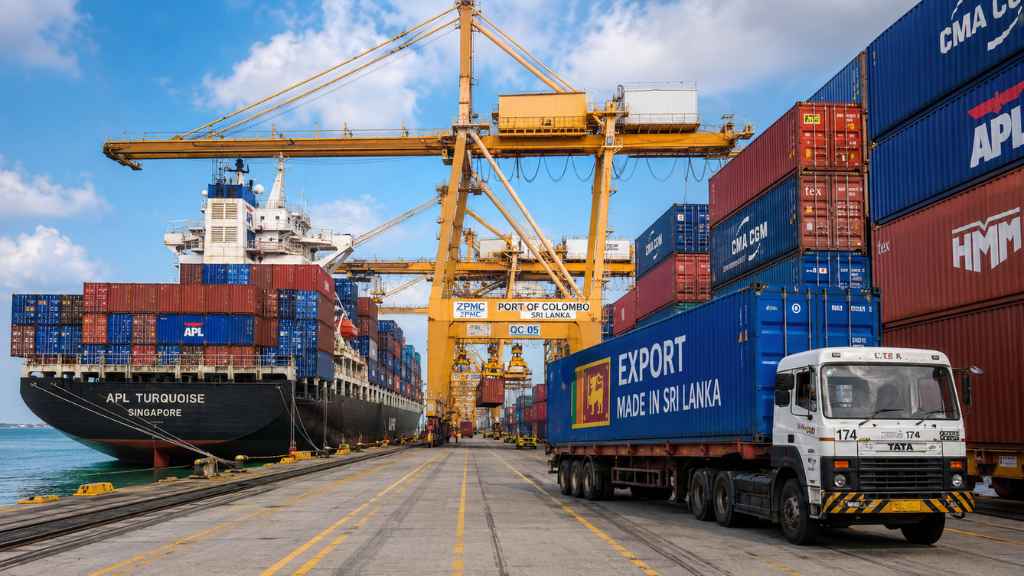
National Export Development Plan was officially launched by Sri Lanka with an ambitious target of generating USD 36 billion in export revenue by 2030, marking a renewed effort to transform the country into an export-led, competitive economy over the next five years.
National Export Development Plan sets Sri Lanka’s export roadmap for 2026–2030
The Cabinet-approved National Export Development Plan (NEDP) 2026–2030 has been jointly developed by the Ministry of Industry and Entrepreneurship Development and the Sri Lanka Export Development Board (EDB), with technical assistance from the Asian Development Bank (ADB). The strategy outlines a comprehensive roadmap to strengthen Sri Lanka’s export sector through diversification, value addition, improved competitiveness, and policy reforms.
The five-year framework seeks to position Sri Lanka as a regional logistics and knowledge-intensive hub while creating a more resilient and sustainable export economy. The plan also aims to improve the country’s ability to compete in global markets by encouraging innovation, expanding high-value exports, and strengthening institutional support for exporters.
Speaking at the launch, Minister of Industry and Entrepreneurship Development Sunil Handunnetti stressed the importance of maintaining policy consistency, transparency, and long-term commitment to achieving the country’s export ambitions. He noted that sustained implementation would be critical to ensuring the success of the new strategy.
The latest initiative comes after previous export strategies fell short of their intended targets due to unforeseen economic challenges. The National Export Strategy (NES) 2018–2022 had targeted USD 28 billion in export earnings but generated only around USD 16 billion, largely because of the COVID-19 pandemic and the severe macroeconomic crisis that affected Sri Lanka’s economy.
Likewise, the country’s 2011–2015 strategic export plan aimed to achieve USD 15 billion in exports but concluded with approximately USD 10.5 billion in merchandise exports. Authorities believe the lessons learned from these earlier strategies have helped shape a more practical and implementation-focused framework for the coming five years.
The National Export Development Plan is built around six cross-sector enablers designed to improve the overall business environment while addressing structural constraints affecting exporters. These include reforms in trade facilitation, logistics, regulatory processes, innovation, skills development, investment promotion, and institutional coordination.
The strategy also identifies eight priority sectors expected to drive export diversification and higher value addition over the medium term. These sectors include Auto Components, Mineral-Based Industries, Rubber-Based Industries, Marine-Based Industries, Spices & Concentrates, Digital Products & Services, Electrical & Electronic Components, and Processed Food & Beverages.
By focusing on these industries, the government expects to increase export competitiveness, encourage technology adoption, and expand access to international markets while reducing dependence on a limited range of traditional export products.
Sri Lanka Export Development Board (EDB) Chairman and Chief Executive Officer Mangala Wijesinghe said the plan addresses several longstanding barriers faced by exporters, including trade logistics, customs digitization, regulatory efficiency, and quality compliance.
He added that the strategy places significant emphasis on strengthening Sri Lanka exports by helping small and medium-sized enterprises (SMEs) become export-ready and better integrated into global value chains. Expanding SME participation is expected to play a key role in broadening the country’s export base and supporting regional economic development.
“We are launching a shared national commitment to building a stronger, more competitive and export-driven Sri Lankan economy,” Wijesinghe said, highlighting the collaborative approach behind the new national strategy.
With clear sector priorities, institutional reforms, and measurable long-term targets, the National Export Development Plan represents Sri Lanka’s latest attempt to accelerate export growth, attract investment, and strengthen the country’s position in international trade as it works toward achieving USD 36 billion in export earnings by 2030.