

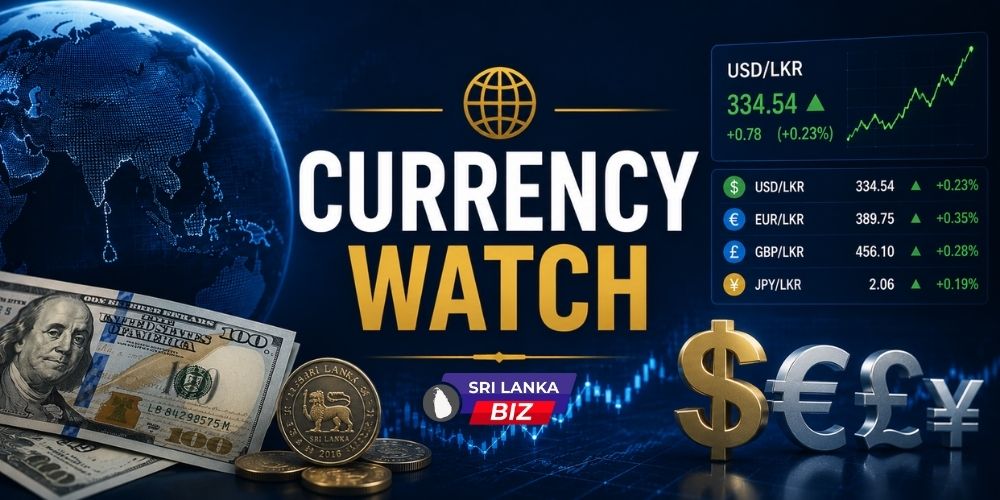
The rupee recorded its sharpest single-session decline in recent weeks on June 25, extending a three-session depreciation run that has now moved the exchange rate from 333.76 to 336.57.
The Sri Lankan rupee depreciated sharply against the US dollar on June 25, 2026, with the USD/LKR rate moving to 336.57 from 334.77 recorded in the previous session. The single-session move of 1.80 rupees represents the most significant daily currency shift recorded in the current week and extends a run of consecutive sessions of rupee weakness.
The depreciation follows two earlier sessions of modest softening. The USD/LKR rate stood at 333.76 on June 23, moved to 334.54 on June 24, and has now reached 336.57 on June 25. Across three sessions, the rupee has lost 2.81 rupees against the dollar, a cumulative move that businesses with dollar-denominated obligations will need to factor into their near-term cost calculations.
The June 25 move was notably larger than the prior two sessions combined. The 1.80 rupee single-day shift suggests that selling pressure on the rupee intensified during the session rather than representing a continuation of the gradual drift seen earlier in the week.
The depreciation occurred on a day when the broader equity market staged a strong recovery, with the ASPI gaining 198 points to close at 22,407.04 and market turnover returning to the monthly average at LKR 2,729.93 million. The rupee weakness therefore cannot be attributed to broad risk-off sentiment in local financial markets, as domestic equity conditions improved significantly on the same day.
Foreign investor activity on the Colombo Stock Exchange on June 25 showed a net outflow of LKR 50.32 million, a notable narrowing from LKR 130.65 million the prior session. The reduced pace of foreign equity selling means that foreign outflow pressure alone does not fully explain the scale of the rupee move, pointing to demand-side factors in the foreign exchange market as a more likely driver.
Banking system excess liquidity expanded to LKR 65.36 billion from LKR 61.04 billion in the prior session, indicating that domestic rupee liquidity conditions remained accommodative. The rupee depreciation therefore reflects external demand for dollars rather than a domestic liquidity squeeze.
The cumulative three-session depreciation from 333.76 to 336.57 amounts to a 0.84% decline in the value of the rupee against the dollar. While this remains within a manageable range in absolute terms, the pace of the move and its acceleration on June 25 warrant close monitoring heading into the June 26 Treasury Bond auction and the large maturity wall of over LKR 110 billion falling due in the week ending July 3.
Key Numbers:
| Metric | Value |
|---|---|
| USD/LKR (June 25) | 336.57 |
| USD/LKR (June 24) | 334.77 |
| Single-Session Change | +1.80 rupees |
| USD/LKR (June 23) | 334.54 |
| USD/LKR (June 22) | 333.76 |
| Three-Session Cumulative Change | +2.81 rupees |
| Three-Session Depreciation | 0.84% |
| Banking System Liquidity | LKR 65.36 Bn |
| Net Foreign Equity Outflow | -LKR 50.32 Mn |
Business Impact:
For importers, a 1.80 rupee single-session move translates directly into higher landed costs on all dollar-denominated purchases. A business importing USD 100,000 worth of goods would face an additional LKR 180,000 in costs based on the June 25 move alone, and LKR 281,000 more across the three-session run. Businesses that price in rupees but source in dollars face immediate margin compression if they cannot pass on the cost increase quickly. For exporters, the weaker rupee improves repatriated earnings on dollar revenues, providing a partial natural hedge for those with significant export income. Companies carrying unhedged dollar-denominated debt will see their effective repayment obligations rise in rupee terms with each session of depreciation. Treasury teams and CFOs with open foreign currency positions should review their hedging strategies in light of the pace of this week’s move. The June 26 T-Bond auction and the upcoming maturity settlement of over LKR 110 billion in the week ending July 3 are near-term events that could influence both liquidity conditions and the exchange rate trajectory.
Source Attribution:
Source: Central Bank of Sri Lanka statistics and publicly available foreign exchange market information.