

Equity trading was subdued to start the week, while a sharper move played out in government securities and the currency market
Key Highlights
Sri Lanka’s equity market closed largely unchanged to start the week, while government securities saw a more pronounced shift, with yields declining across most of the curve. The rupee strengthened modestly against the US dollar, and banking system liquidity expanded.
Stock Market Summary
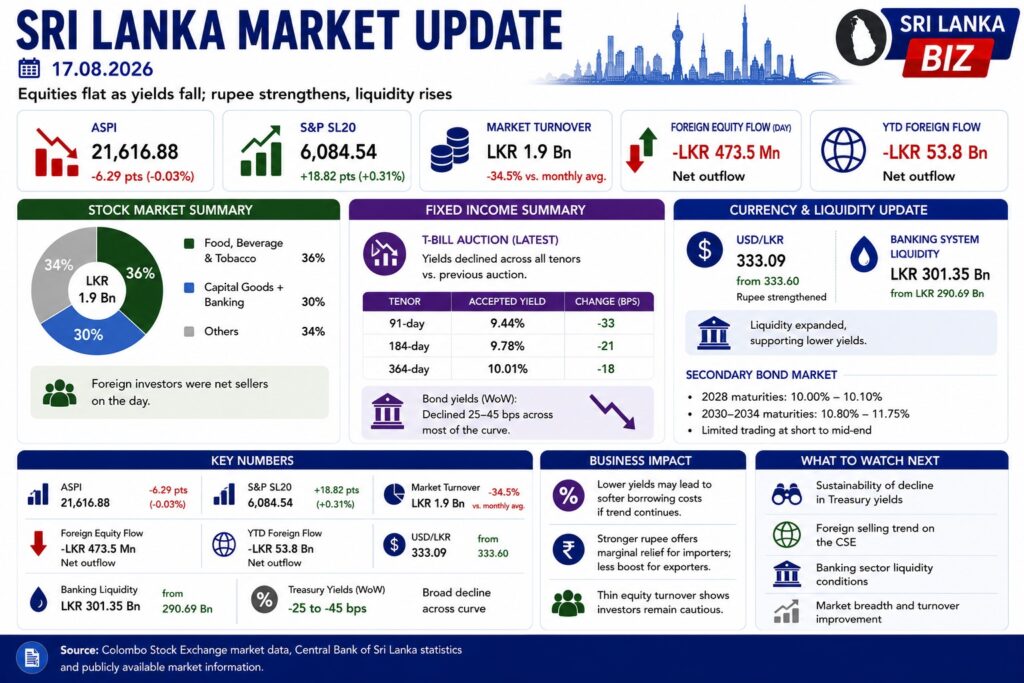
The All Share Price Index (ASPI) slipped 6 points to close at 21,616.88, effectively flat on the day. The S&P SL20 Index, which tracks the market’s most liquid large-cap counters, rose 19 points to 6,084.54. Daily turnover totalled LKR 1.9 billion, a decline of roughly 34.5% from the monthly average of LKR 2.9 billion, pointing to thinner-than-usual trading activity. The Food, Beverage & Tobacco sector accounted for the largest share of turnover at 36%, followed by the Capital Goods and Banking sectors, which together contributed close to 30%. Foreign investors were net sellers on the day, with outflows of LKR 473.5 million, extending a selling trend that has now reached roughly LKR 53.8 billion on a year-to-date basis.
Fixed Income Summary
The secondary bond market opened the week quietly, with limited trading concentrated at the short to mid-end of the curve. Bonds maturing in 2028 changed hands between 10.00% and 10.10%, while longer-dated papers maturing between 2030 and 2034 traded in a range of roughly 10.80% to 11.75%. Measured against the prior week, yields across nearly the entire curve moved lower by between 25 and 45 basis points. At the government’s most recent Treasury bill auction, accepted yields also declined across all three tenors compared to the previous auction.
Currency Market Update
The rupee appreciated against the US dollar, trading at LKR 333.09 compared with LKR 333.60 previously. Liquidity in the banking system expanded to LKR 301.35 billion, up from LKR 290.69 billion.
Business Impact
For businesses and borrowers, the broad-based decline in government security yields is the most consequential development of the day, potentially signalling softer financing costs ahead if the trend holds. The modest currency appreciation offers marginal relief for importers, while exporters may see a slightly reduced competitive edge. Thin equity turnover suggests investors are largely on the sidelines for now.
What to Watch Next
Market participants will be watching whether the decline in Treasury yields continues into subsequent sessions, whether foreign selling on the CSE persists or reverses, and whether banking sector liquidity conditions remain supportive of the shift lower in rates.
Key Numbers
| Metric | Value | Change |
|---|---|---|
| ASPI | 21,616.88 | -6.29 pts (-0.03%) |
| S&P SL20 | 6,084.54 | +18.82 pts (+0.31%) |
| Market Turnover | LKR 1.9 Bn | -34.5% vs. monthly avg |
| Foreign Equity Flow | -LKR 473.5 Mn | Net outflow |
| YTD Foreign Flow | -LKR 53.8 Bn | Net outflow |
| USD/LKR | 333.09 | Appreciation from 333.60 |
| Banking System Liquidity | LKR 301.35 Bn | Up from LKR 290.69 Bn |
| Treasury Yields (WoW) | -25 to -45 bps | Broad decline across curve |
Business Impact
The day’s most meaningful signal for business readers is on the fixed income side: a broad decline in Treasury yields could translate into lower borrowing costs for both government and, over time, the private sector, if sustained. Currency stability and expanding system liquidity are modestly supportive for trade-exposed businesses. Equity market activity remains subdued, with thin turnover suggesting limited near-term direction for listed companies.
Source Attribution
Source: Colombo Stock Exchange market data, Central Bank of Sri Lanka statistics and publicly available market information.