

The Sri Lanka Japan partnership is gaining further momentum as the two countries strengthen efforts to address operational challenges faced by Japanese investors and explore opportunities for export-oriented industrial development.
Sri Lanka Japan cooperation gains momentum as officials work to resolve investor concerns and advance an export-oriented industrial corridor.
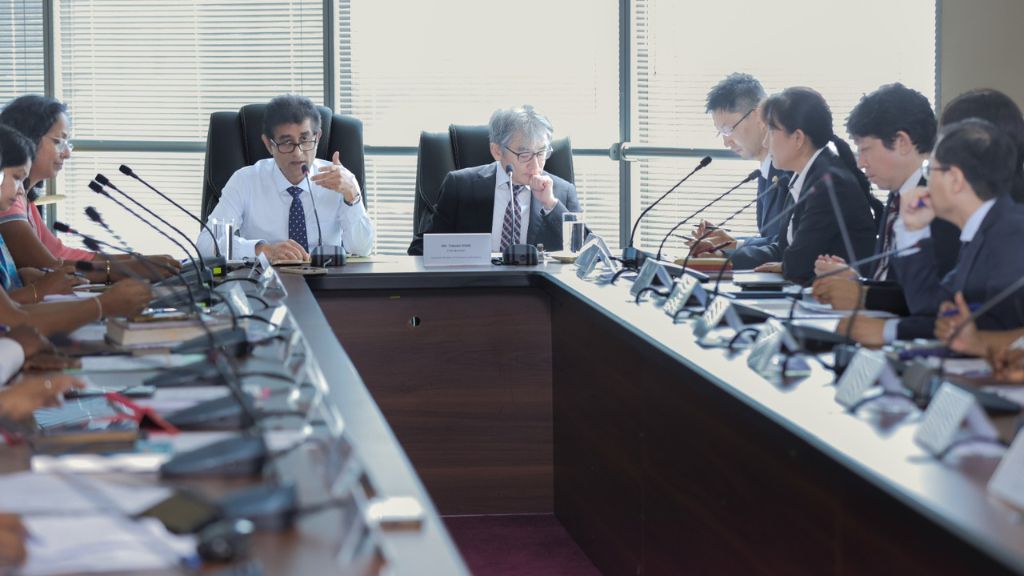
The fifth working-level meeting of the Sri Lanka–Japan Business Environment Committee brought together Japanese companies, government agencies and key bilateral organisations to discuss practical issues affecting investment and business operations in Sri Lanka.
The quarterly forum provided Japanese investors with a direct platform to raise concerns with the relevant authorities, while government representatives responded to the issues presented during the discussions. The approach is intended to improve coordination between the private sector and public institutions and help resolve operational barriers more efficiently.
Representatives from the Embassy of Japan, Japan External Trade Organisation (JETRO), Japan International Cooperation Agency (JICA), Japan Chamber of Commerce and Industry (JCCI), the Board of Investment of Sri Lanka (BOI), Japanese companies operating in the country and other government institutions participated in the meeting.
The issues raised by Japanese investors covered a broad range of activities, reflecting the increasingly diverse nature of Japanese business interests in Sri Lanka. Areas discussed included manufacturing and industrial production, consumer and health-related products, value-added trade, environmental services, infrastructure, logistics and energy.
The breadth of the concerns highlights the importance of addressing investment-related challenges beyond the initial approval and establishment of a project. For businesses already operating in the country, predictable regulatory processes, reliable infrastructure, efficient logistics and access to energy can directly affect operating costs, productivity and the ability to expand.
The BOI said the discussions were productive and constructive, with government officials and Japanese business representatives engaging directly on the concerns raised. Such regular engagement provides an opportunity for authorities to identify recurring operational difficulties and coordinate solutions across institutions.
The meeting also reaffirmed the role of the BOI as the principal liaison between investors and the Government. Participants stressed the importance of maintaining the Committee as a regular mechanism for identifying and resolving investor concerns while strengthening wider economic cooperation between Sri Lanka and Japan.
For Sri Lanka, maintaining a structured dialogue with established investors is particularly important as the country seeks to attract more foreign direct investment and strengthen its position as a competitive destination for international businesses. Addressing practical obstacles faced by existing investors can also help improve confidence among companies considering new projects.
The latest Sri Lanka Japan discussions also extended beyond individual operational concerns. The first meeting of the Sri Lanka–Japan Joint Working Group on Export-Oriented Industrial Corridor Development was held concurrently, marking a new dimension in bilateral economic engagement.
The creation of the working group signals an intention to explore broader industrial development opportunities rather than focusing exclusively on individual investment projects. An export-oriented industrial corridor could potentially connect industrial activity with supporting infrastructure, logistics and export markets, although its eventual scope and implementation will depend on further discussions and planning.
The working group therefore provides a platform for both sides to examine how Japanese expertise, investment and technology could contribute to the development of industrial capacity aimed at international markets. For Sri Lanka, the emphasis on exports is significant as the country continues to seek stronger foreign-exchange earnings and greater integration with global supply chains.
Japan has long been an important economic partner for Sri Lanka, with cooperation extending across investment, infrastructure, development assistance and trade. Strengthening the business environment for Japanese companies could create opportunities for deeper private-sector engagement and encourage additional investment in productive sectors.
The committee’s quarterly format also gives both sides an avenue to monitor unresolved matters rather than treating investor concerns as isolated issues. Continued follow-up will be important if the forum is to translate discussions into measurable improvements for businesses operating in the country.
The latest meetings consequently represent two complementary tracks in the bilateral economic relationship: resolving immediate operational concerns raised by investors while developing longer-term opportunities for industrial and export growth.
As Sri Lanka seeks to attract investment that can generate employment, technology transfer and export revenue, the effectiveness of these mechanisms will depend on sustained coordination between government agencies and the private sector. The continued engagement between Sri Lankan authorities and Japanese business representatives could therefore play an important role in shaping the next phase of bilateral investment and industrial cooperation.