

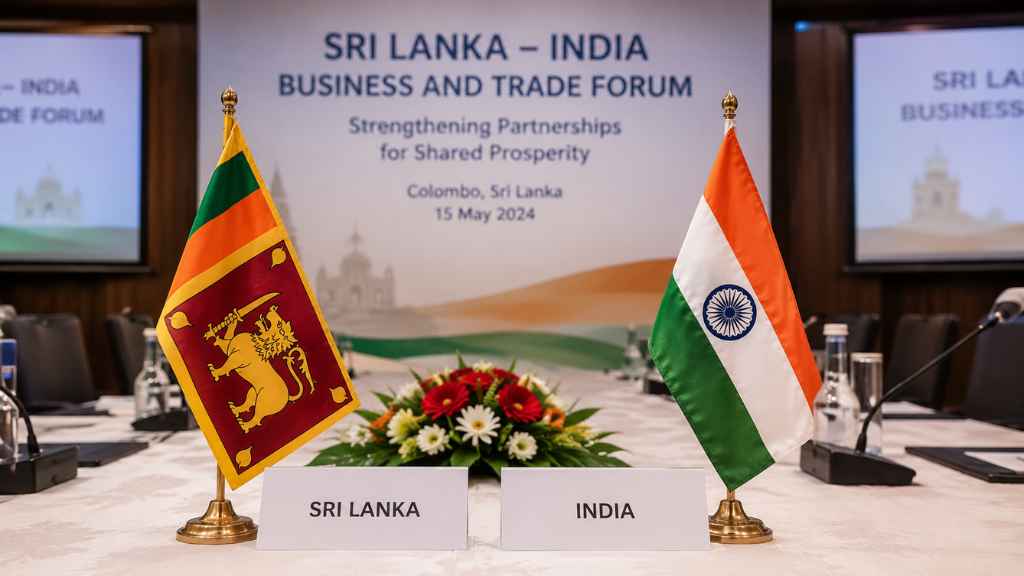
India Desk launch signals push to reboot Sri Lanka-India economic ties as policymakers and business leaders seek to deepen bilateral economic engagement beyond traditional trade and unlock new opportunities in investment, technology, logistics, and digital commerce.
India Desk launch signals push to reboot Sri Lanka-India economic ties
The announcement was made during a forum commemorating 25 years of the Sri Lanka-India Free Trade Agreement (ISLFTA), where the newly established India Trade Desk was unveiled as a strategic platform to help Sri Lankan businesses better access and navigate one of the world’s fastest-growing major economies.
Addressing the forum, Trade and Commerce Minister Wasantha Samarasinghe revealed that the Government’s review of existing Free Trade Agreements is nearing completion. He said a Cabinet-appointed high-level committee is expected to submit its recommendations in July, potentially paving the way for a refreshed framework governing Sri Lanka’s international trade relationships.
According to the Minister, the review reflects the need for trade agreements to evolve alongside changing economic realities. While the Sri Lanka India FTA has facilitated significant trade growth over the past quarter century, authorities believe greater economic integration is now required to maximize the benefits of the bilateral relationship.
The discussion comes as trade between the two countries has expanded to nearly US$5.8 billion. Sri Lankan exports to India surpassed the US$1 billion mark for the first time in 2025, representing a significant milestone in bilateral trade. However, imports from India rose to US$4.3 billion, highlighting the persistent trade imbalance that has generated debate over the effectiveness and limitations of the agreement.
Government officials stressed that future cooperation should extend beyond goods trade and include services, technology, logistics, digital commerce, and investment partnerships. Such diversification is viewed as critical to ensuring more balanced and sustainable economic engagement between the two nations.
Industry and Entrepreneurship Development Minister Sunil Handunneththi described India as one of Sri Lanka’s most important economic partners. He noted that cumulative Indian investments in Sri Lanka have exceeded US$2.5 billion across sectors including energy, manufacturing, telecommunications, banking, tourism, and infrastructure.
He said the India Trade Desk would play an important role in strengthening business-to-business connections, facilitating trade and investment opportunities, and enabling small and medium-sized enterprises to gain access to international markets and technical expertise.
A recurring theme throughout the forum was that Sri Lankan businesses are not fully capitalising on opportunities emerging from India’s rapidly evolving economy.
Representing the High Commission of India, Economic and Commercial Counsellor Devika Lal emphasized that India should no longer be viewed solely as a neighbouring market. Instead, she described the country as a major platform for innovation, advanced manufacturing, technology development, and investment.
She highlighted India’s extensive digital transformation, infrastructure expansion, and growing middle-class consumer base as key factors creating opportunities for Sri Lankan companies. Sectors identified as having significant potential included manufacturing, tourism, pharmaceuticals, engineering, electronics, information technology, and professional services.
Providing further insights into market opportunities, Global Investment and Trade Advisers (GITA) Managing Partner Priya Rawat noted that many Sri Lankan firms continue to underestimate the complexity and scale of the Indian economy.
She explained that India cannot be treated as a single market due to the significant differences between states in terms of industrial strengths, regulations, consumer behaviour, and investment opportunities. Understanding these regional variations, she argued, is essential for businesses seeking long-term success in India.
Rawat said the India Trade Desk was specifically created to help address these challenges. The initiative will provide market intelligence, identify potential business partners, offer investment guidance, and facilitate market entry for Sri Lankan companies looking to expand into India.
The desk has been established by the Indo Lanka Chamber of Commerce and Industry in collaboration with the High Commission of India and will be operated by Global Investment and Trade Advisers. Industry stakeholders believe the platform can reduce information gaps and improve access to opportunities that many Sri Lankan businesses have previously struggled to navigate.
Indo Lanka Chamber of Commerce and Industry President M. Raguraman said the Sri Lanka India FTA had transformed trade and investment flows over the last 25 years but acknowledged that bilateral economic engagement still remains below its full potential.
As policymakers prepare to review the future direction of Sri Lanka’s trade agreements, the launch of the India Trade Desk signals a broader shift toward deeper economic integration with India. Business leaders believe that combining improved market access, stronger investment partnerships, technological collaboration, and enhanced business support mechanisms could help unlock the next phase of growth in Sri Lanka-India economic relations.