

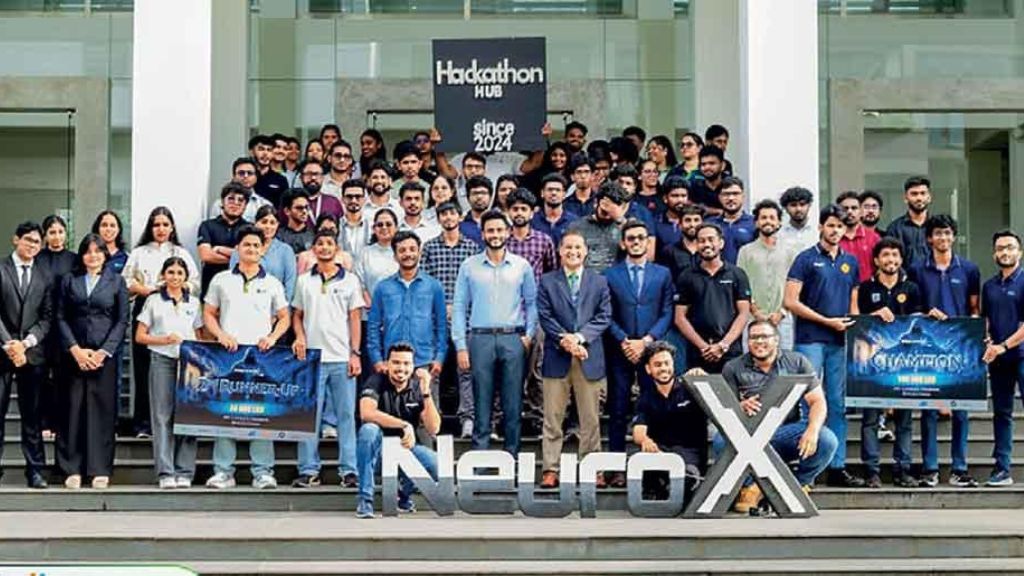
NeuroX 1.0 has brought together more than 300 undergraduates from universities across Sri Lanka, with teams competing to develop autonomous technology solutions for real-world business challenges.
NeuroX 1.0 brings university teams together to build autonomous AI solutions
The inaugural national buildathon was organised by the Hackathon Hub of the Faculty of Computing at NSBM Green University. More than 80 teams representing over 20 universities took part, making the competition a significant gathering of Sri Lanka’s emerging technology talent.
The event was structured around the development and deployment of autonomous, multi-step agents capable of addressing practical challenges in a business-to-business environment. Rather than relying on scripted demonstrations, participants were required to build systems that could respond to real and unrehearsed inputs.
The first round of the competition was judged by Sysco Labs, which evaluated the participating teams before selecting the Top 15 Elite Builder Teams for the Grand Finale. The finalists then demonstrated their solutions in a live physical environment before a panel of judges.
The competition ultimately produced a winning team from the University of Peradeniya. Team Alt + F4 was crowned champion after developing an autonomous, agentic supply chain management system designed to advise shipping companies on logistics-related decisions.
The solution reflects the growing use of artificial intelligence in areas traditionally dependent on complex human decision-making. Supply chain management involves multiple variables, including transportation, inventory, scheduling and logistics planning, creating opportunities for autonomous systems to analyse information and provide recommendations.
Team Power secured the First Runner-Up position, while Team Binary Blitz finished as the Second Runner-Up. Their performances demonstrated the breadth of approaches taken by students during a competition focused on practical applications of emerging technologies.
A key feature of NeuroX 1.0 was its emphasis on autonomous agents rather than conventional software prototypes. Teams were required to design systems capable of goal-directed autonomy, multi-tool integration, human-in-the-loop control and transparent decision trails.
The requirement for human-in-the-loop control was particularly relevant as businesses increasingly explore the use of artificial intelligence for operational tasks. While autonomous systems can handle complex workflows, maintaining human oversight can help organisations review decisions, intervene when necessary and improve accountability.
The transparent decision trail requirement also placed emphasis on understanding how an AI system reaches an outcome. This is becoming increasingly important as organisations evaluate AI applications for business environments where reliability, traceability and responsible use can influence adoption.
The organisers also sought to move participants beyond polished presentations by testing their agents against unrehearsed inputs. This approach required teams to demonstrate that their technology could respond dynamically rather than simply execute a pre-determined sequence prepared for judges.
For Sri Lankan university innovators, the competition provided an opportunity to work with technologies that are increasingly influencing the global technology industry. It also created a setting where students could test their technical knowledge against practical requirements and receive evaluation based on functioning systems.
The event comes as artificial intelligence continues to reshape the skills expected from technology graduates. Students entering the technology workforce are increasingly required to understand not only conventional programming but also AI systems, automation, data integration and the practical limitations of autonomous technologies.
Faculty of Computing Dean Dr. Rasika Ranaweera highlighted the importance of adapting to technological change, noting that hackathons provide an effective environment for students to engage with new technologies.
Hackathon Hub Master-in-Charge Anton Jayakody also emphasised the importance of maintaining human judgment as AI becomes more capable. His comments pointed to a broader challenge facing technology professionals: using AI to enhance productivity while retaining human creativity, responsibility and decision-making.
The focus on AI buildathon projects also reflects the changing nature of university technology competitions. Traditional hackathons have often centred on developing applications within a limited timeframe, whereas autonomous agent competitions require participants to think about decision-making, system architecture, integration and interaction between humans and machines.
With more than 300 participants and representation from over 20 universities, NeuroX 1.0 provided a national platform for students to demonstrate these emerging capabilities. The strong participation also suggests growing interest among Sri Lankan undergraduates in developing practical solutions using artificial intelligence and automation.
The success of Team Alt + F4 further illustrates how university teams can apply advanced technologies to industry-specific problems. Its supply chain management system demonstrated how agentic AI could potentially support decision-making in a sector where efficiency, timing and coordination are critical.
As Sri Lanka’s technology ecosystem continues to develop, competitions such as NeuroX 1.0 can play a role in connecting academic talent with practical industry challenges. They provide students with opportunities to experiment, collaborate and demonstrate capabilities that could become increasingly valuable in the country’s digital economy.
The inaugural competition has therefore established a platform for emerging innovators while highlighting the growing importance of autonomous AI systems in technology education. Its emphasis on real-world testing, human oversight and transparent decision-making also points towards a more practical approach to preparing the next generation of Sri Lankan technology professionals.