

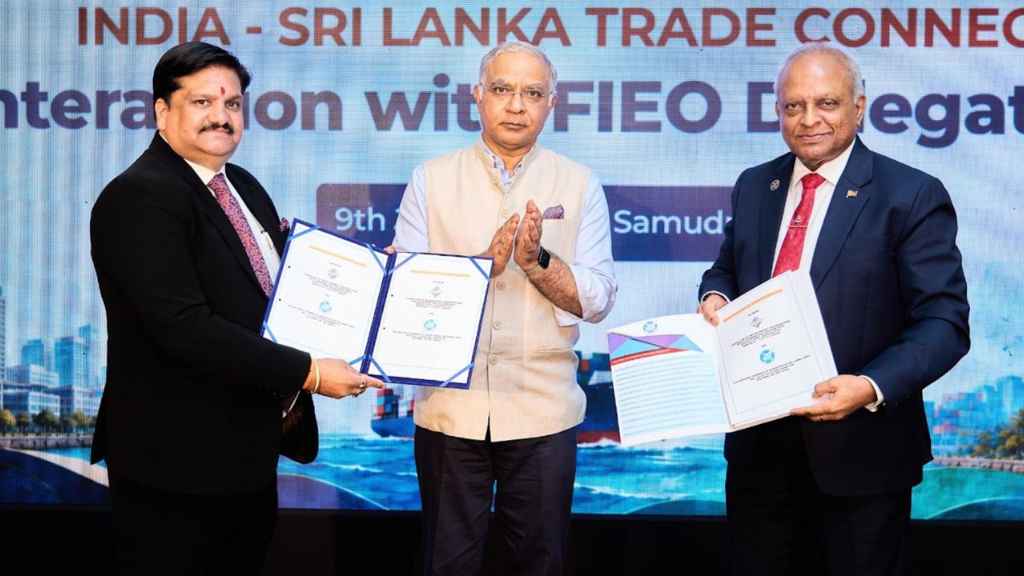
Indian business delegation visits Sri Lanka to expand trade as a 31-member mission led by the Federation of Indian Export Organisations (FIEO) concluded a three-day visit aimed at strengthening commercial ties, promoting investment and creating new business opportunities between the two neighbouring countries.
Indian business delegation visits Sri Lanka to expand trade through new business partnerships
The delegation, which visited Sri Lanka from July 8 to 10, was organised by the Federation of Indian Export Organisations (FIEO), India’s apex export promotion body. It brought together representatives from a broad range of industries, including pharmaceuticals, engineering goods, apparel and textiles, food and agricultural products, and infrastructure.
During the visit, the delegation met with Indian High Commissioner to Sri Lanka Santosh Jha, where discussions focused on the growing economic partnership between India and Sri Lanka and the opportunities available to expand bilateral trade and investment.
According to the Indian High Commission in Colombo, the delegation also held meetings with members of the Indo-Lanka Chamber of Commerce and Industry (ILCCI), representatives of the Access Group and business associations coordinated by the Global Organization of People of Indian Origin (GOPIO). These engagements were intended to identify new commercial opportunities, establish business partnerships and strengthen cross-border trade links.
As part of its efforts to encourage business-to-business engagement, the High Commission organised an interactive forum titled “India-Sri Lanka Trade Connect: Interaction with FIEO Delegation.” The event brought together business leaders from both countries to discuss trade prospects, investment opportunities and areas for future collaboration.
A key milestone during the programme was the formal exchange of the Memorandum of Understanding (MoU) between the Federation of Indian Export Organisations and the National Chamber of Exporters of Sri Lanka (NCE). Although the agreement had been signed virtually on August 19 last year, the official exchange took place during the Colombo event.
The MoU is expected to strengthen institutional cooperation through information sharing, business networking, promotion of trade and investment, and the identification of new opportunities for collaboration between exporters in both countries.
India and Sri Lanka continue to maintain one of South Asia’s most significant bilateral economic relationships, built on decades of geographical proximity, historical ties and cultural connections. Trade between the two countries has expanded steadily over the past two decades, supported largely by the India-Sri Lanka Free Trade Agreement (ISFTA).
Signed in 1998 and brought into effect in March 2000, the India-Sri Lanka Free Trade Agreement was designed to increase bilateral trade by providing preferential market access while recognising the differences in the size of the two economies. India extended broader and faster tariff concessions to facilitate greater market access for Sri Lankan exports.
Since the agreement came into force, annual bilateral merchandise trade has increased from around US$500 million in the early 2000s to approximately US$7.2 billion. Sri Lankan exports to India have recorded particularly strong growth, increasing by nearly 160 percent over the past five years.
India remains Sri Lanka’s largest trading partner and a major supplier of petroleum products, pharmaceuticals, vehicles and textiles. At the same time, Sri Lanka exports products such as spices, apparel, rubber-based goods and coconut products to the Indian market.
The free trade agreement has enabled more than 60 percent of Sri Lankan exports to India to benefit from duty-free market access. India has also emerged as an important investor and development partner, extending lines of credit, financing infrastructure projects and providing economic assistance during Sri Lanka’s financial crisis in 2022.
Despite these achievements, trade experts note that the partnership has yet to reach its full potential. Efforts to expand the existing agreement into a broader framework, including the proposed Comprehensive Economic Partnership Agreement (CEPA), have faced repeated delays due to concerns over sensitive sectors, regulatory barriers and domestic policy considerations.
Both countries continue to maintain extensive lists of products excluded from tariff concessions, particularly in agriculture. Other challenges—including certification requirements, customs procedures, logistics, production capacity and quality standards—have also limited the ability of businesses to fully utilise available market access.
Nevertheless, analysts believe that stronger business engagement, institutional cooperation and continued policy dialogue can help unlock additional opportunities. As Indian business delegation visits Sri Lanka to expand trade demonstrates, both governments and private sector organisations remain committed to deepening commercial ties while working towards a more balanced and mutually beneficial economic partnership.