

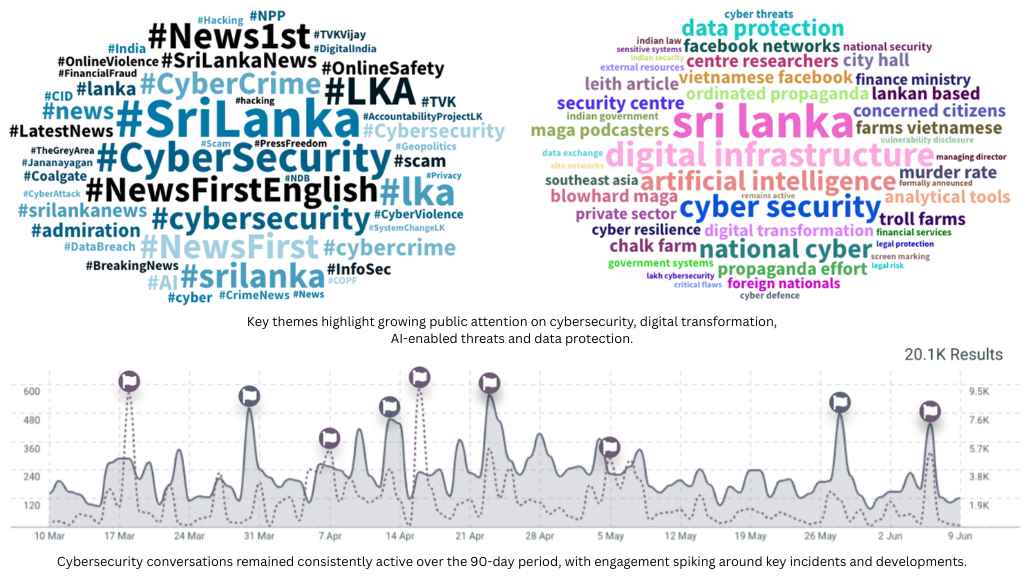
Sri Lanka cybersecurity crisis is exposing growing concerns over digital trust as cyber incidents, online fraud, and security breaches continue to dominate public discussion across the country.
Sri Lanka cybersecurity crisis exposes growing cyber fraud and digital security risks
Sri Lanka’s rapid digital transformation has accelerated online banking, e-government services, and digital payments, bringing greater convenience to businesses and consumers alike. However, this digital progress has also created new vulnerabilities that are increasingly being exploited by cybercriminals. Recent data suggests that cybersecurity has evolved from a technical concern into a national issue affecting public confidence, institutional credibility, and business resilience.
According to an analysis conducted by Mark & Comm using Talkwalker social listening data, cybersecurity-related discussions generated more than 20,000 online results and nearly 146,000 engagements across social media and news platforms in Sri Lanka during the past 90 days. More than 7,800 unique authors actively participated in conversations, representing an almost 20,000 percent increase compared with the previous quarter.
Public sentiment surrounding these discussions paints an equally concerning picture. Only 9.7 percent of online conversations carried a positive tone, while nearly half—47.6 percent—were negative, reflecting widespread concern about the country’s ability to protect individuals and institutions from evolving cyber threats.
Anjalie Munasinghe, Manager – PR & Social Intelligence at Mark & Comm, said the online conversation extends far beyond individual cyber incidents.
“The conversation reflected in this data goes beyond cyber threats themselves. It reveals how quickly security incidents can become reputation issues, public trust issues and, ultimately, business issues. Understanding these shifts in stakeholder perception is becoming increasingly important for organisations operating in a digital environment.”
International cybersecurity data reinforces these concerns. The Kaspersky Security Bulletin 2025 ranked Sri Lanka 20th globally for web-borne cyber threats, with 30.4 percent of internet users experiencing attacks during the year. Nearly 15 million malware incidents were also recorded, many spreading through shared devices and removable storage media, highlighting the continuing importance of basic digital security practices alongside more advanced cyber defences.
Figures from the Sri Lanka Computer Emergency Readiness Team (SLCERT) reveal a similar trend. Reported cybersecurity incidents increased from just 596 in 2019 to 4,347 in 2024. During 2025 alone, the organisation received more than 12,650 complaints relating to cyber fraud, scams, phishing attacks, and other online crimes.
Law enforcement agencies have also intensified operations against organised criminal networks. By mid-May 2026, police had arrested 628 foreign nationals connected to immigration violations and organised online fraud involving suspects from several Asian countries. Authorities believe many criminal groups displaced from neighbouring countries have relocated operations to Sri Lanka, attracted by reliable digital infrastructure and expanding connectivity.
Artificial intelligence has emerged as another growing challenge. Deepfake videos using the identities of public figures to promote fraudulent investment schemes have become increasingly common, creating additional risks for consumers while complicating efforts to distinguish legitimate information from scams. As AI-generated content becomes more sophisticated, protecting the public from deception is becoming an essential component of digital security.
Several high-profile incidents have further intensified public concern. A major domestic bank recently disclosed an internal fraud exceeding its annual profit after irregularities allegedly continued for nearly two years. The Central Bank subsequently instructed licensed banks to strengthen internal controls and review existing risk management procedures.
Government institutions have also been targeted. The Ministry of Finance reportedly lost USD 2.5 million after attackers intercepted and redirected an overseas debt repayment through a business email compromise. Shortly afterwards, the Department of Posts suffered losses exceeding USD 600,000 through a similar phishing-based scheme. Sri Lanka’s national airline also experienced vendor payment fraud involving AED 974,500 while separately warning customers about a malicious mobile application impersonating the airline to steal banking credentials.
Collectively, these incidents have shifted public discussion away from isolated technical failures toward broader concerns about institutional accountability and preparedness. The most widely shared online content focused not only on financial losses but also on practical advice helping consumers recover stolen funds and avoid becoming victims of cyber fraud.
Meanwhile, Sri Lanka’s policy framework continues to evolve. Although a Cybersecurity Act has remained under development since 2019 through multiple draft versions, it has yet to become law. At the same time, authorities are working to connect 37 critical institutions to a National Cyber Security Operations Centre while also advancing a national digital identity platform and government super-app designed to deliver integrated public services.
These initiatives promise significant improvements in efficiency and accessibility. However, they also increase the importance of establishing strong cybersecurity governance before larger volumes of sensitive citizen data become concentrated within interconnected digital platforms.
Munasinghe noted that organisations can use online conversations as an early warning system to identify emerging reputational risks before they escalate into larger crises.
Ultimately, the Sri Lanka cybersecurity crisis is no longer defined solely by hackers or malicious software. It has become a broader test of institutional readiness, governance, and public confidence. As Sri Lanka continues building its digital economy, strengthening digital security, improving coordination between agencies, and rebuilding public trust will be essential to ensuring that technological progress is matched by equally robust protection against evolving cyber threats.