

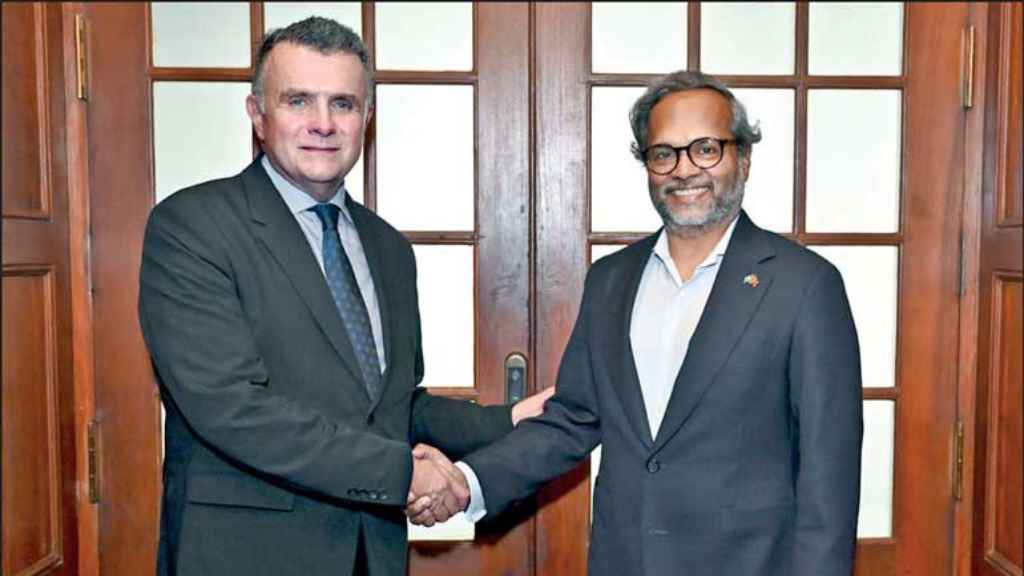
Swedish Ambassador optimistic about Sri Lanka as outgoing envoy Jan Thesleff praised the country’s resilience, improving investment climate and growing economic partnership with Sweden, expressing confidence that bilateral relations will continue to deepen in the years ahead.
Swedish Ambassador optimistic about Sri Lanka as investment and bilateral ties strengthen
After serving nearly four years in Colombo, Thesleff said Sri Lanka has made remarkable progress in recovering from one of its most severe economic crises. Reflecting on his tenure in an exclusive interview with the Daily FT, the ambassador said the country’s resilience, policy stability and skilled workforce continue to strengthen investor confidence and create new opportunities for long-term economic cooperation.
The envoy noted that Sri Lanka has repeatedly demonstrated its ability to overcome external shocks, including the COVID-19 pandemic, global economic disruptions, natural disasters and recent geopolitical tensions in the Middle East. Despite these challenges, he said visible progress is evident across the country, pointing to developments such as the Colombo Port City as signs that long-term projects are moving from planning to implementation.
Discussing Swedish investment in Sri Lanka, Thesleff said Swedish companies continue to view the country as an attractive destination because of increasing economic stability and policy consistency. He stressed that international investors seek predictability, enabling businesses to make long-term investment decisions with confidence.
According to the ambassador, around 80 Swedish companies currently operate in Sri Lanka, a significant presence considering Sweden has approximately 300 companies in neighbouring India, a substantially larger market. Many Swedish firms have expanded their operations after initially entering the Sri Lankan market, reflecting confidence in the country’s long-term business potential.
He highlighted information and communication technology (ICT) as one of the strongest sectors attracting Swedish businesses. Approximately half of Swedish companies operating in Sri Lanka are involved in the ICT industry, benefiting from the country’s highly educated workforce and growing reputation as a regional technology hub. Apparel manufacturing also continues to attract Swedish interest, while opportunities are emerging in renewable energy, healthcare, life sciences, food processing and food packaging.
Thesleff also highlighted Sweden’s longstanding contribution to Sri Lanka’s energy sector. Following Swedish involvement in the Kotmale Hydropower Project, Sweden’s development finance institution, Swedfund, is now working with the Ceylon Electricity Board to support renewable energy development and improve national grid stability as Sri Lanka expands its use of solar power.
The ambassador pointed to major portfolio investments by Swedish investment firm EQT in Sri Lankan technology companies including WSO2 and 99X as further evidence of international confidence in the country’s innovation ecosystem. He said such investments demonstrate trust in Sri Lankan entrepreneurship, corporate governance and technical expertise rather than simply replicating foreign business models.
Education has also become an increasingly important pillar of Sri Lanka Sweden relations. Thesleff noted that Sri Lanka is now one of the largest sources of postgraduate students to Sweden, with nearly 950 English-language master’s programmes available at Swedish universities. He described returning graduates as providing “intellectual remittances” that strengthen Sri Lanka’s human capital and help offset the effects of brain drain.
Looking ahead, he identified healthcare, life sciences and sustainable mining as promising sectors for future collaboration. Swedish companies, including globally recognised healthcare firms, possess technologies that could support Sri Lanka’s development while promoting environmentally sustainable practices.
The ambassador also called for direct air connectivity between Stockholm and Colombo, describing it as a potential “game changer” for tourism. Swedish tourist arrivals have largely recovered to pre-pandemic levels of around 18,000 visitors annually, but direct flights could significantly improve Sri Lanka’s appeal among high-end European travellers. He added that several Swedish hospitality companies are exploring opportunities to invest in Sri Lanka’s tourism sector.
As one of his final initiatives before leaving office, Thesleff confirmed that Business Sweden will lead a major Swedish business delegation to Sri Lanka in January 2027, with participants also attending Sri Lanka Expo 2027. The event will mark Sweden’s first organised participation in the country’s flagship export exhibition and is expected to strengthen commercial partnerships across multiple industries.
Reflecting on his time in Sri Lanka, Thesleff said the country’s greatest strength remains its people. He praised their resilience, hospitality and optimism, expressing confidence that these qualities, together with continued economic reforms and investor confidence, will support Sri Lanka’s future growth. The Swedish Ambassador optimistic about Sri Lanka message underscores growing confidence in the country’s economic recovery and expanding bilateral partnership with Sweden.