

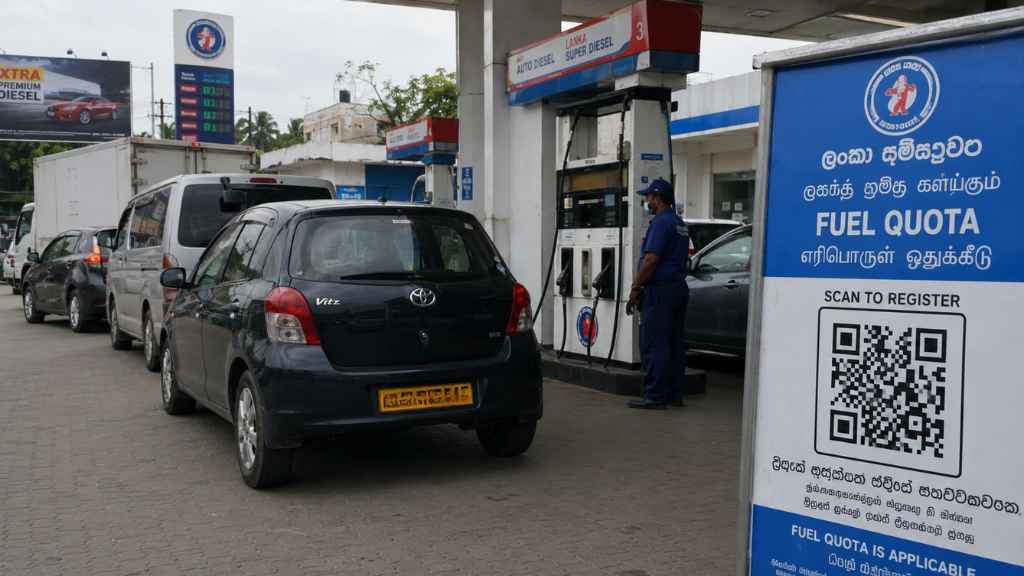
Sri Lanka fuel consumption has come under renewed attention as authorities urged the public to reduce fuel usage further amid rising oil import costs and mounting pressure on the country’s foreign exchange reserves.
Sri Lanka fuel consumption concerns grow as oil import bill pressures rupee
Deputy Finance Minister Anil Jayantha said higher global oil prices and increased import volumes have added pressure on the Sri Lanka rupee despite the government’s fuel quota system remaining in place.
Speaking at a media briefing in Colombo on Saturday, Jayantha noted that Sri Lanka has already raised domestic fuel prices four times since the escalation of tensions in the Middle East began on February 28. The cumulative increase has amounted to around 40 percent, reflecting the sharp rise in international crude oil prices.
Sri Lanka also reintroduced its QR code-based fuel quota system, a mechanism first implemented during the country’s 2022 economic crisis when severe shortages disrupted economic activity and daily life across the island.
According to the Deputy Minister, the increase in fuel prices has forced the country to spend more dollars on imports at a time when maintaining external sector stability remains a key economic priority.
“Likewise due to the price increase, we have to pay more dollars and in the early stage due to the volume increase as well,” Jayantha told reporters.
He explained that while fuel consumption volumes are gradually returning to normal levels, authorities still believe there is a need for greater public awareness regarding energy conservation and responsible fuel usage.
“Now the volume increase is gradually coming down to the normal level, but it is advisable from the country’s point of view to economize your personal fuel use,” he said.
The government’s comments come as policymakers continue efforts to stabilize the economy following Sri Lanka’s financial crisis, which triggered sharp currency depreciation, inflationary pressure, and severe shortages of essential imports in 2022.
Officials believe reducing Sri Lanka fuel consumption could help contain the country’s growing fuel import bill and reduce pressure on foreign currency reserves. Analysts say fuel imports remain one of the largest contributors to Sri Lanka’s external payment obligations.
Jayantha also warned that even if consumption returns to normal levels, the country would still face elevated import costs because of higher international prices.
“Even though the volume would be at the normal level, we still have to pay a higher price,” he said. “So how best we can tackle this issue is if we can further reduce the consumption on our own behaviour, and if necessary, the government also would take some other measures.”
Economists note that sustained increases in oil prices often place direct pressure on the Sri Lanka rupee by increasing demand for US dollars needed for fuel imports. This can widen trade deficits and strain central bank reserve management if not balanced by stronger export earnings or foreign inflows.
The Deputy Minister added that lowering fuel demand below normal consumption levels could help authorities manage the import bill within expected foreign exchange targets.
“If the volume can be reduced from the normal level, then the fuel bill can be managed within the expected forex level,” he stated.
Data shared during the briefing highlighted the scale of the pressure facing the energy sector. Sri Lanka’s state-owned fuel retailer has already spent around one billion US dollars on fuel imports during the first four months of the year.
The figure compares with approximately 1.5 billion dollars spent for fuel imports during the whole of 2025, indicating a significant acceleration in import expenditure amid global market volatility.
Market observers say continued geopolitical uncertainty in the Middle East could maintain upward pressure on oil prices in the coming months, making energy management an increasingly important policy issue for Sri Lanka.
The government is expected to closely monitor fuel demand patterns, exchange rate movements, and global commodity prices while assessing whether additional measures may be required to protect the country’s external finances.