

Turnover of Rs. 815 million was roughly 64% under the monthly average, while the rupee weakened and banking system liquidity rose.
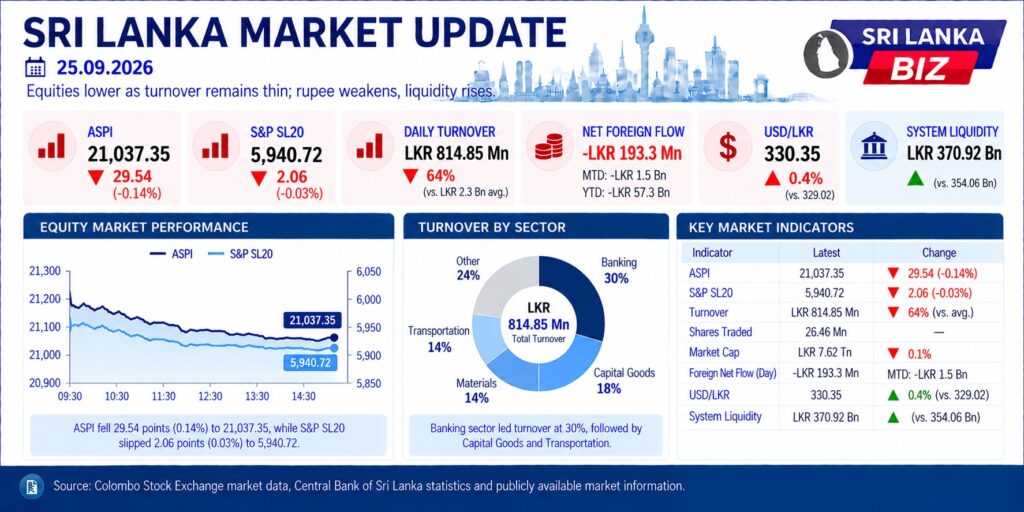
Key Highlights
- ASPI fell 29.54 points (0.14%) to 21,037.35
- S&P SL20 slipped 2.06 points (0.03%) to 5,940.72
- Turnover was LKR 814.85 million against a monthly average of about LKR 2.3 billion
- Foreign investors recorded a net outflow of LKR 193.3 million
- The rupee weakened to LKR 330.35 per US dollar
- Banking system liquidity rose to LKR 370.92 billion
Stock Market Summary
The All Share Price Index (ASPI) closed at 21,037.35 and the S&P SL20 at 5,940.72. Both moves were small, but activity was thin. Turnover fell to LKR 814.85 million (about US$2.44 million) on 26.46 million shares traded, and market capitalisation eased 0.1% to LKR 7.62 trillion.
DIAL, COMB, CCS, CINS and DIST were the largest drags on the ASPI. The banking sector accounted for about 30% of turnover, with NDB (LKR 203 million) and PLC (LKR 112 million) the two biggest contributors by value. ASPH, SEMB and BRR led the price gainers, while PEG, KFP and PACK were among the biggest decliners.
Foreign investors bought LKR 13.7 million of shares and sold LKR 207.1 million. Net foreign outflows now stand at about LKR 1.5 billion for the month and LKR 57.3 billion for the year to date.
Fixed Income Summary
Government securities yields were largely unchanged from the previous session. Compared with a week earlier, Treasury bill yields were 3 to 5 basis points higher, at about 9.25% for 91-day, 9.45% for 182-day and 9.95% for 364-day paper. Yields on several bonds maturing between 2028 and 2035 were 5 to 15 basis points lower over the same period.
Secondary market trading was light. The 2030 maturities changed hands at 11.12% to 11.15% (August) and 11.22% to 11.30% (October), and a 2032 maturity traded at 11.70%.
Currency Market Update
The rupee weakened about 0.4% to LKR 330.35 per US dollar, from LKR 329.02 previously.
Business Impact
A softer rupee raises the local cost of imported inputs and dollar-denominated obligations, while exporters receive slightly more rupees per dollar. Higher banking system liquidity generally means easier short-term funding conditions for lenders. Thin equity trading means index moves on a day like this reflect fewer transactions and carry less weight as a signal.
What to Watch Next
- Whether turnover recovers toward the monthly average
- Whether foreign selling continues, and whether it stays concentrated in a few stocks
- Further movement in the rupee
- Treasury bill maturities of about LKR 91.8 billion in the week ending October 2
Key Numbers
| Indicator | Latest | Change |
|---|---|---|
| ASPI | 21,037.35 | -29.54 (-0.14%) |
| S&P SL20 | 5,940.72 | -2.06 (-0.03%) |
| Turnover | LKR 814.85 Mn | About 64% below monthly average |
| Shares traded | 26.46 Mn | n/a |
| Market capitalisation | LKR 7.62 Tn | -0.1% |
| Foreign net flow | -LKR 193.3 Mn | Month-to-date: -LKR 1.5 Bn |
| USD/LKR | 330.35 | From 329.02 |
| Banking system liquidity | LKR 370.92 Bn | From LKR 354.06 Bn |
| 91-day T-bill yield | About 9.25% | +5 bps week-on-week |
| 364-day T-bill yield | About 9.95% | +3 bps week-on-week |
Source Attribution: Colombo Stock Exchange market data, Central Bank of Sri Lanka statistics and publicly available market information.