


Yields on bonds maturing between 2028 and 2036 mostly fell compared with a week earlier, while short-dated bill yields rose slightly. Day-to-day changes were negligible.
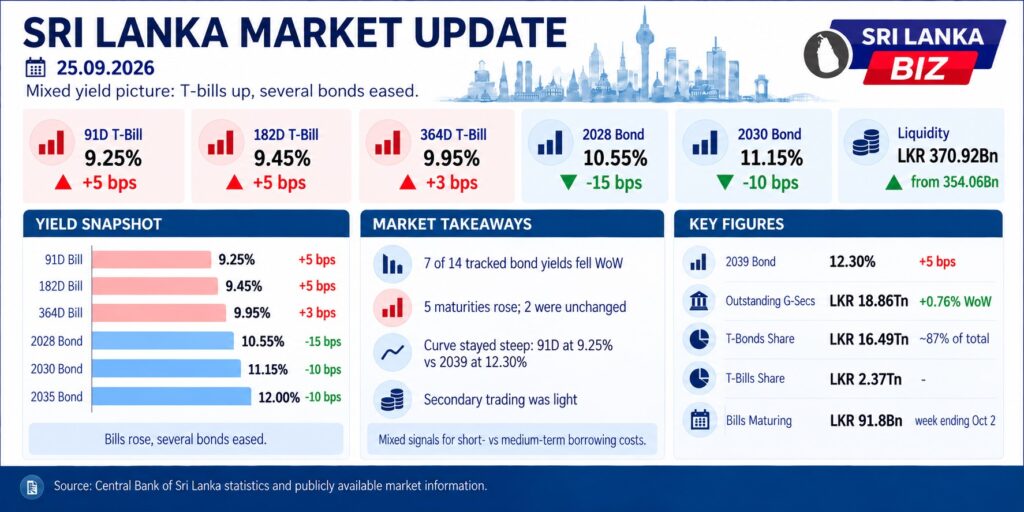
Sri Lanka’s government securities yields showed a split picture over the past week. Yields on Treasury bills rose by 3 to 5 basis points, while yields on many bonds maturing between 2028 and 2036 fell by up to 15 basis points. A basis point is one hundredth of a percentage point.
Across the 14 maturities tracked in the secondary market, seven yields were lower than a week earlier, five were higher and two were unchanged. The largest decline was 15 basis points on the October 2028 bond, which moved to about 10.55%. The August 2030 and June 2035 bonds each fell 10 basis points, to about 11.15% and 12.00%.
At the short end, the 91-day bill yield rose 5 basis points to about 9.25%, the 182-day bill rose 5 basis points to about 9.45%, and the 364-day bill rose 3 basis points to about 9.95%. At the long end, the August 2039 bond edged up 5 basis points to about 12.30%, and the October 2032 bond rose 3 basis points to about 11.63%.
Compared with the previous trading session, yields were unchanged across the curve. Trading was light, and secondary market activity was limited to a handful of bonds. The August 2030 bond traded between 11.12% and 11.15%, and the October 2030 bond between 11.22% and 11.30%. The February 2031 bond changed hands between 11.35% and 11.25%, and the December 2032 bond traded at 11.70%.
The Shape of the Curve
The yield curve remains steeply upward sloping. The 91-day bill yields about 9.25%, while the 2039 bond yields about 12.30%, a gap of roughly 3 percentage points. Even after this week’s easing, the government is paying noticeably more to borrow for 10 years than for one.
Treasury bill auction results pointed the same way as the secondary market. Phase One yields at the latest auction were 9.20% for 91-day, 9.37% for 184-day and 9.93% for 364-day bills, up 1 to 5 basis points.
Liquidity and Stock of Debt
Liquidity in the banking system rose to LKR 370.92 billion from LKR 354.06 billion, an increase of about 4.8%. Total government securities outstanding were LKR 18.86 trillion, up 0.76% on the week. Treasury bonds made up about LKR 16.49 trillion of that (roughly 87%), and Treasury bills about LKR 2.37 trillion. Bills worth about LKR 91.8 billion mature in the week ending October 2.
Key Numbers
| Instrument | Yield (approx.) | Change vs. last week |
|---|---|---|
| 91-day Treasury bill | 9.25% | +5 bps |
| 182-day Treasury bill | 9.45% | +5 bps |
| 364-day Treasury bill | 9.95% | +3 bps |
| Bond maturing 15-Oct-2028 | 10.55% | -15 bps |
| Bond maturing 01-Aug-2030 | 11.15% | -10 bps |
| Bond maturing 15-May-2031 | 11.40% | 0 bps |
| Bond maturing 15-Jun-2035 | 12.00% | -10 bps |
| Bond maturing 15-Aug-2039 | 12.30% | +5 bps |
| Banking system liquidity | LKR 370.92 Bn | From LKR 354.06 Bn |
| Government securities outstanding | LKR 18.86 Tn | +0.76% week-on-week |
Business Impact
Government bond yields act as a reference point for pricing medium-term borrowing across the economy. The easing in the 2-to-10-year range is modest, and a week is a short window, but businesses that borrow at rates linked to government securities will want to see whether it persists. Rising bill yields nudge up the cost of short-term funding, while higher banking system liquidity generally supports the availability of short-term funds for lenders. Treasury managers and lenders will be watching whether the mixed picture of the past week settles into a clearer direction.
Source Attribution: Central Bank of Sri Lanka statistics and publicly available market information.