

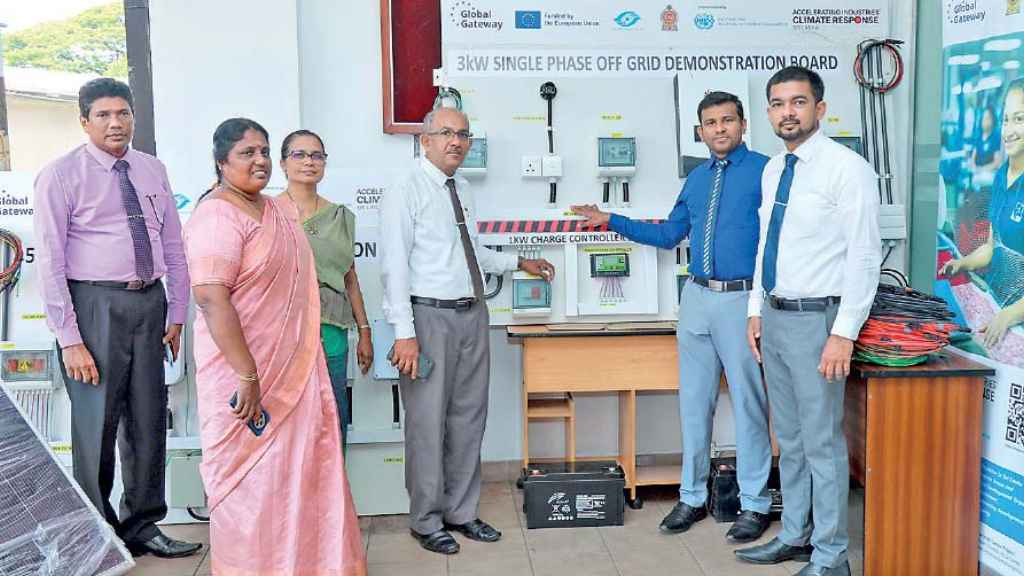
EU supports accredited solar training to accelerate clean energy transition in Sri Lanka, marking a significant step toward building a skilled workforce capable of supporting the country’s renewable energy ambitions and long-term sustainability goals.
EU supports accredited solar training to accelerate clean energy transition in Sri Lanka
The European Union (EU), through the Accelerated Industries Climate Response Sri Lanka (AICRSL) Project implemented by the United Nations Industrial Development Organisation (UNIDO), has facilitated the handover of advanced Solar PV training and demonstration equipment to five Technical Colleges across the country. The initiative, carried out at the Department of Technical Education and Training (DTET) in Colombo, responds directly to a request by the Public Utilities Commission of Sri Lanka (PUCSL) to strengthen national training capacity in the renewable energy sector.
This development comes at a critical juncture as Sri Lanka accelerates its transition towards cleaner energy sources. By equipping Technical Colleges in Gampaha, Matara, Badulla, Warakapola, and Jaffna with modern training infrastructure, the program aims to address persistent skills gaps while supporting broader Sri Lanka renewable energy goals. The provision of industry-standard equipment, including on-grid and off-grid solar systems, panel structures, and installation tools, ensures that students gain hands-on experience aligned with real-world industry requirements.
A central outcome of the initiative is the ability of Technical Colleges to meet formal accreditation standards for Solar PV training programs. Previously, limited access to modern equipment posed a significant barrier to delivering certified courses. With this support, institutions can now offer accredited training that enhances both the credibility of their programs and the employability of graduates. This aligns with national priorities to build a workforce capable of delivering safe, efficient, and standards-compliant solar installations.
The EU supports accredited solar training to accelerate clean energy transition not only by providing infrastructure but also by strengthening institutional capacity. The expansion of Solar PV training facilities increases the total number of accredited centres supported by the PUCSL to eight, ensuring wider geographic access and more inclusive opportunities for students across the island. This decentralised approach is expected to play a key role in scaling up renewable energy adoption.
Officials from the PUCSL highlighted the importance of technical training in ensuring the safety and reliability of solar installations. As the sector regulator, the commission emphasised that high-quality workmanship is essential for maintaining system integrity and achieving national energy targets. Strengthening training frameworks is therefore seen as a critical enabler of the country’s clean energy transition, particularly as demand for solar solutions continues to grow.
The Department of Technical Education and Training also underscored the transformative impact of the initiative. Director General D. Wathsala Marambage noted that access to modern training infrastructure has long been a challenge, limiting the ability of institutions to deliver high-quality programs. With the new equipment in place, colleges can expand their course offerings, improve training standards, and better prepare students for employment in the renewable energy sector.
The EU supports accredited solar training to accelerate clean energy transition within the broader framework of its climate action commitments in Sri Lanka. The AICRSL Project, funded by the EU with an investment of approximately Rs. 2.8 billion, is designed to support sustainable industrial development while reducing greenhouse gas emissions. The project targets a 13% reduction in emissions from the industrial sector by 2035, aligning with global climate objectives and national policy goals.
The initiative is implemented in partnership with the Sri Lankan Government and UNIDO, with support from the Environment Ministry, the Industry and Entrepreneurship Development Ministry, and the Energy Ministry. This multi-stakeholder collaboration reflects a coordinated approach to addressing climate challenges while promoting economic development.
Beyond immediate training outcomes, the program is expected to contribute to the growth of the solar PV industry in Sri Lanka by creating a pipeline of skilled technicians and professionals. This will not only support domestic energy needs but also position the country to capitalise on emerging opportunities within the global renewable energy market. The emphasis on practical skills and accreditation ensures that graduates are job-ready, enhancing their ability to contribute effectively from the outset.
The EU supports accredited solar training to accelerate clean energy transition as part of a long-term strategy to link education, skills development, and environmental sustainability. By addressing both supply-side and demand-side challenges, the initiative lays the foundation for a more resilient and sustainable energy system.
As Sri Lanka continues to pursue its renewable energy targets, the availability of skilled labour will be a decisive factor in determining the pace and success of this transition. Initiatives such as this not only strengthen institutional capacity but also empower individuals with the knowledge and skills needed to participate in the country’s evolving energy landscape.