

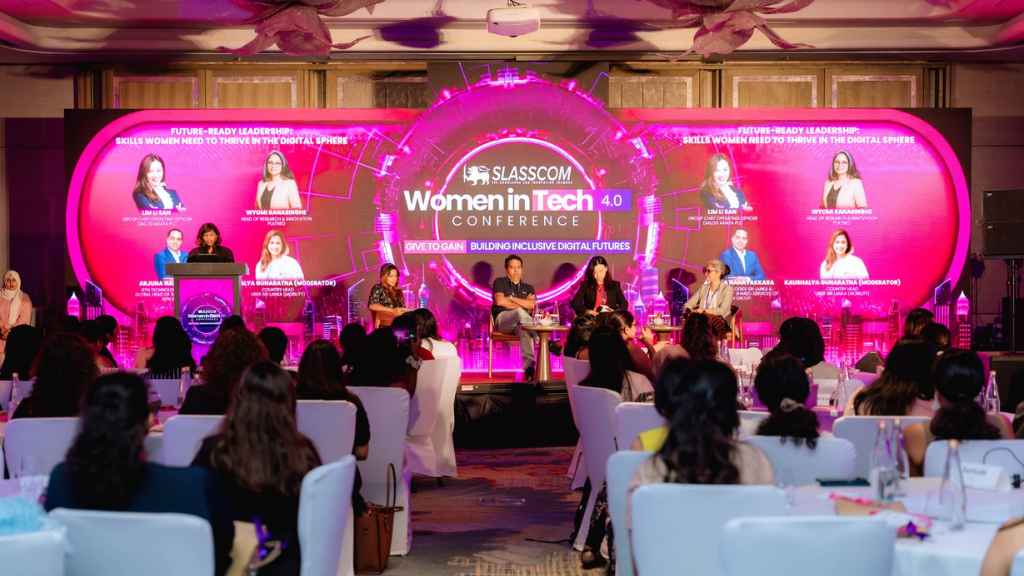
SLASSCOM Women in Tech Conference 4.0 sets benchmark as a leading platform driving women’s leadership and inclusion across Sri Lanka’s digital economy, bringing together industry leaders to shape future-ready, diverse workplaces.
SLASSCOM Women in Tech Conference 4.0 sets benchmark for inclusive digital leadership
SLASSCOM Women in Tech Conference 4.0 reaffirmed its position as the country’s premier forum for advancing women’s participation in technology, business, and policy. Held under the theme “Give to Gain: Building Inclusive Digital Futures,” the event convened a cross-section of corporate leaders, policymakers, and technology experts to address the evolving dynamics of the digital economy, with a strong emphasis on gender diversity as a strategic business priority.
Now in its fourth edition, the conference demonstrated measurable impact, attracting over 290 delegates and recording a satisfaction rate exceeding 88%. This performance signals growing institutional and corporate commitment to fostering inclusive leadership pipelines, particularly in high-growth sectors driven by digital transformation and artificial intelligence.
A key highlight was the keynote delivered by NASSCOM Chairperson and SAP Labs India Managing Director Sindhu Gangadharan, who outlined how artificial intelligence can expand workforce participation for women. Her address focused on AI as an equaliser—enabling flexible work models, reducing entry barriers, and unlocking new career pathways in emerging technology domains. Complementing this perspective, World Bank Senior Digital Specialist Anna Metz emphasised the need for inclusive digital ecosystems that enable access, collaboration, and scalable leadership opportunities for women across industries.
Leadership development remained central to the conference agenda. A high-level panel featuring Dialog Axiata’s Lim Li San, GTN Technologies’ Arjuna Nanayakkara, and Platned’s Wyomi Ranasinghe, moderated by Uber’s Kaushalya Gunaratne, explored the competencies required for future-ready leadership. The discussion identified adaptability, continuous learning, and strategic thinking as critical capabilities for navigating a digital-first business environment increasingly shaped by automation and data-driven decision-making.
From an organisational performance standpoint, Dijital Team Director Peter Ward reinforced the link between diversity and business outcomes, highlighting that inclusive teams consistently outperform homogeneous structures in innovation, resilience, and long-term value creation. This aligns with broader global research indicating that companies prioritising diversity tend to achieve stronger financial and operational performance.
Governance and accountability also featured prominently, particularly in the panel titled “Women Leading with Responsibility.” Industry experts including Nikin Matharaarachchi, Ashwini Natesan, Sashiprabha Dharmadasa, and Andreene Balthazaar examined ethical leadership frameworks and the importance of accountability in digital enterprises. The session underscored that as organisations scale digitally, governance structures must evolve in parallel to ensure transparency, compliance, and stakeholder trust.
Beyond corporate strategy, the conference addressed individual performance and wellbeing. A fireside chat with Dr. Mihirini de Zoysa and Samra Aman provided practical insights into managing pressure, sustaining performance, and maintaining mental wellbeing in high-demand professional environments. These discussions reflected a broader shift toward holistic leadership development, where personal resilience is viewed as integral to professional success.
Entrepreneurial and personal growth narratives added depth to the event. Tilli CEO Kavindya Thennakoon shared her journey of resilience, encouraging women to embrace failure as part of the growth process. This was reinforced by a masterclass led by Ayanthi Philip, who challenged traditional definitions of success and urged participants to adopt more individualised and sustainable approaches to career progression.
At the strategic level, a boardroom-focused panel featuring Shehani Seneviratne, Sanjini Munaweera, Zahra Cader, and Thilanka Jayathilake examined long-term leadership trajectories and the importance of mentorship and sponsorship in advancing women into executive roles. The discussion highlighted a structural gap in leadership pipelines and the need for deliberate interventions to ensure continuity in female representation at senior decision-making levels.
The conference also delivered practical, domain-specific insights through three focused tracks. These included “Women Engineering the Future,” “Winning in the Age of AI Search: Rethinking Google Advertising for Tech Brands,” and “Women Driving Decisions: From Dashboards to Strategic Impact.” Each track addressed emerging industry challenges, from AI-driven marketing disruption to data-led decision-making, equipping participants with actionable frameworks for navigating technological change.
Supported by a broad ecosystem of partners, including EY GDS, Cloud Solutions, Roar, IIT, LSEG Technology, and IFS, the event demonstrated strong cross-industry collaboration in advancing the women in tech Sri Lanka agenda. This multi-stakeholder engagement is critical in sustaining momentum and translating conference insights into measurable organisational change.
Overall, SLASSCOM Women in Tech Conference 4.0 sets benchmark not only in participation and satisfaction metrics but also in shaping the strategic discourse around diversity, leadership, and digital transformation. As Sri Lanka continues to position itself within the global digital economy, such platforms play a pivotal role in ensuring that growth is both inclusive and sustainable.