

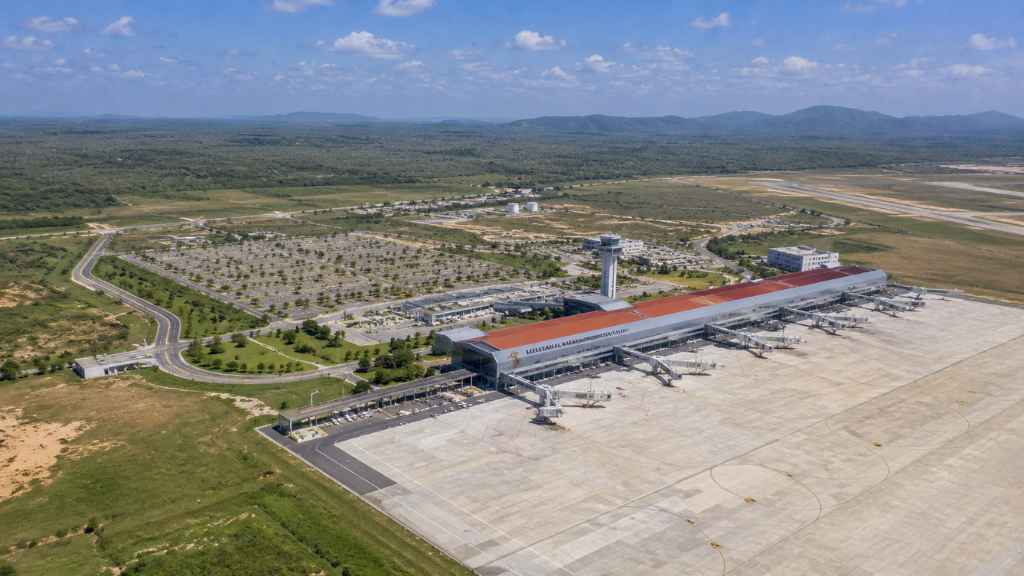
Sri Lanka opens airport next to Chinese-owned sea port as authorities launch a fresh drive to attract foreign investment into the loss-making Mattala Rajapaksa International Airport (MRIA) in the country’s southern Hambantota district.
Sri Lanka opens airport next to Chinese-owned sea port for global investors
The government’s latest move is aimed at transforming the underutilized airport into a commercially viable aviation and logistics hub by leveraging its strategic location near the Chinese-operated Hambantota Port and major international shipping routes.
According to a statement issued by the Board of Investment (BOI), the Ministry of Ports and Civil Aviation has formally invited both local and international investors to submit Expressions of Interest (EOIs) for the operation and development of MRIA.
The initiative includes opportunities in Airside and Aerodrome operations as well as Landside Operations, with authorities promoting the airport as a multi-sector investment destination capable of supporting logistics, cargo, tourism, manufacturing, and renewable energy activities.
The Mattala Rajapaksa International Airport, inaugurated in March 2013, was constructed with an investment of around 209 million US dollars, primarily financed through loans from the Export-Import Bank of China. The airport was originally envisioned as Sri Lanka’s second international gateway and a catalyst for economic growth in the southern region.
Located close to the Hambantota Port, the airport was intended to support sea-air transshipment services, tourism expansion, and industrial development. The nearby port, officially known as the Magampura Mahinda Rajapaksa Port, was later leased to a Chinese company under a 99-year agreement, making the region a strategically significant logistics corridor in the Indian Ocean.
Officials say the renewed investor drive is part of a broader effort to increase foreign direct investment and strengthen Sri Lanka’s position in regional aviation and trade networks.
Authorities are offering flexible investment structures including public-private partnerships, joint ventures, and direct investments to attract a wider range of investors with different levels of capital commitment and risk appetite.
The BOI noted that the airport’s investment proposition extends beyond passenger aviation. Proposed sectors include cargo handling services, logistics operations, maintenance, repair and overhaul (MRO) facilities, aircraft spare parts manufacturing, industrial parks for packaging and warehousing, renewable energy projects, and hospitality ventures such as resort hotels.
Government officials believe the airport’s infrastructure remains a significant untapped asset despite years of financial underperformance. MRIA was designed to handle up to one million passengers annually and features a 3,500-meter runway capable of accommodating large aircraft including the Airbus A380.
However, despite its advanced infrastructure and strategic location, the airport has struggled to attract sustainable commercial traffic since its opening. The facility became internationally known as one of the world’s emptiest airports due to limited passenger demand and recurring financial losses.
Over the years, Sri Lankan authorities have explored multiple strategies to operationalize the airport more effectively. A previous management arrangement involving Indian and Russian firms sought to develop the airport under a 30-year lease agreement focused on transit flights and specialized cargo services.
That proposed deal was later cancelled after both companies involved were reportedly blacklisted by the US State Department, leaving the future of the airport uncertain once again.
The latest investment call signals a renewed push by the Sri Lankan government to reposition MRIA as a regional aviation and logistics hub linked closely with maritime trade activity in Hambantota.
Analysts say the airport’s proximity to major international shipping lanes could offer long-term advantages if integrated air-sea logistics operations are successfully developed. The southern region’s growing tourism potential and industrial development plans may also help improve the commercial viability of the airport over time.
The Sri Lanka opens airport next to Chinese-owned sea port initiative is expected to attract attention from regional logistics operators, aviation companies, infrastructure investors, and hospitality developers seeking opportunities in South Asia’s expanding transport and trade sectors.
The BOI said the EOI process remains open to both domestic and foreign investors. Interested parties can obtain documents free of charge from Sri Lanka’s main international airport in Katunayake or download them through the official Airport and Aviation Services website.